

Why should your software vendor get a pay raise every time you launch a new LLC? Most legacy platforms treat your growth like a taxable event. They charge you a premium for every new entity you add to your portfolio. It is a "growth tax" designed to extract rent from successful operators. If you are searching for accounting software without per-entity pricing, you already know the frustration of paying a penalty just to house a new tax ID. You shouldn't be punished for being ambitious.
We agree that the current industry standard is a logical failure. You're likely exhausted by manual Excel consolidations and the friction of fragmented data across dozens of logins. This guide will show you how to scale your multi-entity portfolio without your software bill tripling. We'll cover how to leverage tiered subscriptions for high-volume entity management, real-time consolidated reporting, and automated inter-company eliminations. It's time to stop paying a fee for the privilege of growing your business.
Scaling a multi-entity business should be a milestone, not a financial penalty. Most legacy platforms treat your growth like a taxable event, charging a premium for every new LLC you bring into the fold. If you're searching for accounting software without per-entity pricing, you've realized that linear cost scaling is a "growth tax" that punishes your success. You shouldn't have to choose between accurate financial data and a software bill that swallows your margins.
We agree that the industry standard is fundamentally broken. This article outlines a better path, moving from the chaos of fragmented logins to the clarity of real-time consolidated reporting. You'll discover how to eliminate the "journal entry madness" of inter-company transactions and why manual Excel consolidation is a liability in 2026. We compare the value of tiered subscriptions, specifically the EmLedger Solo, Growth, and Scale plans, against legacy models that charge per subsidiary. Learn how a platform built by CPAs can automate your eliminations and provide a clean, logical exit from the complexity of multi-layered management.
The Per-Entity Tax: Why Legacy Accounting Software Throttles Growth
Growth is a success metric. For legacy software companies, it's a revenue opportunity. The "Per-Entity Tax" is a linear cost increase that scales directly with your ambition. Every time you launch a new LLC or acquire a new property, your software vendor demands a pay raise. It's a predatory model that treats your expansion as a taxable event. If you manage a holding company or a real estate portfolio, you're the primary target of this extraction. You shouldn't be penalized for being productive.
The industry standard is fundamentally broken. Legacy platforms charge you based on the number of tax IDs you manage. This logic assumes that 20 entities require 20 times the software resources. It's a false premise. Most multi-entity operators have several low-volume "holding" entities that only see a few transactions a month. Paying a full subscription fee for a shell company is a logical failure. You need accounting software without per-entity pricing to align your costs with actual utility rather than legal structure.
The Mathematical Trap of Linear Scaling
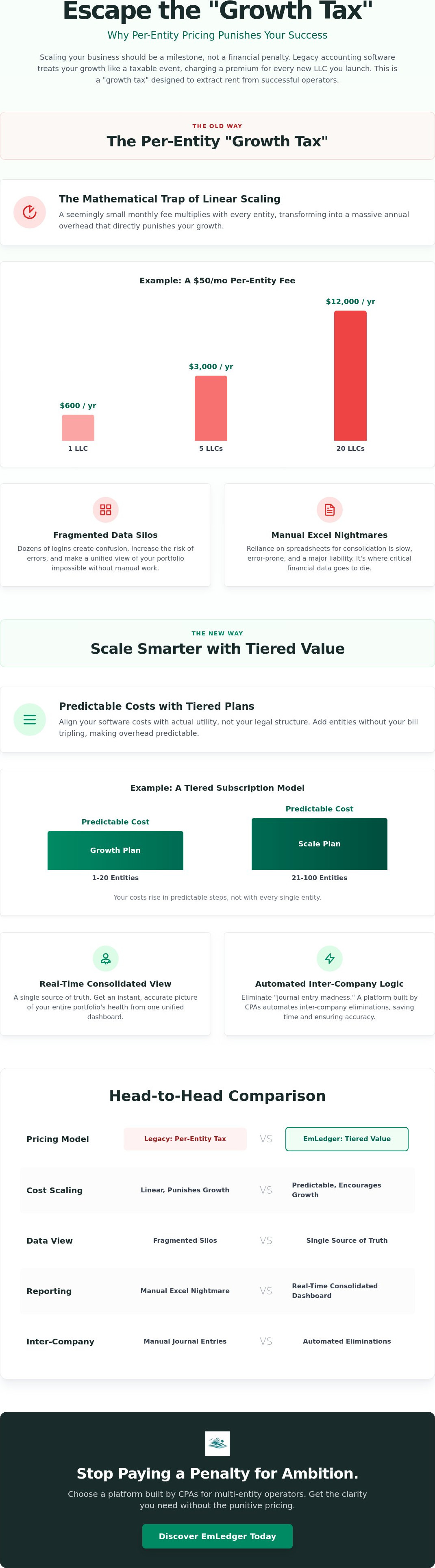
A $50 monthly fee sounds reasonable for a single entity. It's a rounding error on a balance sheet. But when you scale to 20 LLCs, that rounding error transforms into a $12,000 annual overhead. This is the bait-and-switch of "low-cost" starters. They lure you in with a cheap entry point, knowing that as your portfolio grows, your switching costs will skyrocket. You become a captive customer, forced to pay a premium for every new entity you add. A tiered subscription model or a flat-fee approach is the only rational exit from this trap. It allows you to forecast your overhead without worrying about how your next acquisition will impact the bottom line.
Operational Friction Beyond the Invoice
The cost isn't just financial; it's operational. Managing 20 different logins is a recipe for data fragmentation and human error. When your data lives in 20 separate silos, you lose the ability to see the big picture. This fragmentation makes generating consolidated financial statements a manual, high-risk nightmare in Excel. The search for accounting software without per-entity pricing isn't just about saving money; it's about reclaiming your time. You need a single source of truth where you can toggle between entities in one click. Without it, you're not just paying a growth tax; you're paying a complexity tax that slows down every decision you make.
- Linear costs: Your software bill should not be a mirror of your LLC count.
- Fragmented data: Separate logins lead to "forgotten" entities and reconciliation gaps.
- Manual labor: Per-entity silos force you back into Excel for basic group reporting.
Consolidated Reporting: The Logical Core of Multi-Entity Success
If you own five companies, you don't have five separate problems. You have one portfolio to manage. Consolidation isn't a luxury feature or a year-end chore. It is the primary job of a multi-entity operator. Legacy software vendors want you to believe otherwise. They sell you isolated silos and then charge you extra for the tools to connect them. This is why accounting software without per-entity pricing is a functional necessity; it's the only way to align your software with the reality of your business structure.
Relying on Excel-based consolidation in 2026 is a high-risk strategy. Spreadsheets are where data goes to die. They are slow, prone to formula errors, and offer zero real-time visibility. When your data is fragmented across twenty different logins, you aren't managing; you're just surviving the data entry. True success requires a "Real-Time Truth." You need a dashboard that reflects your group’s health the moment a transaction clears. This isn't just about tax compliance. It's about liquidity management. You need to know exactly how much cash is available across the entire group to seize the next opportunity without waiting for a bookkeeper to "close the books" on ten different entities.
Moving Beyond the Manual P&L
Seeing your group-level performance shouldn't require clicking through ten browser tabs. Automated Consolidated Reporting pulls data into a single view instantly. This process relies on a standardized chart of accounts. When every entity speaks the same financial language, the software does the heavy lifting. You get a clean Profit and Loss statement that follows the control principles of IFRS 10. No manual adjustments. No weekend-long spreadsheet sessions. Just the facts, delivered when they actually matter.
Real-Time Balance Sheet Visibility
Net worth is your true north. However, tracking group-wide debt and equity manually is a logistical nightmare. You need an instant snapshot of your total equity position across all LLCs. Modern accounting software without per-entity pricing provides this visibility without the data lag. This speed is a competitive advantage. When you apply for a bank loan or report to investors, you don't send "approximate" numbers from last month. You send precise, real-time data. This level of transparency builds trust and speeds up capital allocation. It proves you're an operator in control of your growth, not a victim of your own complexity.
Inter-Company Transactions: Stop the Journal Entry Madness
Inter-company transfers are the number one source of bookkeeping errors. Period. When you move cash between LLCs, you aren't just moving money; you're creating a web of liabilities and reciprocal debts. Basic software ignores this reality. It forces you into a loop of manual journal entries that never quite balance across different files. If your platform doesn't handle these relationships out of the box, it isn't a multi-entity solution. It's a bookkeeping disaster waiting to happen. You need a system that recognizes the relationship between your entities without charging you a fee for every connection.
Searching for accounting software without per-entity pricing often leads to generic tools designed for single-shop operators. These tools lack the logic required for complex portfolios. They treat every entity as an isolated silo. In reality, your entities borrow, lend, and trade. Forcing manual workarounds for inter-company loans is dangerous. It invites audit risk and creates a reconciliation nightmare that can take weeks to untangle at year-end. Facilitating growth through accounting software requires a system that understands these connections natively. This is the only way to maintain a clean audit trail while scaling your operations.
Automating the Due-To/Due-From Ledger
Modern software creates reciprocal entries automatically. When Entity A records a loan to Entity B, the system should instantly update both ledgers. No double entry. No human error. This automation is a "Straight-Shooter" benefit that provides total transparency in every transfer. It also slashes your year-end audit and tax prep fees. CPAs hate manual journal entries. They love clean, automated reciprocal ledgers. By removing the manual friction, you ensure your books are always ready for scrutiny. Using accounting software without per-entity pricing that includes these tools means you can add as many entities as you need without increasing your bookkeeping workload.
Eliminating Double-Counted Revenue
Inter-company billing is a trap. It often inflates perceived revenue and distorts your group-level performance. If Entity A bills Entity B for management fees, that "revenue" isn't real on a consolidated basis. It's just moving money from one pocket to another. Automated eliminations are the only way to get an accurate group P&L. They strip away the noise and show you the true net income of the entire portfolio. This is a critical feature for businesses on a Scale Plan. You can't make strategic decisions based on inflated numbers. You need the cold, hard truth of eliminated group financials to understand your actual profitability.
Comparing Per-Entity Costs vs. Tiered Subscription Value
Software pricing should reflect utility, not your corporate chart. Most vendors charge you for every single tax ID you register. This is a rent-seeking strategy that ignores the operational reality of holding companies. If you have ten entities, you shouldn't be forced to buy the same core ledger ten times. EmLedger flips this script. We provide accounting software without per-entity pricing, moving the focus from "how many LLCs do you have?" to "what level of power do you need?" It is a rational calculation for a rational operator.
Manual consolidation is a silent profit killer. Spending ten hours a month wrestling with Excel is not "free" labor. It's a massive opportunity cost. If your time is worth $200 an hour, you're burning $2,000 a month just to see your own data. A Growth Plan that includes Consolidated Reporting as a standard feature pays for itself before the first week of the month is over. You don't just save money on subscriptions; you reclaim the mental bandwidth required to actually run your business. Stop paying for the privilege of doing manual work.
The Breakdown: 10 LLCs Comparison
Let's look at the math. Managing 10 subsidiaries on many traditional per-entity platforms requires 10 separate subscriptions. To see those entities together, you'll likely bolt on additional third-party consolidation apps. Now you're managing 11 different bills and 11 different data syncs. Contrast this with the EmLedger model. You pay for the platform capacity, not the tax ID count. One login. One bill. Zero reconciliation headaches. The hidden cost of manual labor for reconciliation in the legacy model often exceeds the software cost itself. It's a losing game.
Scalability Without the Software Headache
Ambition shouldn't be a licensing trigger. You should be hunting for your next deal, not calling a sales rep to add another subsidiary to your account. The Growth Plan acts as a bridge for mid-sized operators who need professional tools without the legacy bloat. For those at the top of their game, the Scale Plan is the smarter, leaner alternative to traditional enterprise solutions. You get the enterprise-grade power of automated eliminations and multi-entity management without the "enterprise tax" or the six-month implementation cycle. It's about efficiency, not ego.
Ready to escape the per-entity trap? View our multi-entity pricing plans and start scaling without the growth tax.
EmLedger: The CPA-Built Platform for Multi-Entity Operators
EmLedger wasn't born in a marketing meeting. It was built in the trenches by a CPA who saw the "Per-Entity Tax" for exactly what it is: a parasite on growth. Most software companies treat your expansion as a revenue stream. They wait for you to add an LLC, then they raise your rent. We decided to build a disruptive alternative. EmLedger is accounting software without per-entity pricing designed for the business operator who values logic over legacy bloat. We've stripped away the corporate-speak and replaced it with functional utility.
Financial visibility shouldn't be a puzzle. We've integrated critical tools like Bank Reconciliation and Inventory Management directly into the platform. You don't need a dozen third-party apps to see your truth. You need a single, authoritative system that understands multi-entity structures. This is a "No-BS" approach to accounting. We focus on the granular headaches of multi-layered management so you can focus on the big picture. It's time to escape the QuickBooks trap and join a platform built for operators, not software sales quotas.
Solo, Growth, and Scale: A Plan for Every Stage
Your software needs change as you grow. Our plans reflect that reality without punishing your tax ID count. The Solo Plan is for the ambitious founder who wants professional-grade tools early. You get the foundation right from the start. The Growth Plan acts as the bridge for mid-sized portfolios. It introduces Consolidated Reporting as a standard, giving you a group-level view without the manual Excel labor. For those managing high-volume portfolios, the Scale Plan offers enterprise-level power. It automates Inter-Company Transactions and eliminations, providing a clean exit from complexity for even the most layered organizations.
Next Steps: Stop Overpaying Today
Check EmLedger Pricing and Stop the Per-Entity Tax
Reclaim Your Growth Potential
Your software vendor shouldn't be a silent partner in your profit margins. Legacy systems use per-entity pricing to tax your success. It's a predatory model that relies on your inability to leave. You've seen the alternative. Logic dictates that you scale by volume, not by tax ID count. You need real-time consolidated reporting and automated inter-company eliminations to maintain a clear birds-eye view of your portfolio. EmLedger is the only rational exit from this complexity.
Stop paying for the privilege of doing manual work in Excel. EmLedger was built by a CPA for multi-entity operators who are tired of the status quo. It includes real-time consolidated reporting with no hidden per-entity fees. You can finally scale your portfolio without your software bill tripling every time you close a deal. It's time to trade fragmentation for financial clarity. By choosing accounting software without per-entity pricing, you are choosing a partner that rewards your growth instead of penalizing it.
Switch to EmLedger: The Multi-Entity Accounting Alternative
The path to a leaner, more efficient operation is clear. Take control of your financial data and stop the growth tax today.
Frequently Asked Questions
Is it legal to manage multiple LLCs in one accounting software?
Yes, as long as you maintain a clear separation between the ledgers of each legal entity. EmLedger is designed to keep your books distinct while housing them under one digital roof. You avoid commingling funds while gaining a unified view of your entire portfolio. It is the professional standard for holding companies, real estate investors, and multi-unit franchisees.
Do I need separate bank feeds for every entity in a flat-fee system?
Yes, you must link separate bank feeds for each entity to maintain the corporate veil and ensure accurate Bank Reconciliation. A flat-fee or tiered system doesn't change the fundamental rules of accounting; it simply changes how much you pay for the software. You still get the security of isolated bank accounts without the predatory per-entity surcharge.
How does consolidated reporting handle inter-company loans?
Consolidated Reporting uses automated eliminations to cancel out reciprocal debts and credits. When one LLC lends money to another, the system identifies the matching due-to and due-from entries. It removes these from the group-level balance sheet so your total net worth isn't artificially inflated. This is the only way to generate clean, audit-ready group financials.
Can I use EmLedger for real estate holding companies with 50+ properties?
Absolutely. The Scale Plan is specifically built for high-volume operators who manage 50 or more properties or subsidiaries. It is the premier accounting software without per-entity pricing for large-scale real estate portfolios. You can launch new LLCs for every acquisition without worrying about your software overhead doubling. It is built for scale, not for rent-seeking.
Will my CPA be able to access the data for tax filing?
Yes, all plans include unlimited users so your CPA can access your data whenever they need it. You don't have to pay extra for "accountant seats" or deal with the friction of exporting messy CSV files. Your tax professional can pull the reports they need directly from the platform. This simplifies year-end filing and reduces the hours they bill you for manual data gathering.
What is the difference between tiered pricing and per-entity pricing?
Per-entity pricing is a growth tax that charges you a fixed fee for every tax ID you register. Tiered pricing, like our Solo Plan, Growth Plan, and Scale Plan, is based on feature sets and entity volume ranges. This model provides a logical exit from linear cost scaling. It ensures your software bill remains predictable even as you add new subsidiaries to your structure.
Does EmLedger support inventory management across multiple companies?
Yes, Inventory Management is a core feature that works across multiple companies in your portfolio. You can track stock levels and valuations for different entities within the same interface. This is critical for operators using accounting software without per-entity pricing to manage diverse holdings. You get enterprise-grade control without the enterprise-grade price tag or implementation headache.


