

Managing the finances for one company is a challenge. Managing them for ten, twenty, or fifty feels like an exponential leap in complexity. You’re buried in a mountain of CSV exports, drowning in a sea of browser tabs, and constantly logging in and out of siloed accounting files. The month-end close is a frantic, error-prone scramble of stitching together spreadsheets.
There's a nagging question every multi-entity operator asks: "Why does managing 10 companies take 20 times the effort of one?"
The answer isn’t your team or your work ethic. It’s your architecture. Legacy accounting software was built for a single-entity world. When forced to manage a corporate group, these systems break, creating workflow bottlenecks that bleed time and money. They penalize your growth with predatory per-entity pricing and force you into manual processes that belong in a 20th-century ledger book.
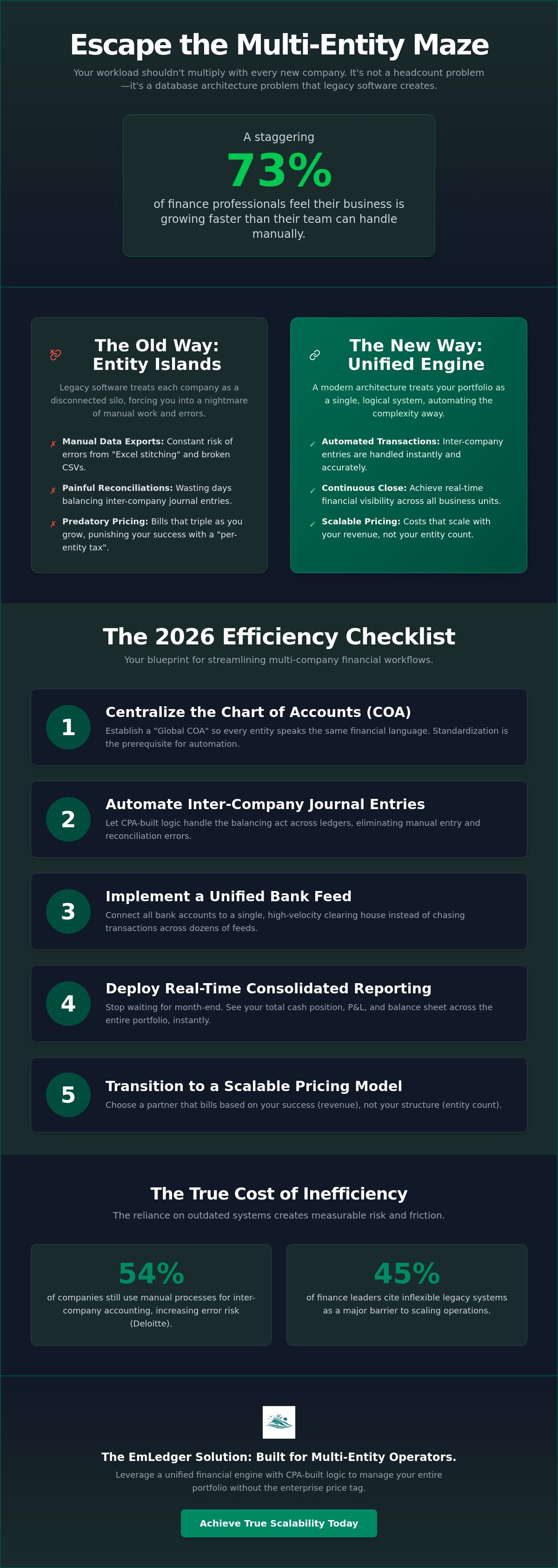
This is the 2026 checklist for streamlining multi-company financial workflows. It's a new model for efficiency—one that stops the manual export madness and shows you how to manage multiple legal entities through a single, logical financial engine. It's time to solve the problem at its core: the database.
The Multi-Company Workflow Bottleneck: Why Legacy Systems Fail
The fundamental flaw in traditional accounting software isn't a missing feature; it's the core design. Each of your LLCs is treated as an "Entity Island"—a completely separate database, walled off from the others. To get a complete picture of your portfolio’s health, you are forced to build manual bridges between these islands. This is where the workflow breaks down.
This isn't just inefficient; it's a structural liability. The "logging in and out" routine isn't just an annoyance. It's a symptom of a broken architecture that actively prevents real-time visibility and automated control. Every time you export a report to Excel, you create a static, disconnected copy of your data that is immediately outdated and prone to human error. This outdated approach directly leads to the high cost of manual data re-entry, reconciliation nightmares, and a financial reporting process that's always looking in the rearview mirror.
The problem is compounded by a business model designed to punish scale. Legacy providers charge a "Per-Entity Tax," a fee for every new LLC you add. Your reward for growing your business is a bigger software bill. This model is fundamentally misaligned with your goals. You need a system built on a unified database architecture, where all your legally distinct entities live within one intelligent engine, not a patchwork of expensive, isolated files.
The Manual Export Trap
The CSV export is the silent killer of financial accuracy. It feels like a quick solution, but it’s a trap that creates three distinct points of failure. First, it severs the data from its source, creating a version control nightmare. Is this the latest P&L, or did someone pull a new one five minutes ago? Second, it introduces massive potential for "copy-paste" errors, transpositions, and broken formulas. A single mistake in your master spreadsheet can take days to find and fix. Third, it creates a psychological burden. Managing 10+ separate bank feeds, exporting statements, and manually ticking off transactions across different files is exhausting, repetitive work that burns out your best people.
This "stitching" of reports in Excel might give you a consolidated view, but it's fragile. The entire financial truth of your organization rests on a single, fallible spreadsheet. This isn't a workflow; it's a liability waiting to happen.
Software That Throttles Growth
Many operators start with a system like QuickBooks Online, which works fine for a single entity. But as you add your second, third, and tenth LLC, you hit a wall. The multi-company pricing structure is designed to extract maximum revenue from your growth. Each new entity is another subscription fee, and your bill balloons without any corresponding increase in functionality. You're paying more just to keep your data in separate silos.
Even the "Pro" or "Advanced" versions of these tools fail to deliver the consolidated visibility you need. They are still single-entity tools with a multi-entity price tag. They can't handle automated inter-company transactions, real-time consolidated reporting, or centralized management of financial data. This is the critical difference between a simple accounting tool and a true multi-entity financial engine. One is a digital checkbook; the other is a command center for your entire corporate group.
The 5-Step Checklist for Streamlining Multi-Company Workflows
Breaking free from the manual grind requires a systematic shift in your approach. It’s not about finding clever workarounds; it’s about rebuilding your financial foundation on a logical, scalable architecture. This five-step checklist provides the framework for achieving true multi-company efficiency.
- Step 1: Centralize the Chart of Accounts (COA) across all business units. Standardization is the bedrock of automation. You cannot compare, consolidate, or analyze entities if they don’t speak the same financial language.
- Step 2: Automate inter-company journal entries to eliminate manual balancing. This is the single biggest source of reconciliation errors. A proper system should handle due-to/due-from entries automatically at the point of transaction.
- Step 3: Centralize bank feed management in a unified dashboard. Stop logging in and out of ten different files. Manage and reconcile the separate bank feeds for all your entities from a single, powerful interface.
- Step 4: Deploy real-time consolidated reporting dashboards. Your consolidated P&L, balance sheet, and cash flow statements should be available on demand, not after a week of spreadsheet gymnastics.
- Step 5: Transition to a scalable pricing model that ignores entity count. Stop paying the "Per-Entity Tax." Your software cost should scale with your business's success (e.g., by revenue or users), not punish you for your corporate structure.
Standardizing Your Financial Foundation
Before you can automate anything, you must standardize. A "Global Chart of Accounts" (COA) is non-negotiable for any multi-entity operation. This doesn't mean every entity must have the exact same accounts, but it does mean there is a single, master reporting hierarchy. For example, your holding company might have "Rent Expense" map to three different types of rent accounts used by its operating subsidiaries.
This mapping process is the prerequisite for meaningful consolidation. It allows your system to roll up data from disparate entities into a single, coherent financial statement. Without a standardized COA, you’re comparing apples to oranges, and any attempt at consolidated reporting is just guesswork. Standardization transforms raw data from individual ledgers into portfolio-level intelligence.
Eliminating the Month-End Crunch
The traditional month-end close is a relic of a bygone era. In a truly streamlined system, the books are always close to being "closed." This concept of a "continuous close" or "continuous visibility" is only possible with automation. When inter-company transactions are balanced in real time and bank reconciliations are managed daily from a central hub, the frantic end-of-month scramble disappears.
Handling high-volume bank reconciliations for a dozen LLCs becomes manageable when you don't have to switch contexts constantly. A unified dashboard that pulls in all your separate bank feeds—leveraging modern aggregation technology like Wealthreader—allows one person to do the work of three. You can set up automated rules and alerts for inter-company discrepancies, catching errors the moment they happen, not weeks later during a manual review. This shifts your finance function from reactive and historical to proactive and strategic.
Consolidated Reporting & Inter-Company Automation
For a multi-entity organization, the consolidated financial statement is the ultimate source of truth. Yet, for most, it’s the most difficult report to produce. The challenge lies in two key areas: inter-company transactions and eliminations.
A true multi-entity platform automates this process. When one of your entities pays a bill on behalf of another, the system should automatically generate the corresponding "due to/due from" entries in both legal ledgers. This ensures your books are always balanced at both the entity and group level. No more one-sided entries or manual journal entries that fail to reconcile.
The hardest part of consolidation, however, is handling eliminations. These are the entries required to remove the effect of inter-company transactions from the consolidated report. For example, if one LLC records revenue for services sold to a sister LLC, that revenue and the corresponding expense must be eliminated to avoid overstating the group's performance. Automating these eliminations is a game-changer. It’s what separates a real-time consolidated P&L from a static, manually created report that’s obsolete the moment it's finished.
Inter-Company Transaction Management
Effective inter-company transaction management goes beyond simple due-to/due-from entries. It involves a system that can handle the full lifecycle of cross-entity activity. This includes:
- Automated Balancing: The system should enforce that for every inter-company debit, there is an equal and opposite credit in the corresponding entity's books. This eliminates the risk of "one-sided" entries that break the consolidated balance sheet.
- Loan and Interest Management: Automatically manage inter-company loans, track balances, and accrue interest according to predefined schedules. This removes a significant manual burden from your accounting team.
- Centralized AP/AR: Pay a vendor bill for one entity from another entity's bank account, with the system automatically creating the correct inter-company loan entries in the background.
This level of automation turns a complex, error-prone process into a reliable, background function of your financial engine.
The Power of the Consolidated Dashboard
A consolidated dashboard is more than just a report; it's an interactive analytical tool. The real power lies in the ability to move seamlessly from a high-level group view to the underlying details. Imagine seeing your consolidated revenue number, then clicking to see the breakdown by entity, and then clicking again to see the individual transaction that makes up that number in a specific LLC's general ledger. All in one system, without ever leaving the screen.
This capability allows you to compare performance across different business units in real time. You can customize reports for different stakeholders—giving an investor a view of the entire portfolio while providing a regional manager with data for only their specific group of LLCs. This is what it means to have true financial clarity and control.
The Hidden Cost of Scaling: Software Bloat vs. Lean Logic
As multi-entity businesses grow, they often face a false choice: stick with the inadequate, siloed system that nickels and dimes them with per-entity fees, or make a massive leap to a full-blown Enterprise Resource Planning (ERP) system like NetSuite or Oracle.
This is the "NetSuite Trap." Founders believe they need a $50,000+ piece of software to handle multi-entity logic, when in reality, they need a smarter, leaner database architecture. Many ERPs are bloated with features a typical holding company or real estate portfolio will never use, but you pay for all of them. The implementation is long, expensive, and disruptive.
The alternative is to choose logic over bloat. A streamlined, purpose-built multi-entity platform can provide the core functionality you need—consolidation, inter-company automation, centralized management—without the crushing overhead of an enterprise suite. When evaluating your tech stack, the ROI isn't about the number of features. It's about how efficiently the architecture solves your biggest workflow bottlenecks.
The Per-Entity Pricing Fraud
Let's call the per-entity pricing model what it is: a scam. It's a financial penalty for executing a sound legal and operational strategy. Why should your software bill triple when you create two new LLCs for new real estate investments, even if the transaction volume remains the same? It shouldn't. This model is a holdover from a time when software was installed on-premise and required separate databases.
To understand the true cost, you must calculate it over a 3-5 year growth period. That "affordable" per-entity fee becomes an anchor on your profitability as you scale. A more equitable model aligns the software cost with a true metric of business size, like revenue or transaction volume. As you evaluate solutions, demand pricing transparency and reject any model that punishes you for growing. For a deeper dive into this flawed model, you can read more about accounting software without per-entity pricing and why it's a tax on your growth.
Finding the "Goldilocks" Solution
For most small-to-medium corporate groups, QuickBooks is too small, and NetSuite is too big. The "just right" solution sits in the middle. The rise of specialized multi-entity accounting platforms has created a new category of software designed specifically for holding companies, real estate investors, and franchise operators.
When searching for this solution, focus on the "Must-Have" features:
- A single database architecture that can house multiple, separate legal ledgers.
- Automated inter-company transaction and elimination capabilities.
- Real-time consolidated reporting across all entities.
- A centralized dashboard for managing key workflows like bank reconciliation.
- A fair pricing model that doesn't charge per entity.
Anything else is a "Nice-to-Have." Don't be distracted by feature-heavy sales pitches. Focus on the core architectural logic that solves your primary pain points.
The EmLedger Solution: Built for Multi-Entity Operators
We saw the frustration, the wasted hours, and the predatory pricing. So we built the solution we wanted for ourselves. EmLedger was built by a CPA who lived in the trenches of multi-entity management. It’s not just software; it’s a logical framework for running a complex business with clarity and efficiency.
Our platform is built on a single, powerful database that provides a unified view of all your entities without ever co-mingling funds or compromising legal separation. We solve the core problems head-on:
- Real-Time Consolidated Reporting: Get an instant, accurate view of your entire portfolio's financial health, included in every tier. Drill down from the group level to a single transaction in seconds.
- Automated Inter-Company Transactions: Eliminate manual journal entries and reconciliation headaches. Our system keeps your entities in balance, automatically.
- Centralized Bank Reconciliation: Connect the bank accounts for all your companies and manage them from a single, efficient dashboard. No more logging in and out.
- Fair Pricing: We’ve eliminated the "Per-Entity Tax." Our pricing scales with your business, not your corporate structure. Whether you have 5 entities or 50, you get the tools you need without being penalized for growth.
Solo to Scale: A Plan for Every Growth Stage
Your needs change as you grow, and your software should adapt. We offer clear, tiered plans designed for each stage of your journey.
- Solo Plan: The essential multi-entity toolkit for lean founders and early-stage holding companies. Get consolidation and inter-company logic from day one.
- Growth Plan: For expanding teams that need advanced inventory management, multi-currency support, and more robust reporting capabilities.
- Scale Plan: The logical, powerful, and fairly-priced alternative to bloated and overpriced enterprise ERPs like Oracle NetSuite.
Your Move Toward Financial Clarity
Achieving this clarity often requires looking beyond just accounting; for example, if you're scaling a hospitality business, you can visit Shiftify to discover how a specialized platform can streamline your restaurant onboarding and staff training.
Switching systems can be daunting, which is why we've designed a "No-BS" onboarding process to move you from your disconnected silos to a unified platform. Our support team is staffed by experts who understand the unique complexities of multi-entity accounting. They're not just software specialists; they're your partners in streamlining your financial workflows.
Stop overpaying for software that slows you down. Stop accepting the manual, error-prone workflows of the past. It’s time to start scaling your business on a foundation of logic and clarity.
Stop overpaying for your accounting software and start scaling with EmLedger


