

The legacy "per-entity" pricing model is a direct tax on your real estate success. Legacy software giants have turned your portfolio growth into their personal profit center by charging you for every new LLC you form. If you're managing multiple properties, you're likely trapped in a cycle of logging in and out of different files while searching for accounting software for real estate investors that actually works. You're wrestling with manual Excel sheets that break every month and praying your inter-company loans balance. It's inefficient. It's expensive. It's an insult to your intelligence.
We agree that bookkeeping shouldn't be your biggest operational hurdle, even though 67% of property managers claim it is. You need a single dashboard for all LLCs and automated inter-company eliminations that don't require a math degree, especially with the permanent tax changes from the One Big Beautiful Bill Act now in play. This guide shows you how to find a consolidated accounting truth without scaling your costs alongside your entity count. You'll learn how to escape the per-entity trap and move into 2026 with a financial engine built for scale, not just for subscriptions.
Key Takeaways
- Stop paying a separate subscription for every LLC. Learn how legacy "per-entity" pricing models actively penalize your portfolio growth.
- Identify the essential features of modern accounting software for real estate investors, from automated bank reconciliations to one-click consolidated reporting.
- Eliminate the "Excel Step" from your month-end close. Discover how to generate P&L statements across your entire portfolio without manual data merging.
- Solve the inter-company loan nightmare. Automate transfers between holding companies and property LLCs to prevent "ticking time bomb" errors in your ledger.
- Shift to a scalable accounting architecture. Transition from fragmented data silos to a single, unified dashboard built for multi-entity management.
The Multi-Entity Growth Throttle: Why Legacy Accounting Software Fails Investors
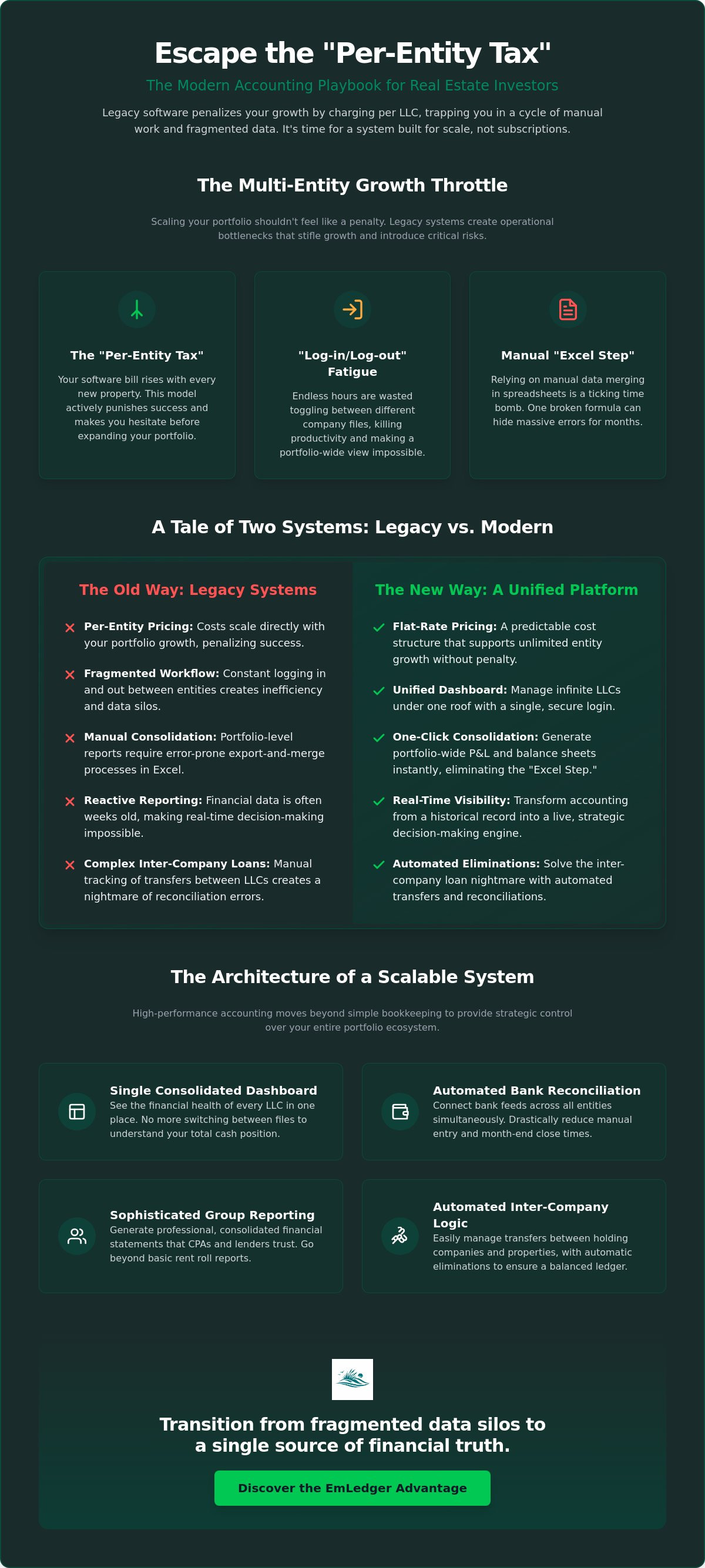
Scaling a portfolio shouldn't feel like a financial penalty. For decades, the industry has been shackled by a flawed standard: the "Per-Entity Tax." This is the hidden cost of growth where your software bill rises in lockstep with your property count. Most accounting software for real estate investors treats every new LLC as a completely separate business. It forces you into a fragmented workflow that wastes hours and breeds expensive errors. The evolution of legacy accounting software hasn't kept pace with the needs of modern, multi-layered portfolios. It's time to call out the inefficiency.
The Problem with Per-Entity Pricing
Legacy platforms have a simple, predatory trick. They charge you per company file. If you manage ten LLCs, you pay ten subscriptions. The mathematical reality is offensive. Your software overhead shouldn't triple just because you acquired three more buildings. This model creates psychological friction. It makes you hesitate before forming a new entity because you're calculating the inevitable software bloat. It's a growth throttle. A rational accounting system should support your expansion, not tax it. You need a predictable cost structure that doesn't punish you for being successful.
Accounting vs. Property Management Software
Many investors mistakenly believe a Property Management System (PMS) is a substitute for a ledger. It's not. Platforms like Buildium or AppFolio are designed to track rent rolls and maintenance tickets. They are operational tools, not financial engines. They often fail when you need the granular "truth" of the business for CPAs or lenders. Lenders don't care about your tenant communication logs; they want a professional, consolidated balance sheet. PMS platforms frequently lack the architecture for complex corporate group reporting. They can't handle the sophisticated inter-company logic that a scale-ready ledger provides.
The "Log-in/Log-out" fatigue is another silent killer of productivity. You spend your entire Monday toggling between different entity files. You manually export data into a master Excel sheet to see your total cash position. This "Spreadsheet Sprawl" is a disaster waiting to happen. One broken cell in a manual consolidation sheet can hide a massive loss for months. It leads to data fragmentation where you never truly know your portfolio's health. Multi-entity accounting is the ability to manage infinite LLCs under one roof. It's the only way to maintain a single, consolidated truth in real-time without the manual labor.
Core Features of High-Performance Real Estate Accounting Systems
High-performance accounting isn't about recording numbers. It's about strategic control. Most tools focus on tactical "landlord" tasks like tracking rent or scanning receipts. They ignore the strategic "investor" perspective. If you are structuring multi-entity real estate investments, you need a system that understands holding companies and subsidiaries. You need a platform that treats your portfolio as a single ecosystem, not a collection of isolated islands. Choosing the right accounting software for real estate investors is the difference between a scalable business and a manual job. It’s about building a foundation that doesn’t crumble as you add properties.
Real-Time Financial Visibility
Stop waiting for the end of the month. Traditional accounting is reactive. You wait for a bookkeeper to finish manual entries, then look at a P&L that is already 30 days old. Modern accounting software for real estate investors provides real-time visibility. A consolidated dashboard shows you which properties drag down cash flow today. It transforms accounting from a historical record into a decision-making engine. You can spot a spike in utility costs or a dip in occupancy across your entire portfolio in one click.
Automation That Actually Works
Automation should do more than just categorize a coffee purchase. In a multi-entity setup, you deal with multiple banks and dozens of accounts. High-performance systems use intelligent bank reconciliation to connect feeds across every LLC simultaneously. This isn't just about saving time; it's about accuracy. It eliminates manual upload errors and allows for automated eliminations, ensuring your consolidated statements don't double-count internal transfers. This level of automation directly addresses the fact that 67% of property managers identify bookkeeping as their biggest operational challenge, according to industry research.
Moving cash between LLCs is a daily reality. Legacy software requires manual journal entries for every transfer. This creates a "ticking time bomb" for your ledger. You need automated Inter-Company Transactions that balance both sides of the entry instantly. This ensures an audit-ready ledger for lenders and buyers. They want a clean trail, documented loans, and professional Inventory Management for development assets or capital improvements. If your ledger is messy, you lose leverage during due diligence. A clean, automated system ensures you're always ready for the next deal. It provides the "consolidated truth" that separates professional operators from hobbyists.
Solving the Inter-Company Headache: Managing Transfers Between LLCs
Real estate isn't static. Cash moves. You pay for a roof repair on a duplex using funds from your holding company because the property-level LLC is light on liquidity. In the eyes of a generic ledger, this is a crisis. In the reality of a growing portfolio, it's a Tuesday. Most accounting software for real estate investors fails to account for this fluidity. It forces you to choose between messy co-mingling or a mountain of manual journal entries. Neither is a viable strategy for a professional operator. You need a system that anticipates the movement of capital across your entire corporate structure.
The "Journal Entry Madness" Explained
The danger starts small. You use a personal credit card for a quick hardware store run. You transfer five thousand dollars from a "Stable" property to a "Value-Add" project to cover a contractor draw. Without specialized Inter-Company Transactions, you're left with a "ticking time bomb" of errors. Manual entries require you to record the "Due To" in one file and the "Due From" in another. Forget one side, and your books are permanently out of balance. This isn't just an administrative annoyance. It's a liability that creates "co-mingling" red flags for lenders and tax authorities. You're building a house of cards, and the wind is picking up.
Closing the Books in Record Time
Automation is the only logical exit from this complexity. Specialized accounting software for real estate investors automates the "Due To/Due From" logic instantly. When cash moves, the ledger updates both sides of the transaction simultaneously. It eliminates the need for manual "balancing" at the end of the year. This feature is the "holy grail" for operators with five or more LLCs. It ensures your Balance Sheet reflects the true relationship between your companies at all times. No more guessing. No more midnight reconciliation sessions.
The impact is measurable. Inter-company automation can cut your monthly reconciliation time by 80%. Instead of hunting for missing transfers, you spend your time analyzing performance. You move from being a data-entry clerk to a strategic asset manager. High-performance software removes the friction of multi-entity management. It allows you to move capital where it's needed most without sacrificing the integrity of your financial records. Your books should balance because the software is smart, not because you are exhausted. Stop the manual madness and start scaling with logic.
- Instant Balancing: Every transfer creates a mirrored entry automatically.
- Audit Protection: Maintain a clean, documented trail of every inter-company loan.
- Real-Time Accuracy: See your true cash position across all entities without waiting for year-end adjustments.
Consolidated Reporting: Seeing the Truth Across Your Entire Portfolio
If you're still exporting data into a master spreadsheet to see your total net worth, you aren't running a business. You're running a science experiment. Legacy accounting software for real estate investors treats your properties like strangers. It forces you to spend hours every month manually stitching together P&Ls. This "Excel Step" is a growth-killer. It’s slow. It’s prone to human error. It’s the reason you don't know your true cash position until three weeks after the month ends. Professional operators don't have time for that friction. They need the truth immediately.
High-performance systems deliver "One-Click Consolidation." You get a unified P&L, Balance Sheet, and Cash Flow statement across all entities instantly. This isn't a luxury. It is a requirement for scaling. Professional Consolidated Reporting allows you to benchmark property performance in a single view. You can see which assets are the engines and which are the anchors. Lenders don't have patience for messy spreadsheets. Professional reports speed up the refinancing process by proving you have a total handle on your numbers. It gives you leverage. It proves maturity. It makes the due diligence process for your next acquisition a breeze rather than a nightmare.
- Unified View: See every LLC's performance on one screen without logging out.
- Benchmarking: Compare ROI and Cap Rates across your portfolio in real-time.
- Lender-Ready: Generate professional, group-level financial packages in seconds.
The ROI of Financial Clarity
Stop managing liquidity property by property. That's a recipe for a cash crunch. Consolidated reporting allows you to manage liquidity at the group level. You can identify "leaky" properties that are draining capital from the rest of the portfolio before they sink the ship. You need to see the group cash position in a single dashboard to make rational decisions. Consolidated reporting is the difference between a "hobby" and a "firm". It allows you to move from tactical survival to strategic dominance.
Multi-Entity Cash Flow Forecasting
Predicting capital needs is vital. You must know when a specific LLC will need a capital injection from the parent company before the bank account hits zero. Visualizing group-level debt-to-equity ratios helps you negotiate better financing terms with banks. It turns reactive accounting into proactive strategy. Accounting software for real estate investors should provide a forward-looking lens, not just a rearview mirror. When you see the entire board, you make better moves. You protect your equity. You win.
Scaling Without the "Entity Tax": The EmLedger Advantage
Stop paying the growth tax. Legacy software giants treat your expansion like a profit center. They demand a separate subscription for every LLC you form. It’s a predatory model built on outdated technology. EmLedger is the disruptive alternative. It’s accounting software for real estate investors that actually understands how a holding company works. Built by a CPA for multi-entity operators, it prioritizes functional architecture over marketing fluff. It provides a clean, logical path for scaling your portfolio without the overhead explosion.
Scaling SMBs often think their only choice is an expensive ERP like NetSuite or Sage Intacct. That’s a false choice. EmLedger delivers the same multi-entity power without the six-figure price tag or the corporate bloat. We’ve stripped away the distractions. No payroll processing. No tax filing upsells. We focus on one thing: providing a single, consolidated accounting truth. It’s a "No-BS" approach to your ledger. You get pure accounting power designed for the trenches of real estate management.
A Plan for Every Stage of Growth
We don’t believe in one-size-fits-all. We believe in logical scalability. Our tiers match the lifecycle of your real estate business, ensuring you only pay for the capacity you need.
- Solo Plan: Ideal for the emerging investor. Consolidate 1 to 3 entities into a single, professional ledger.
- Growth Plan: Built for the active operator managing 4 to 15 entities. Handle complex Inter-Company Transactions and inventory with ease.
- Scale Plan: The ultimate command center. Designed for complex corporate groups with 16 or more entities that require advanced reporting and infinite support.
Why Real Estate Investors Are Switching
The math is simple. Legacy software bills triple when your property count triples. EmLedger’s flat-tiered model stops the bleeding. It’s the difference between managing a dozen siloed files and operating a unified firm. You gain peace of mind. You gain a single source of truth. You gain the ability to close your books in record time. You move from being a data-entry clerk to a strategic asset manager. Logic dictates your software should support your growth, not hinder it. It is time to stop paying the "growth tax" and see how EmLedger handles your multi-LLC portfolio. Make the rational choice for your bottom line.
Command Your Portfolio with Logic
The per-entity tax is a relic of the past. Legacy software giants shouldn't penalize your success by charging for every new LLC you form. We've established that high-performance accounting software for real estate investors must provide a single, consolidated truth. It must automate inter-company transfers. It must eliminate the "Excel Step" that kills your productivity. You need a professional engine that treats your portfolio as a unified firm, not a collection of disconnected silos.
EmLedger is the disruptive alternative built by a CPA specifically for multi-entity operators. We include consolidated reporting in every plan and refuse to use per-entity pricing traps. You deserve a system that values your time and respects your resources. Stop fighting fragmented data and start making strategic decisions based on real-time visibility. Stop overpaying for multi-entity accounting—Explore EmLedger Plans. Your growth is inevitable; your software should finally support it.
Frequently Asked Questions
Do I need separate accounting software for each real estate LLC?
You don't. Legacy software giants want you to believe separate subscriptions are mandatory so they can harvest more fees. Professional accounting software for real estate investors allows you to manage multiple LLCs under a single login. This eliminates the friction of logging in and out of different files. It stops the data fragmentation that leads to expensive errors. One environment. Infinite entities. No growth tax.
Can I consolidate my real estate financial statements if I use different banks for each property?
Yes. You can connect feeds from different banks across all your entities simultaneously. High-performance software aggregates these transactions into a master dashboard. This provides a consolidated view of your cash position without manual data merging. It's about centralizing the data while maintaining the legal separation of the LLCs. You get the benefits of a single financial truth without the spreadsheet headache.
What is the difference between property management software and real estate accounting software?
Property management software (PMS) is tactical; accounting software is strategic. PMS tracks rent rolls, tenant communication, and maintenance tickets. It's built for the "landlord" tasks. Real estate accounting software tracks the actual financial health, inter-company loans, and investor-level reporting. It's built for the "investor." You need a robust ledger that speaks the language of CPAs and lenders, not just a tool for collecting rent.
How do I handle inter-company loans between my holding company and rental properties?
Stop using manual journal entries. They are a "ticking time bomb" for your ledger. Use automated Inter-Company Transactions that balance "Due To" and "Due From" accounts across entities instantly. When you move cash from a holding company to a property LLC, both sides of the ledger should update simultaneously. This maintains a clean audit trail and ensures your books always balance without year-end adjustments.
Is legacy accounting software better for real estate investors with multiple entities?
Most legacy platforms are not optimized for multi-entity scale. They use a "per-entity" pricing model that taxes your growth. If you have ten LLCs, you pay for ten subscriptions. They lack the native architecture for automated inter-company eliminations and consolidated reporting. EmLedger was built specifically to solve these architectural flaws. It's a rational alternative that values your resources over corporate profit margins.
How does consolidated reporting help with real estate tax preparation?
It provides a bird's-eye view of your entire portfolio's performance. This allows your CPA to make better strategic decisions regarding bonus depreciation or SALT deduction caps. Instead of handing them ten separate files, you provide a single, clean report. It reduces their billable hours and ensures no tax-saving opportunities are missed. Clarity leads to better tax planning and higher net returns.
Does EmLedger handle depreciation and 1099s?
Yes. EmLedger includes standard ledger functions to manage fixed assets and vendor payments. You can track asset values for depreciation and categorize expenses to streamline 1099 reporting at year-end. While we don't file your taxes, we provide the clean, audit-ready data your CPA needs to do their job efficiently. It's about maintaining a professional financial record that stands up to scrutiny.
What is the best way to track inventory for property development projects?
Use a ledger with integrated Inventory Management. This allows developers to track raw materials, labor costs, and work-in-progress (WIP) assets for specific projects. You need to know exactly how much capital is tied up in each development before it hits the market. Specialized accounting software for real estate investors ensures these costs are captured accurately. It prevents capital leakage and provides a true picture of project profitability.


