

What if your software provider is the biggest obstacle to your expansion? For many portfolio managers, every new acquisition comes with a "growth tax" in the form of redundant subscription fees and mounting manual labor. Most legacy platforms treat your success as a profit center. They force you to choose between predatory per-entity pricing or a manual spreadsheet nightmare. You need accounting software for multi-entity growth that scales with your logic, not your entity count. It is time to stop paying a penalty for your own success.
You know the drill. Every new entity means a new login, a new subscription, and another hour wasted on manual inter-company reconciliations. It is inefficient. It is expensive. It is unnecessary. This guide shows you how to ditch those predatory models and reclaim your time. We will explore how to achieve a single source of truth with automated inter-company transactions and logical scaling costs. You can finally keep your overhead predictable and your data consolidated without the usual industry overhead.
Key Takeaways
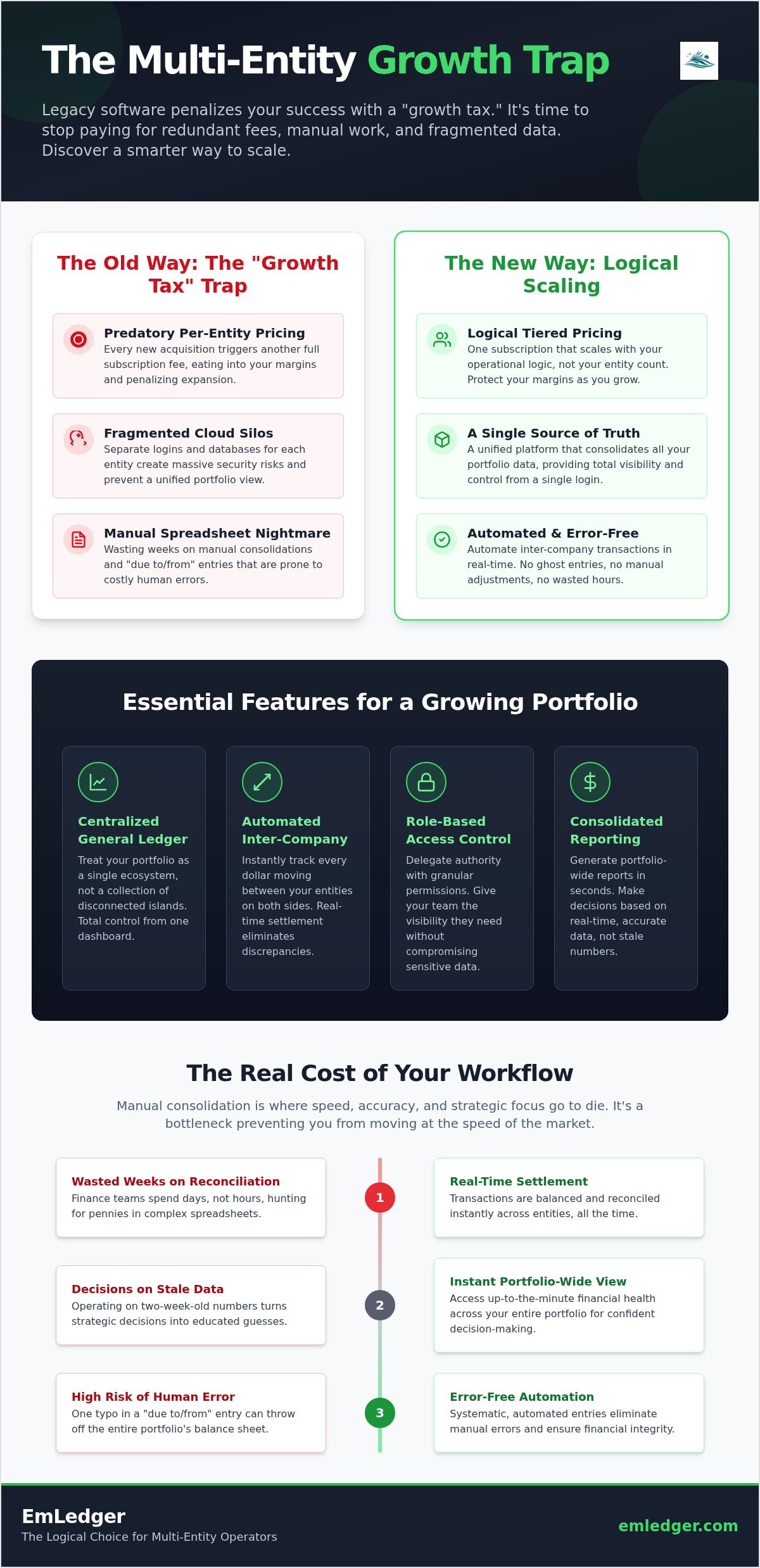
- Identify the "growth tax" where legacy software penalizes your expansion with predatory per-entity fees and redundant logins.
- Stop wasting weeks on manual consolidations by leveraging automated inter-company transactions and centralized general ledgers.
- Evaluate accounting software for multi-entity growth based on its ability to provide a single source of truth across all your legal entities.
- Replace fragmented cloud silos with a unified platform that secures your entire portfolio data and eliminates manual spreadsheet errors.
- Scale from a solo venture to a multi-entity empire using logical, tiered pricing that protects your margins as you grow.
The Multi-Entity Growth Trap: Why Legacy Software Fails Scaling Businesses
Growth should be celebrated, not penalized. Yet, the industry standard for financial tools does exactly the opposite. Most legacy platforms operate on a model that treats your expansion as an opportunity to gouge your margins. They call it "scaling." We call it a trap. When you outgrow basic accounting software, you're usually met with two bad choices: stay on a platform that breaks under the weight of multiple entities, or pay enterprise-level ransom for features you don't actually need.
The primary issue is the "Cloud Silo." If you manage ten LLCs, you shouldn't need ten separate logins. Managing a dozen different passwords and user permissions isn't just an administrative headache; it's a massive security risk. Fragmented data leads to fragmented decisions. You cannot see the health of your entire portfolio if your data is locked in ten different rooms. True accounting software for multi-entity growth should consolidate your visibility, not just your bills.
The Real Cost of Subscription Bloat
Managing five, ten, or twenty separate accounting subscriptions is a logistical nightmare. Every new entity requires a manual setup, a new billing cycle, and a unique set of user permissions. This administrative bloat eats into the time your finance team should spend on strategy. The Growth Tax is a predatory industry standard that penalizes business expansion by charging a full subscription fee for every individual legal entity added to a portfolio. It's a logical fallacy that forces mid-market operators to pay Fortune 500 prices just to have a clear view of their own assets. Beyond the pricing, you face a hidden tax on your team's productivity:
- Redundant data entry for shared vendors or customers across entities.
- Manual user access audits that take hours instead of seconds.
- The constant risk of phantom costs hiding in unmonitored subscriptions.
Why Your Current Workflow is Killing Your Scalability
Manual consolidation is where speed goes to die. If your team only reconciles inter-company transactions at the end of the month, you're operating on stale data. Decisions made on two-week-old numbers are just guesses. Manual entries also invite human error, especially with "due to/due from" accounts. One typo in a spreadsheet can throw off the entire portfolio's balance sheet. This creates a culture of "spreadsheet dread," where your best talent spends their days hunting for pennies in a grid instead of driving growth. For a scaling business, this isn't just a nuisance. It's a bottleneck that prevents you from moving at the speed of the market. Finding the right accounting software for multi-entity growth is the only way to break this cycle of inefficiency and reclaim your focus.
Essential Features for Managing a Growing Portfolio of Entities
Scaling a portfolio isn't just about adding more numbers to a spreadsheet. It's about building a financial architecture that won't collapse under its own weight. If your tech stack doesn't prioritize accounting software for multi-entity growth, you're just building a house of cards. You need tools that work as hard as you do. Most platforms offer basic ledgers. You need a command center. This starts with a centralized general ledger that treats your entire portfolio as a single ecosystem rather than a collection of disconnected islands. One platform. Every entity. Total control.
Security and efficiency must coexist. Role-based access is the foundation of this balance. Your regional managers need to see their specific P&L to make informed decisions. They don't need to see your holding company's distributions or sensitive payroll data. You need granular control that scales. This allows you to delegate authority without compromising sensitive financial data. It's about giving your team the visibility they need and keeping the rest under lock and key.
The Power of Automated Inter-Company Transactions
Manual "due to/due from" entries are a recipe for financial disaster. One side of the transaction gets recorded. The other side gets buried in a pile of paperwork. Suddenly, your balance sheets are lopsided. Your CPA then spends hours, and your money, hunting for the discrepancy. Real-time settlement is the only logical answer for a serious operator. Using inter-company transaction software ensures that every dollar moving between your entities is tracked on both sides, instantly. No ghost entries. No manual adjustments. Just clean, balanced books across the entire portfolio.
Bank Reconciliation at Scale
Reconciling one bank account is a necessary chore. Reconciling fifty accounts across ten different entities is a full-time job that adds zero value to your bottom line. Doing this entity-by-entity is a massive waste of human capital. You need a unified workflow that pulls every feed into a single, manageable view. EmLedger’s bank reconciliation tool transforms this from a manual matching game into a streamlined, high-velocity process. Automated feeds ensure a clean audit trail for every transaction. This moves your finance team from defensive data entry to offensive financial strategy. You can explore how these multi-entity features replace complexity with logic to keep your growth on track.
Consolidated Reporting vs. Manual Spreadsheets: The Real Cost
Stop lying to yourself about your spreadsheets. That "quick" monthly consolidation isn't quick. It is a slow, error-prone drain on your most expensive resources. If you are waiting 15 days after the month-end to see a consolidated P&L, you are already too late. You are navigating a 2026 market using a 2010 map. Real-time visibility is the difference between proactive capital allocation and reactive damage control. Leveraging consolidated reporting isn't just a convenience. It's a strategic requirement for any serious operator.
Accuracy is the first casualty of manual workflows. One broken formula in a hidden cell can distort your entire portfolio's valuation. This is the "Audit Trap." Spreadsheets fail the professional standard because they lack a verifiable audit trail. When you rely on static files, you're building your empire on a foundation of stale data and human error. True accounting software for multi-entity growth eliminates these risks by pulling data directly from the source. No copy-pasting. No manual adjustments. Just the truth.
The Spreadsheet Inefficiency Breakdown
The math is simple. If your finance team spends 20 hours a month wrestling with Excel to produce a single report, you are burning thousands of dollars in labor. Static files are dead the moment you save them. Automated reporting is dynamic, accurate, and instant. It replaces "spreadsheet dread" with one-click certainty. Look at the logical choice:
| Feature | Manual Consolidation | EmLedger Automation |
|---|---|---|
| Time to Report | 10-20+ Hours | 1 Click |
| Data Integrity | High Error Risk | 100% System-Verified |
| Visibility | Monthly Snapshot | Real-Time Dashboard |
| Audit Trail | Non-Existent | Full Transaction History |
Strategic Visibility for Holding Companies
Holding companies live and die by capital allocation. A bird’s-eye view allows you to identify underperforming entities before they drain the group's liquidity. You can't spot a cash-flow leak in Entity B if you're only looking at Entity A's siloed data. Consolidated visibility turns your accounting department from a cost center into a growth engine. It gives you the leverage to move capital where it earns the highest return. This is why choosing the right multi-entity accounting software is the most logical move for a scaling empire. It’s time to trade your spreadsheets for a single source of truth.
Choosing a Platform That Scales: From Solo Ventures to Multi-Entity Empires
The market for financial tools is polarized. You're either trapped in a "small business" app that chokes on its second entity or forced into a bloated ERP that requires a six-figure implementation fee. There is almost no middle ground for the high-growth operator. True accounting software for multi-entity growth must bridge this gap. It should offer the simplicity of a lean startup tool with the horsepower of an enterprise system. It's about providing a logical path from your first acquisition to your fiftieth.
Your software should match your current reality while preparing for your future ambition. In the Solo phase, you need clean, foundational accounting without the distraction of enterprise modules. As you move into the Growth phase, complexity usually spikes. You start adding LLCs, locations, and physical stock. This is where integrated inventory management becomes a non-negotiable asset. Without it, you're back to manual spreadsheets and data silos. You need a system that handles the weight of your inventory without breaking your workflow.
When you reach the Scale phase, the game changes again. You're dealing with high-volume transaction management and complex tax structures that would break a standard platform. This is why the "CPA-built" factor is critical. You need a system designed by someone who has actually managed a consolidated balance sheet, not just someone who writes code. Logic matters. Accuracy matters. Your software should be your most reliable partner, not your biggest bottleneck. It should simplify the complex, not complicate the simple.
Matching Your Plan to Your Ambition
You shouldn't pay for features you don't use, but you shouldn't be penalized for outgrowing your current tier. Evaluating the EmLedger Solo, Growth, and Scale plans reveals a different approach to expansion. These tiers are designed for the transition from a single-entity mindset to a portfolio mindset. They allow you to add entities without the friction of a platform migration. You get the tools you need today with a clear, predictable path for tomorrow. It is about matching your technology to your vision.
The Logic of Flat-Rate Entity Management
Predatory pricing models are a parasite on your margins. Most legacy providers charge a percentage of your growth by taxing every new entity you open. It's irrational. Your software costs should be a fixed, predictable line item, not a variable expense that scales with your success. EmLedger disrupts this "Per-Entity" pricing model by offering tiered, logical costs that respect your bottom line. EmLedger is the professional alternative for operators who value logic over legacy. It's time to stop paying the growth tax and start investing in your own expansion. Check out our comparison guide to see how we stack up against the status quo.
EmLedger: The Logical Choice for Multi-Entity Operators
Legacy software is a shackle. You've seen the trap and felt the cost of the status quo. Most providers want you to pay a premium for the privilege of growing your own business. EmLedger is the antidote. It's the only accounting software for multi-entity growth designed to strip away the "Growth Tax" and replace it with logical, tiered pricing. We don't just sell a ledger. We offer a clean exit from the predatory per-entity models that have stalled your progress for too long. Your success shouldn't be a profit center for your software provider.
This platform wasn't built by a Silicon Valley committee. It was built by a CPA who spent years in the trenches managing complex, multi-layered portfolios. We understand the specific pain of a lopsided balance sheet and the frustration of manual consolidation. Moving from legacy apps to a unified ledger shouldn't be a logistical nightmare. Our migration process is seamless. We move your data into a system where visibility is the default, not an expensive upgrade. It's time to trade fragmented silos for a single source of truth.
A Better Way to Manage Multiple LLCs
Holding companies and serial entrepreneurs need a technical partner that understands the stakes. You need a platform that matches your ambition. Whether you are managing three entities or thirty, your software should provide a bird’s-eye view of your entire empire. EmLedger supports holding companies by centralizing control while maintaining the legal integrity of each individual LLC. You get the horsepower of an enterprise system without the corporate bloat. Stop paying the growth tax and switch to EmLedger today.
Designed for Real Growth
The era of manual eliminations is over. Spreadsheet chaos is a choice, and it's a choice you no longer have to make. We provide professional-grade tools without the enterprise ego or the six-figure price tag. Our system automates the grunt work so you can focus on capital allocation and strategy. You can read more about selecting accounting software for growth stages to ensure your tech stack is ready for the next acquisition. Your portfolio's future should be scalable, visible, and finally under your control. Choose the accounting software for multi-entity growth that values your logic over legacy norms.
Reclaim Your Margins and Scale with Logic
The "Growth Tax" is a relic of legacy thinking. You don't have to accept predatory per-entity pricing or manual spreadsheet chaos as the cost of doing business. You need a system that respects your bottom line. It should provide a single source of truth across every LLC in your portfolio. Choosing the right accounting software for multi-entity growth is a strategic decision that defines your ceiling. It's the difference between administrative bloat and having the real-time visibility needed for high-stakes capital allocation.
EmLedger was built by a CPA who understands the granular headaches of multi-layered management. We've eliminated the predatory fees. We replaced them with automated inter-company transactions and real-time consolidated reporting. You deserve a platform that works as hard as you do without taxing your success. It's time to stop overpaying for complexity. Start investing in your own expansion. Take control of your portfolio's financial future today.
View Pricing & Stop Paying the Growth Tax
Frequently Asked Questions
What is the "Growth Tax" in accounting software?
The "Growth Tax" is a predatory pricing model where legacy software providers charge a separate subscription fee for every new legal entity you add to your portfolio. Instead of rewarding your expansion, they penalize it with redundant costs and administrative bloat. It forces operators into expensive enterprise tiers just to gain basic visibility. EmLedger rejects this norm by using tiered plans that support multiple entities without the per-unit penalty.
Can I manage multiple LLCs under one EmLedger account?
Yes, you can manage your entire portfolio of LLCs within a single EmLedger account. Our Solo, Growth, and Scale plans are specifically designed to house multiple legal entities under one roof. You don't need multiple logins or fragmented subscriptions. It is the most logical accounting software for multi-entity growth because it centralizes your control and visibility. You can add new entities to your portfolio without adding new software headaches.
How does EmLedger handle inter-company transactions?
EmLedger automates the "due to/due from" process to ensure your books stay balanced on both sides. When you move funds or share expenses between entities, the system records the transaction across all relevant ledgers simultaneously. This eliminates manual entry errors and ghost balances that plague spreadsheet-based workflows. It is a professional-grade solution that prevents lopsided balance sheets and saves your finance team hours of tedious reconciliation work every month.
Does EmLedger offer consolidated financial reporting?
We provide real-time consolidated financial reporting with a single click. You can view your P&L, balance sheet, and cash flow across all entities or specific groups within your portfolio. There is no need for manual spreadsheet exports or risky Excel formulas. You get a live, bird's-eye view of your entire empire's financial health. This visibility allows for faster capital allocation decisions and identifies underperforming units before they impact the group.
Is EmLedger a better alternative to QuickBooks for multiple companies?
EmLedger is a superior alternative for multi-entity operators because we don't charge you for every additional company file. QuickBooks often requires separate subscriptions for each LLC. This leads to "subscription bloat" and fragmented data silos. We offer a unified ledger system designed for the serial entrepreneur. It is for the operator who values logic and transparency over legacy name recognition and the predatory pricing of the status quo.
Can I track inventory across multiple entities in EmLedger?
Yes, our platform includes robust inventory management that works across your entire portfolio. You can track stock levels, valuations, and movements for each entity individually or as a consolidated group. This is essential for product-based businesses scaling across multiple locations or legal structures. It ensures your physical assets are as visible as your cash flow. You get accurate data without the need for disconnected third-party inventory apps.
Who built EmLedger and why?
EmLedger was built by a seasoned CPA who was tired of the inefficiencies and hidden costs of legacy software. After years of wrestling with manual consolidations and predatory pricing for clients, he built a better way. It is a platform designed by a professional who has actually managed multi-entity portfolios in the trenches. It solves the granular headaches that generic software developers overlook. We built this for operators, not just for accountants.
Does EmLedger support bank reconciliation for multiple accounts?
We support bank reconciliation for multiple accounts across all your entities simultaneously. Our system pulls automated feeds into a unified workflow, allowing you to match transactions at scale without switching company files. You don't have to log in and out of different entities to clear your statements. This high-velocity approach keeps your audit trail clean and your monthly close fast. It is about efficiency, accuracy, and total control.


