

Your accounting software is charging you a success tax for every new LLC you open. It’s a calculated penalty on your ambition. In 2026, the industry standard for accounts ledger software remains fundamentally broken for the multi-entity operator. You’re forced to pay separate subscriptions for every entity. You’re trapped in a cycle of manual spreadsheet consolidation. You’re constantly fixing inter-company loan tracking errors that shouldn't exist in a modern system.
We know the frustration of watching your overhead spike just because you launched a new project. It’s inefficient. It’s outdated. It’s logically flawed. This article exposes why legacy systems fail growing businesses and how to choose a platform that offers a single source of truth without the per-entity tax. You’ll learn how to implement automated inter-company eliminations and transparent pricing that actually respects your bottom line. We’re moving past the era of software silos and into a future of streamlined, consolidated financial control.
Key Takeaways
- Stop paying a success tax for every new LLC you launch. Traditional accounts ledger software often penalizes expansion with per-entity surcharges that bloat your overhead.
- Eliminate manual spreadsheet consolidation. Real-time consolidated reporting provides a single source of truth across all your business entities.
- Automate inter-company transactions. Modern systems handle eliminations and "due-to/due-from" tracking without the risk of manual reconciliation errors.
- Audit your current software for hidden efficiency gaps. Calculate the true cost of legacy systems by tracking the hours your team spends on manual bridge work between entities.
- Transition logically from a Solo Plan to Growth and Scale tiers. Scale your operations with a system that supports expansion instead of adding administrative bloat.
Beyond the Basic Journal: What Accounts Ledger Software Actually Does
Accounts ledger software is the immutable record of every financial event across an organization. It’s the DNA of your business. Most legacy providers want you to think of it as a digital shoebox; a place to dump data and hope it balances. That’s a lie. In 2026, high-quality accounts ledger software isn't just a journal. It’s a real-time database. If your system doesn't handle double-entry logic, live bank feeds, and automated sub-ledgers, you aren't using a ledger. You’re using a glorified spreadsheet.
The difference between a "cloud ledger" and a "smart ledger" is the difference between storage and automation. Cloud ledgers just store your mistakes in a remote server. Smart ledgers use bank reconciliation and logic-based rules to prevent errors before they hit the books. One saves your data. The other saves your time.
The Core Components of a High-Performance Ledger
Rigid structures kill growth. If your Chart of Accounts (COA) requires a manual rewrite every time you add a new revenue stream, it’s broken. You need a system that supports your expansion, not one that forces you into a pre-set box. High-performance ledgers rely on three pillars:
- COA Flexibility: Your ledger should adapt to new business models without breaking your historical data.
- Sub-ledger Integration: You must keep detailed records for inventory management and AP/AR separate from the general ledger to maintain clarity.
- Real-time Visibility: Waiting for "month-end" to see your financial health is a legacy failure. Decisions require live data.
Why Command-Line Ledgers Aren’t for Operators
Some developers swear by the ledger-cli approach. It’s text-based. It’s manual. It’s great for a solo coder with one bank account. It’s a disaster for a scaling team. Using command-line tools for multi entity accounting introduces massive technical debt into your financial records. One syntax error can corrupt your entire history. You need a GUI-based smart platform that enforces guardrails. Logic should be built into the interface, not hidden in a terminal script. Clarity beats "cool" tech every time.
A smart ledger provides a visual source of truth that every member of your finance team can use. It eliminates the gatekeeper problem. When your ledger is accessible and automated, you stop being a data entry clerk and start being an operator. Don't let technical debt in your books slow down your physical growth.
The Hidden Tax: Why Per-Entity Ledger Pricing is a Growth Killer
The industry standard for accounts ledger software is built on a predatory pricing model. It’s called the per-entity fee. If you’re a serial entrepreneur or a holding company operator, you’ve felt the sting. Every time you spin up a new LLC to protect an asset or launch a project, your software provider sends a bill. They’re charging you for a new database entry as if it’s a revolutionary feature. It’s a scam. It’s a growth tax on your ambition.
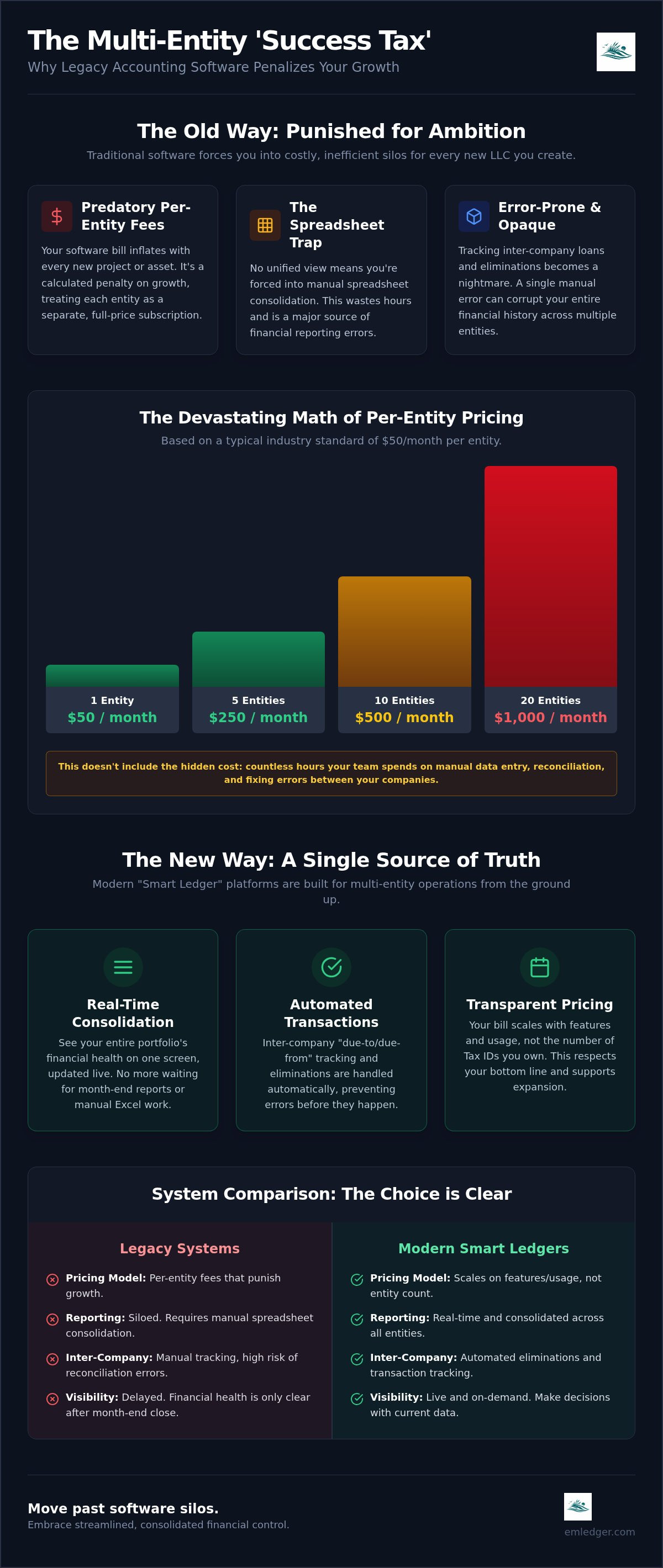
The math is simple and devastating. If you pay $50 per month for each entity, a portfolio of 10 companies costs you $500 monthly. By the time you hit 20 entities, you’re paying $1,000 every month just for the right to keep your books separate. Your software bill triples while your actual operational overhead should stay flat. This isn't a rational business calculation; it's a ransom paid to legacy providers who haven't updated their logic since the 1990s. A logical alternative is software that scales based on features and complexity, not the number of Tax IDs you own.
The Spreadsheet Trap of Per-Entity Software
Most legacy providers don't actually offer multi-entity management. They offer multiple subscriptions. This siloed approach forces you into a log-in/log-out workflow that wastes hours every week. When you need to see your total cash position, you’re forced back into manual Excel consolidation. You’re paying for modern software but performing manual labor to bridge the gaps between your own companies. This inefficiency is a hidden cost that dwarfs the subscription fee. You can read more about why the multi-entity tax is a scam in our deep dive into industry pricing myths.
Transparency as a Disruptor
EmLedger was built by a CPA who was tired of being billed for growth. The architecture is different because the logic is different. Instead of taxing your Tax IDs, we offer a transparent tiering system designed for operators. We provide a Solo Plan for single-entity founders, a Growth Plan for expanding portfolios, and a Scale Plan for complex organizations. To find your true Cost Per Entity, divide your total accounting software bill by the number of LLCs you manage. If that number makes you angry, your system is broken. You shouldn't be penalized for being successful. It’s time to move to a platform that values logic over marketing fluff. Take a look at our multi-entity management features to see how we’ve eliminated the growth tax once and for all.
Essential Ledger Features for Multi-Entity Operations
Legacy accounts ledger software treats every entity as an island. You’re left rowing between them with spreadsheets. It’s a waste of mental energy. A real system handles the complexity of inter-company transactions without requiring a manual journal entry every time cash moves. If you can't see your total cash position across ten LLCs in five seconds, your ledger isn't a tool. It's a bottleneck. Operators need features that automate the "due-to/due-from" nightmare. Anything less is just a digital filing cabinet.
Automated Financial Consolidation
Forget the month-end "bridge work." Smart ledgers handle consolidated reporting by pulling data from every subsidiary into a single dashboard. You get real-time P&L visibility without waiting for a bookkeeper to finish their manual checks. The system should automatically handle inter-company eliminations. It removes the noise of internal transfers so you see the actual profit, not just a list of due-to/due-from balances. You can learn more about ending the manual spreadsheet trap in our specialized guide. This isn't just about convenience. It’s about having a single source of truth for every subsidiary you own.
Inventory and Bank Feeds: The Accuracy Anchors
Most operators make the mistake of using third-party apps for everything. It creates data silos. Your inventory management must live inside your ledger. Tracking assets across different locations and entities shouldn't require a sync button that fails half the time. When inventory and ledger data are one, your balance sheet is actually accurate. You see what you have, where it is, and what it’s worth in real time. This level of integration is what separates professional systems from amateur workarounds.
Mastering bank reconciliation for dozens of accounts is the final test of your accounts ledger software. A high-performance ledger centralizes these feeds. You reconcile by exception, not by manual line-item matching. It’s about logical efficiency. You don't have time to log in to twenty different bank portals. Your software should aggregate that data, flag the anomalies, and let you get back to building the business. When your reconciliation is centralized, you eliminate the risk of missing a transaction in a forgotten sub-account. It’s about total visibility without the total headache.
How to Audit Your Current Ledger System for Efficiency Gaps
Stop guessing about your profitability. Start measuring the friction. Your accounts ledger software should be a high-velocity engine for your business. If it feels like an anchor, it’s because the system is fundamentally misaligned with your operational needs. Most operators ignore the slow bleed of time because they are too busy putting out fires. You need to audit your system before the inefficiency becomes permanent. Use this four-step framework to identify where your current ledger is failing you.
- Step 1: Track the time spent on "manual bridge work" between entities. Every hour spent in Excel is an hour lost to growth.
- Step 2: Audit your software invoices for "hidden" per-user or per-entity surcharges. Calculate the total cost of your success.
- Step 3: Check for "Data Lag." How many days does it take to see a consolidated balance sheet after a transaction occurs?
- Step 4: Evaluate your entity management workflow. If you are re-keying the same data into multiple portals, your system is broken.
The "Ghost Work" Audit
Siloed software creates "ghost work." These are tasks that only exist because your accounts ledger software can't talk to itself. Identifying these tasks is the first step toward reclaiming your time. Think about the manual journal entries you make for inter-company loans or the time spent matching due-to/due-from accounts. For holding companies, this isn't just a nuisance. It's a massive liability. Reconciliation errors in internal transfers lead to bad data. Bad data leads to expensive mistakes during tax season or acquisitions. If you can't trust your consolidated numbers, you don't have a ledger; you have a collection of guesses.
Evaluating the "Growth Path"
Is your software designed to scale, or just to upsell you? There is a massive difference between "Enterprise-Ready" and "Growth-Friendly." Enterprise-ready systems usually involve long implementation times and bloated feature sets you'll never use. Growth-friendly systems are built to expand as your entity count grows. They don't penalize you for launching a new LLC. You can read more in our deep dive on Accounting Software for Growth Stages: Stop Paying the Growth Tax. A logical system should feel like a partner, not a parasite that takes a cut of your expansion.
Stop paying for your own growth. Check out our transparent pricing tiers and see how EmLedger provides a clean, logical exit from legacy complexity.
Scaling Your Books: From Solo Founder to Multi-Entity Powerhouse
Legacy software providers love a bait and switch. They start you on a "Basic" plan that feels like a toy. As soon as you add your second LLC, they demand a platform migration. It’s inefficient. It’s expensive. It’s a logical failure. Moving from one accounts ledger software to another just because you’re successful is a waste of your most valuable resource: time. You shouldn't have to retrain your team or risk data loss every time you hit a revenue milestone. Retraining is a waste of capital. Migration is a risk you don't need to take.
The EmLedger architecture is built to stay with you. We offer a single platform that evolves through three logical stages:
- The Solo Plan: Professional-grade accounting for the single-entity founder who needs a real ledger, not a digital shoebox.
- The Growth Plan: The bridge for expanding portfolios. It allows you to add entities and inventory management without the administrative bloat of per-entity fees.
- The Scale Plan: Advanced consolidated reporting built for complex franchises and multi-layered brands.
Managing 10 LLCs Without 10 Headaches
Managing ten companies shouldn't feel like running ten separate businesses. Centralized control is the only way to scale without losing your mind. EmLedger handles inter-company transactions at scale by treating your entities as a unified system. You wear multiple hats. Your software should support that. It’s the logical transition from being an operator who fights fires to an owner who manages assets. When you stop logging in and out of different portals, you start seeing the big picture. One platform. Zero migrations. Total control.
Your Next Step: Auditing the Logic
Stop paying for features you don’t use. Stop paying for companies you haven’t built yet. Most legacy providers front-load their costs or hide them in complex "Enterprise" tiers that require months of implementation. We don't. Review the EmLedger Pricing to see the disruptive difference for yourself. It’s a rational calculation, not a marketing gimmick. We value your resources as much as you do.
A ledger should be the foundation of your empire, not a ceiling on your growth. You’ve already done the hard work of building the business. Your accounts ledger software should be the easiest part of your day. Logic wins. Transparency wins. You win. It’s time to build on a foundation that actually supports your ambition.
Build Your Empire on Logic, Not Legacy Fees
The industry standard for accounts ledger software isn't just outdated; it's predatory. You’ve seen how per-entity pricing models act as a ransom for your expansion. You’ve identified the ghost work that siloed systems force upon your team. Most importantly, you now have a framework to audit your current ledger for efficiency gaps. Logic dictates that your software should scale with your ambition, not penalize it. Success shouldn't come with a subscription surcharge.
EmLedger offers a clean exit from this complexity. It’s a CPA-built architecture designed specifically for operators who manage multiple Tax IDs. You get real-time consolidated reporting and automated inter-company eliminations without the burden of per-entity fees. It’s time to move past digital shoeboxes and toward a single source of truth that actually functions in 2026. Stop settling for a system that creates more work than it helps you avoid.
Stop paying the growth tax. View EmLedger Pricing.
Take control of your financial data today. You've done the hard work of building your business. Use a system that finally respects your success.
Frequently Asked Questions
What is the difference between a general ledger and accounts ledger software?
A general ledger is a conceptual record of all financial transactions; the software is the specific tool used to manage it. The tool automates the recording of data into the ledger database. Modern systems go beyond basic recording by integrating bank feeds and automated reconciliations. It’s the difference between a manual, static record and a real-time financial engine. Operators need the software to handle the heavy lifting while they focus on growth.
Does accounts ledger software include multi-entity consolidation?
Most legacy systems treat consolidation as a premium add-on or require manual spreadsheet work. That’s a scam. High-performance accounts ledger software should include multi-entity consolidation as a core feature. It aggregates data from every subsidiary into one dashboard. You see your total cash position without logging in and out of different company files. If your software makes you bridge data in Excel, it isn't truly consolidating your books. It's just wasting your time.
Can I track inventory across multiple companies in one ledger?
Yes, if the system is built with a multi-entity architecture. Centralized inventory management allows you to track assets across different locations and Tax IDs without data silos. You see what you have, where it is, and which entity owns it in real time. This prevents the blind spot created when inventory is tracked in separate, disconnected apps. Logical inventory control requires a single source of truth for your entire operation.
How does inter-company transaction automation work?
Automation works by creating balanced journal entries across two entities simultaneously. When Company A pays a bill for Company B, the system automatically records the due-to and due-from entries. It eliminates the risk of lopsided books. You stop chasing manual reconciliation errors because the logic is built into the transaction flow. This ensures your inter-company loans always balance at the end of the month without manual adjustments or guesswork.
Is accounts ledger software suitable for holding companies?
A smart ledger is essential for holding companies that manage diverse portfolios. Holding companies face unique challenges like inter-company eliminations and consolidated tax reporting. A unified system provides the bird’s-eye view needed to manage multiple subsidiaries effectively. It replaces the chaos of separate subscriptions with a single financial structure. You gain clarity on your total liability and asset exposure across the entire organization with one click. It’s about total control over your assets.
What are the best alternatives to QuickBooks for multi-entity accounting?
Operators are moving toward platforms that prioritize transparent pricing and native consolidation. EmLedger is a disruptive alternative built by a CPA specifically to eliminate the growth tax found in legacy accounts ledger software like QuickBooks and NetSuite. Other options like Sage Intacct exist, but they often come with high implementation costs. You need a system that offers professional-grade features without the predatory per-entity surcharges common in the industry. Logic should dictate your choice.
Do I need a CPA to set up my accounts ledger software?
You don't need a CPA for the technical setup, but using a CPA-built platform ensures the financial logic is sound from day one. A well-designed system should be intuitive for operators while maintaining professional accounting standards. The focus should be on clean data entry and automated reconciliations. While you’ll still want a professional for tax strategy, your software should be simple enough for your internal team to manage daily without confusion.
How much does modern ledger software cost in 2026?
Legacy providers in 2026 still cling to high-cost models, with some enterprise platforms starting near one thousand dollars per month plus user fees. Others charge per entity, which punishes your success. Modern alternatives have disrupted this by using tiered plans that focus on features rather than Tax IDs. This allows you to scale from a Solo founder to a multi-entity powerhouse without a success tax. Always audit your total cost per entity.


