

Scaling to 10 entities shouldn't feel like a financial penalty, yet legacy software providers treat your growth like a taxable event. If you're managing a portfolio of LLCs, you've likely realized the traditional per-entity pricing model is a predatory relic designed to drain your margins. You're already fighting the operational friction of logging in and out of ten separate ledgers. You shouldn't have to tolerate a software bill that doubles every time you launch a new venture.
It's exhausting to watch your team waste hours manually consolidating P&Ls in Excel only for the data to be outdated by the time it's finished. Professional accounting should provide clarity, not overhead. This article explains how to streamline your operations using multi-LLC financial management software built for operators. You'll learn how to ditch the spreadsheet grind for a system that offers instant consolidated reporting and predictable pricing. We'll preview the move to a single login for all 10 entities so you can stop paying the growth tax and focus on your next move.
Key Takeaways
- Stop wasting hours on manual spreadsheet consolidation and login hopping. Learn how to view your entire portfolio's cash position with a single click.
- Expose the "growth tax" that penalizes your success through redundant per-entity fees. Discover the math behind why legacy pricing models are designed to drain your margins.
- Identify the specific features of modern multi-LLC financial management software that replace the manual Due To and Due From grind.
- Protect your corporate veil by automating inter-company transactions across your 10-LLC ecosystem. Sloppy flows aren't just annoying; they're a legal liability.
- Transition to a CPA-led accounting system built for operators, not software sales teams. Get predictable, flat-rate pricing that scales with your ambition.
The 10-LLC Management Trap: Why Spreadsheets and Separate Logins Fail
Scaling a corporate group to 10 entities should be a milestone of success. Instead, for many founders, it becomes a logistical prison. The problem isn't the number of businesses; it's the tools used to manage them. Most operators start with a single-entity mindset and simply duplicate it ten times. This leads to a fragmented ecosystem where data is trapped in silos. You can't see the big picture because you're too busy managing the minutiae of ten different logins. It’s an inefficient way to run a portfolio.
Entity hopping is a silent productivity killer. Every time you log out of one account to check another, you lose context. You deal with ten sets of MFA codes. You navigate ten different dashboards. This operational drag adds up to hours of wasted effort every week. Without a unified multi-LLC financial management software, you're forced to act as a human bridge between disconnected datasets. This manual reconciliation doesn't just take time; it introduces a level of risk that no serious operator should accept. You need clarity, not more tabs open in your browser.
The Myth of the Simple Spreadsheet
Excel is a liability for a 10-LLC portfolio in 2026. It's static, disconnected, and prone to catastrophic human error. A single broken formula in a consolidation tab can lead to months of incorrect financial reporting. Maintaining audit-ready books in a manual system is a fool's errand that leaves you vulnerable. The manual entry threshold where spreadsheets become a business risk is the moment you have more than three inter-company transactions per month. Beyond that point, you aren't managing data; you're just hoping the numbers are right.
The Legacy Software Wall
Traditional accounting platforms were built for the single-user, single-entity world. Their entire architecture assumes you have one business and one set of books. When you bring ten entities to the table, they don't see a growing enterprise. They see ten separate subscription opportunities. The friction of managing ten different bills is an unnecessary tax on your growth. Multi-company features in these legacy apps are typically clunky add-ons that fail to solve the core problem of fragmentation. You need a multi-LLC financial management software that treats your portfolio as a single, logical unit. Stop fighting the tools and start using a system designed for your scale.
The Hidden Cost of the Growth Tax: Exposing Multi-Entity Pricing
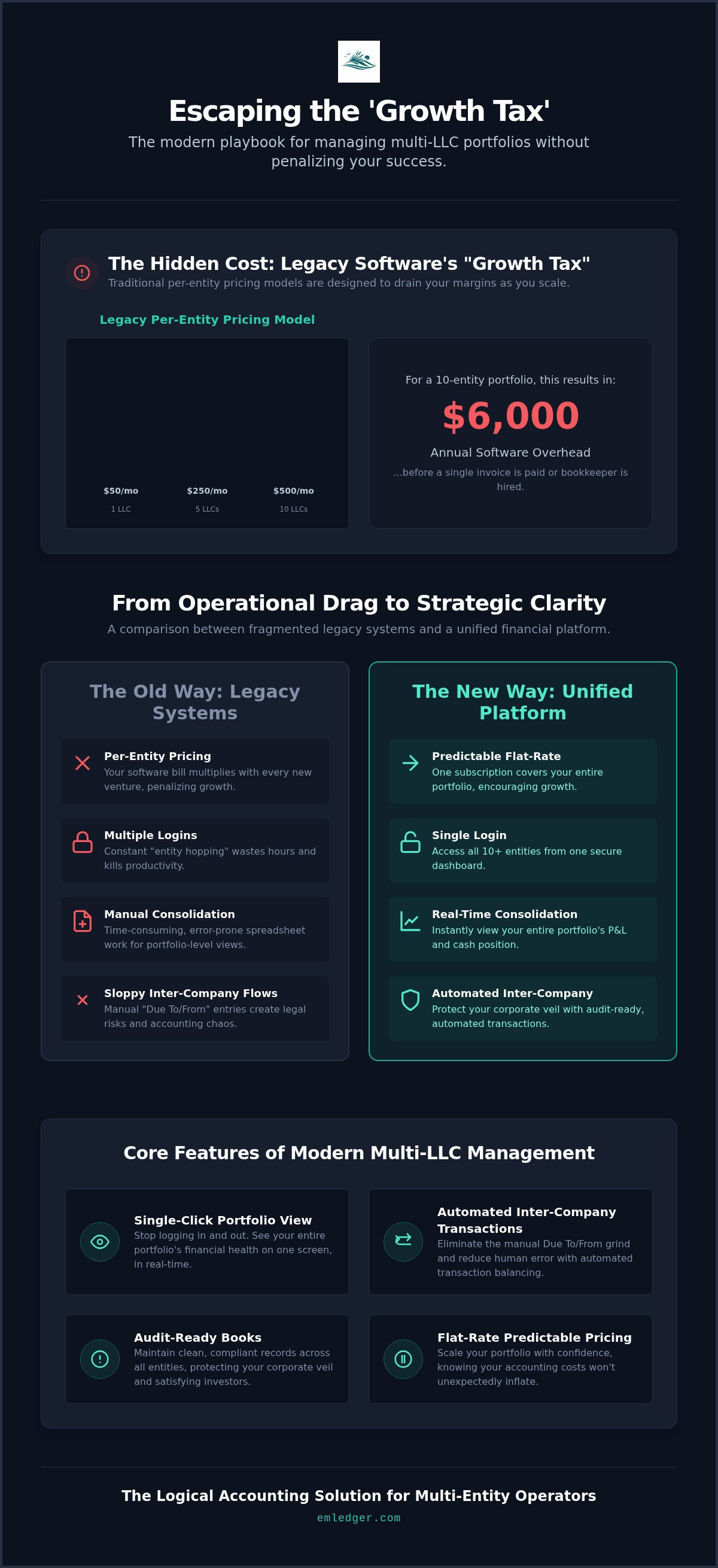
Legacy accounting brands have a dirty secret. They don't want you to scale efficiently. They want to leech off every new LLC you register. This is what we call the Growth Tax. It’s a predatory pricing model that penalizes your success by charging you on a per-entity basis. If you’re managing 10 entities, you’re likely paying for the same software, the same features, and the same support team 10 times over. It’s redundant. It’s inefficient. Most importantly, it’s logically broken.
The math of 10 LLCs is sobering. When a legacy provider charges $50 per month per ledger, your bill hits $500 monthly just for the privilege of keeping your books separate. That’s $6,000 a year before you’ve even paid a bookkeeper or a CPA. Your accounting bill should not triple just because your entity count does. There is no rational reason a holding company with two transactions a month should cost as much as your primary operating business. This pricing structure creates a psychological toll; it makes you hesitate before launching a new venture because you’re already calculating the software overhead. You need multi-LLC financial management software that respects your margins instead of eroding them.
The Economics of Multi-Entity Operations
Fragmented systems are a drain on your ROI. Every hour your team spends logging in and out of different files is an hour stolen from high-level strategy. When you move to a unified system, you aren't just saving on subscription fees. You’re reclaiming operational capacity. Flat-rate tiered pricing changes the game for serial entrepreneurs. It turns accounting from a variable cost that scales with your complexity into a predictable, fixed expense. You can see how this logic applies to your portfolio by reviewing the EmLedger pricing structure, which is built for growth, not for penalties.
Why Per-Entity Pricing is Logically Flawed
The industry status quo ignores the difference between data volume and entity count. A single-entity enterprise with 5,000 transactions requires more server resources than a corporate group of 10 quiet LLCs with 50 transactions each. Yet, legacy providers charge the group ten times more. It makes no sense. We challenge this nonsense with a straightforward approach: pay for the platform, not the number of tax IDs. Choosing the right multi-LLC financial management software means finding a partner that understands your structure. If you’re tired of redundant bills, it’s time to evaluate a more rational alternative that scales alongside your ambition.
Beyond Bookkeeping: Achieving Real-Time Consolidated Visibility
Managing 10 LLCs without a unified view is like flying a plane with ten different instrument panels, each showing a different altitude. You can't see the big picture because your data is trapped in silos. For the ambitious operator, bookkeeping isn't just about compliance. It’s about visibility. You need a single source of truth that reflects the financial health of your entire portfolio. Without it, you’re making decisions based on fragmented guesses rather than hard data. Modern multi-LLC financial management software dismantles these silos, allowing you to view your total cash position across all entities with a single click.
Lender readiness is another casualty of fragmented accounting. When you approach a bank for a line of credit or a new acquisition loan, they don't want ten separate, disconnected P&L statements. They want a clear, consolidated balance sheet that proves your total enterprise value. Relying on last month's manual reports means you're always looking in the rearview mirror. Real-time visibility moves you from reacting to what happened 30 days ago to managing what is happening right now. It transforms your accounting from a historical record into a strategic asset.
Automated Financial Consolidation
The "Friday afternoon CSV dance" is a waste of your talent. Exporting data from ten different files to manually merge them in Excel is a recipe for disaster. Even large organizations struggle with this; a recent GAO report on financial consolidation challenges highlights how even government agencies face significant hurdles when reporting across multiple branches. For a small business owner, these hurdles lead to expensive errors. Implementing consolidated reporting empowers better capital allocation by showing you exactly where your liquidity sits. Automated consolidation prevents double-counting of assets by ensuring inter-company receivables and payables are eliminated during the roll-up process, giving you an honest look at your net worth.
Holding Company Insights
If you operate a parent company with several subsidiaries, you must understand the flow of resources between them. Not all LLCs are created equal. Some are high-growth engines; others might be quiet drains on your capital. You need to identify which entities are performing and which are stagnant. This level of granular detail is essential for a Holding Companies Use Case where the parent entity must act as an internal bank. Using multi-LLC financial management software allows you to monitor these relationships without getting lost in the weeds of individual transactions. You gain the clarity to cut losses or double down on winners before the quarter ends.
Mastering Inter-Company Transactions Without the Manual Labor
Sloppy inter-company accounting is more than just a headache; it’s a legal ticking time bomb. If you’re treating 10 bank accounts like one big wallet, you’re inviting a court to pierce your corporate veil. You need distinct boundaries. You need a logical framework for every dollar that moves between entities. A multi-LLC financial management software ensures that every transfer is mirrored correctly on both sides of the ledger. No more guessing. No more messy spreadsheets.
Automating the Due To and Due From entries across your 10-LLC ecosystem is the only way to maintain sanity. When LLC A pays a bill for LLC B, the system should recognize the liability and the receivable instantly. This isn't just about clean books. It’s about audit protection. Handling shared expenses or management fees shouldn't require writing 10 manual checks every month. It should be a single, logical transaction that flows through your entire structure. A professional multi-LLC financial management software built by CPAs understands these nuances and builds them into the core workflow.
The Inter-Company Workflow
Recording a transfer shouldn't be a manual chore. Here is the logical workflow: you record the payment in LLC A, tag it as an inter-company flow, and the system automatically generates the corresponding receipt in LLC B. This bilateral synchronization is the core of inter-company transaction software. It eliminates the risk of forgotten entries that plague 10-entity structures. You don't have to remember to log into a second account to "finish" the transaction. The software does the heavy lifting for you.
Reconciliation at Scale
Reconciling 10 separate bank accounts can swallow an entire work week if you're doing it manually. High-volume operators don't have that kind of time. You need automated matching that identifies transactions across all 10 ledgers simultaneously. These bank reconciliation features turn a multi-day ordeal into a few minutes of oversight. Automated matching is non-negotiable for anyone scaling past five entities. If you're ready to stop the manual grind, it's time to automate your inter-company transactions today.
EmLedger: The Logical Accounting Solution for Multi-Entity Operators
EmLedger exists because legacy software failed the modern entrepreneur. We didn't build another generic tool; we built a platform specifically for operators who manage multiple tax IDs. If you're running 10 LLCs, you don't need marketing fluff or a "relationship manager" who doesn't understand inter-company flows. You need a multi-LLC financial management software that respects your intelligence and your bottom line. Our promise is simple: no per-entity fees and no hidden "success taxes" that penalize you for expanding your portfolio.
We've structured our platform into logical tiers: the Solo Plan, the Growth Plan, and the Scale Plan. For the founder with 10 entities, the Growth Plan provides the exact capacity you need without the redundant costs of 10 separate subscriptions. Migrating from your current spreadsheet mess or fragmented legacy accounts in 2026 is a straightforward process. We've optimized the transition so you can stop bleeding time and start managing your corporate group like a professional. It is a clean, logical exit from the complexity that legacy providers use to keep you trapped in their ecosystem.
Built by a CPA, for Entrepreneurs
Most software is built by developers who have never reconciled a bank statement. EmLedger is different. It was designed by a CPA who understands that logic must beat corporate-speak every time. We know that while you need a unified dashboard, you must maintain the strict legal separation of your 10 LLCs to protect your assets. Our system is engineered to respect those boundaries while automating the repetitive tasks that usually require a team of expensive bookkeepers. You can read more about our Multi-Entity Accounting Software and how we're dismantling the myths used to justify high legacy fees.
Taking the Next Step
Efficiency is the only way to scale without burning out. The setup process for your first 10 entities takes about five minutes, not five weeks. By consolidating your workflow into a single multi-LLC financial management software, you can reclaim over 20 hours of management time every month. That’s half a work week returned to you for high-level strategy and new acquisitions. Stop overpaying for outdated tools and start using a system built for your reality. Start your EmLedger trial today and see the difference that logical accounting makes for your portfolio.
Reclaim Your Operational Freedom
Scaling to 10 entities shouldn't feel like an administrative prison sentence. Legacy software providers have spent years convincing you that fragmented data and redundant fees are just the cost of doing business. They're wrong. You've seen how the "growth tax" erodes your margins and how entity-hopping kills your productivity. It's time to demand a system that respects your scale. Real-time consolidated reporting isn't just a convenience; it's the only way to prove your enterprise value to lenders and stakeholders without a week of manual Excel labor.
Choosing a dedicated multi-LLC financial management software is the logical next step for any serious operator. By centralizing your portfolio, you eliminate the risk of sloppy inter-company flows and protect your corporate veil. EmLedger was built by a CPA specifically to solve these granular headaches. We offer a transparent, no-nonsense alternative with zero per-entity pricing and instant consolidated visibility across your entire ecosystem. Stop settling for tools that weren't built for your reality.
Stop paying the "Growth Tax" and manage your 10 LLCs logically with EmLedger. You've done the hard work of building your portfolio. Now, it's time to use the tools that help you protect it.
Frequently Asked Questions
How do I keep my 10 LLCs legally separate in one accounting system?
You maintain legal separation by using distinct ledgers for each entity within the unified platform. EmLedger ensures each LLC has its own chart of accounts and tax ID while allowing you to manage them through a single interface. This structure prevents the commingling of funds while providing the efficiency of a single login. It's a professional way to respect the corporate veil without the friction of ten separate software subscriptions.
Can I generate a consolidated P&L for just 5 of my 10 LLCs?
Yes, you can filter and group specific entities for custom reporting. While full consolidation is a standard feature of multi-LLC financial management software, the ability to create sub-groups is essential for diverse portfolios. You might want to analyze the performance of your real estate holdings separately from your retail ventures. Flexible grouping allows you to gain these specific insights without manually merging spreadsheets or excluding data sets.
Is there a limit to how many inter-company transactions I can process?
There are no transaction limits on any EmLedger plan. Whether you process ten or ten thousand inter-company flows, the software handles the volume without charging extra fees. We believe you shouldn't be penalized for high-velocity operations. The system automates the Due To and Due From entries regardless of the quantity, ensuring your inter-company balances remain perfectly synchronized across your entire 10-LLC ecosystem without manual intervention.
Do I need a separate bank account for each of my 10 LLCs?
Yes, maintaining separate bank accounts is a fundamental requirement for legal entity protection. While you manage the data in one system, the physical cash must reside in accounts tied to the specific Tax ID of each LLC. EmLedger simplifies this by integrating with each account for automated bank reconciliation. This setup ensures you respect the corporate veil while reclaiming the hours usually spent on manual data entry or login hopping.
What happens to my data if I grow from 10 LLCs to 50?
Your data scales seamlessly as you move from the Growth Plan to the Scale or Enterprise tiers. Moving from 10 to 50 entities is a logical progression, not a technical crisis. The software architecture is designed to handle increased data volume without sacrificing performance. You won't lose historical records or have to migrate to a new platform; you simply unlock more capacity to support your expanding corporate group.
Can my CPA access all 10 LLCs with a single login?
Your CPA receives a single, unified login to access every entity in your portfolio. Giving your tax professional separate credentials for ten different files is a waste of their billable time and your money. With multi-LLC financial management software, they can toggle between ledgers or view consolidated reports instantly. This streamlined access ensures they spend their time on high-level strategy rather than fighting with login screens and fragmented data.
How does EmLedger handle different fiscal years for multiple entities?
The system supports independent fiscal year settings for each LLC within your group. While many portfolios align their entities to the calendar year, some industries require specific reporting periods. You can configure each ledger's start date to match its legal requirements. The consolidated reporting engine then aligns this data logically so you can still see a unified view of your total enterprise performance at any given moment during the year.
Does EmLedger support multi-entity inventory tracking?
Integrated inventory management is a core feature that tracks stock levels across all your entities. If you move inventory between LLCs, the system records the transfer and the corresponding inter-company transaction automatically. This prevents the manual reconciliation nightmares common in e-commerce and retail portfolios. You get real-time visibility into your total asset value without having to manually count stock or merge disconnected inventory spreadsheets from ten different sources.


