

Why are you being punished for succeeding? Every time you launch a new LLC or add a franchise location, your software bill shouldn't double. Most cloud ledger software providers treat your growth like a taxable event. They lock you into a per-entity pricing model that makes zero logical sense. You've likely accepted this as the "cost of doing business." You're tired of the manual consolidation hell and the spreadsheet marathons required to get a clear picture of your total holdings. It's a broken system designed by legacy corporations, not by people who actually run businesses.
It's time to stop paying the growth tax. In 2026, your financial stack should scale with your business logic, not your entity count. This article exposes why traditional pricing models are a scam for multi-entity operators. We'll show you how to choose a platform that handles inter-company transfers and automated reporting without the "per-book" penalty. You'll discover how a CPA-led approach to multi-entity accounting can finally eliminate the manual mess and let you manage ten companies as easily as one.
Key Takeaways
- Modern cloud ledger software provides real-time visibility that legacy desktop systems cannot match. Learn why immediate data access is the baseline for modern financial management.
- Stop paying the "growth tax" imposed by legacy software companies that charge per entity. Learn why per-company pricing is a relic that punishes your expansion.
- Master the tools of multi-entity visibility. Automate your inter-company transactions and generate consolidated reports without touching a single spreadsheet.
- Audit your accounting stack with a 5-point logical framework. Focus on pricing architecture and native elimination capabilities to ensure your software scales with your logic.
- Discover how a CPA-designed platform offers a clean exit from legacy complexity. Position your business for 2026 with a system built for serial entrepreneurs and holding companies.
Beyond the Buzzwords: What Cloud Ledger Software Actually Is
Stop listening to the marketing fluff. Most legacy providers use the term "cloud" as a buzzword to justify a recurring subscription fee for outdated tech. In reality, true cloud ledger software is a centralized, internet-based system of record. It documents every financial transaction your business makes in real time. It isn't just a digital version of a paper book; it's a live engine that powers your entire operation. It provides the single source of truth for your assets, liabilities, and equity.
The core difference between modern tools and legacy systems is visibility. Old-school desktop software relies on "batch" processing. You enter data, you wait for a sync, you reconcile manually, and you finally see a report that is already two weeks out of date. That's a rear-view mirror approach to management. Cloud accounting software has evolved into a proactive management tool. It replaces manual entry with automated bank feeds and AI-assisted reconciliation, ensuring your books are always current.
The Anatomy of a Modern Cloud Ledger
A functional ledger must be built on the non-negotiable foundation of double-entry accounting. This ensures every debit has a corresponding credit, maintaining mathematical integrity across your books. Automated bank reconciliation is the next pillar. It turns hours of tedious manual matching into minutes of oversight. When your bank feeds talk directly to your ledger, you get real-time financial statements. Your P&L and Balance Sheets update as business happens, not at the end of the month when it's too late to pivot.
Why "Cloud-Based" is No Longer Optional
If you can't access your data from a phone in an airport or a laptop at home, you don't own your business; your office does. Cloud accessibility is mandatory for founders, bookkeepers, and investors who need to make fast decisions. It removes the IT overhead of manual backups and server maintenance. You get enterprise-grade security and automatic data protection without hiring a tech team. Furthermore, a modern ledger acts as a hub. It connects to your banks, payment gateways, and inventory management tools. This integration ecosystem creates a seamless flow of data that eliminates human error and keeps your logic clean.
The 'Growth Tax': Why Per-Entity Pricing is a Legacy Scam
The industry has a dirty secret. Legacy cloud ledger software companies don't see your new LLC as a milestone; they see it as a fresh revenue stream. Every time you expand, they take a bigger cut. This is the "Growth Tax." It's a pricing model that punishes success and rewards complexity. While major publications often list these apps as top choices, they frequently overlook the massive multiplier effect for multi-entity owners. A standard monthly fee sounds reasonable until it's applied to ten different companies. Suddenly, your software bill grows faster than your profit.
Let's look at the logic. It doesn't cost a software provider ten times more to host ten entities for a single user. The storage is negligible. The processing power is minimal. The price hike isn't based on their operational costs; it's based on your perceived ability to pay. This is a logical fallacy that stifles serial entrepreneurs and holding companies. You're being charged for the privilege of organizing your own assets. It's time to stop accepting this as the status quo.
The Hidden Costs of Per-Company Software
Subscription bloat is real. Beyond the dollar amount, you're forced into massive administrative friction. You end up managing 15 different logins just to see your total cash position. Adding a new company shouldn't require a sales call or a mandatory price hike. It should be as simple as adding a new folder on your desktop. You're overpaying for basic ledger access while doing the heavy lifting of manual consolidation. This inefficiency is a drain on your focus and your capital.
The EmLedger Alternative: Pricing Based on Logic
We decided to build a better way. We replaced the per-entity trap with tiered plans that respect your expansion. The Solo Plan is for the focused founder getting their foundation right. For those managing multiple ventures, our Growth and Scale plans offer a clean exit from the growth tax. You pay for the platform's power, not the number of legal entities you own. You can Check out our fair pricing model to see how we align with your business logic.
If you're tired of being penalized for your ambition, it's time to switch to a system that scales with you. See how our multi entity accounting features simplify your life without draining your bank account.
Essential Features for Multi-Entity Visibility
Legacy software often gates multi-entity features behind "enterprise" tiers that cost thousands. They make it sound like rocket science to justify the fee. It isn't. The right cloud ledger software should handle multiple entities as a core function, not a premium add-on. Scientific research on cloud-based accounting effectiveness shows that real-time data access significantly improves firm performance and decision-making. For a multi-entity operator, that performance depends on seeing the big picture without waiting for a bookkeeper to merge ten different files into a messy master sheet.
Visibility is about more than just logging transactions. It's about having a unified interface for bank reconciliation across every LLC you own. Managing twenty feeds in twenty different logins is a recipe for burnout and human error. You need to track inventory management across locations and entities seamlessly. Logic, not manual labor, should drive your financial stack.
Consolidated Reporting: Ending the Spreadsheet Chaos
Stop using VLOOKUPs to run your business. Real-time P&L consolidation allows you to see total revenue across every LLC with a single click. You need to know your total liability and cash position instantly, not in three weeks. Consolidated Balance Sheets give you the high-level strategy view required for true growth. You can Learn more about Consolidated Reporting and how it replaces manual reporting marathons with automated accuracy.
Inter-Company Logic: The Professional Way to Move Money
Moving money between entities shouldn't be a manual nightmare. Standard software forces you to make double entries in two different sets of books. This leads to balances that never match and a headache for your CPA. Modern cloud ledger software uses automated eliminations to ensure inter-company revenue doesn't artificially inflate your total profit. It tracks "due to/due from" loans and transfers natively. Explore Inter-Company Transaction features that keep your logic clean and your books balanced without the journal entry fatigue.
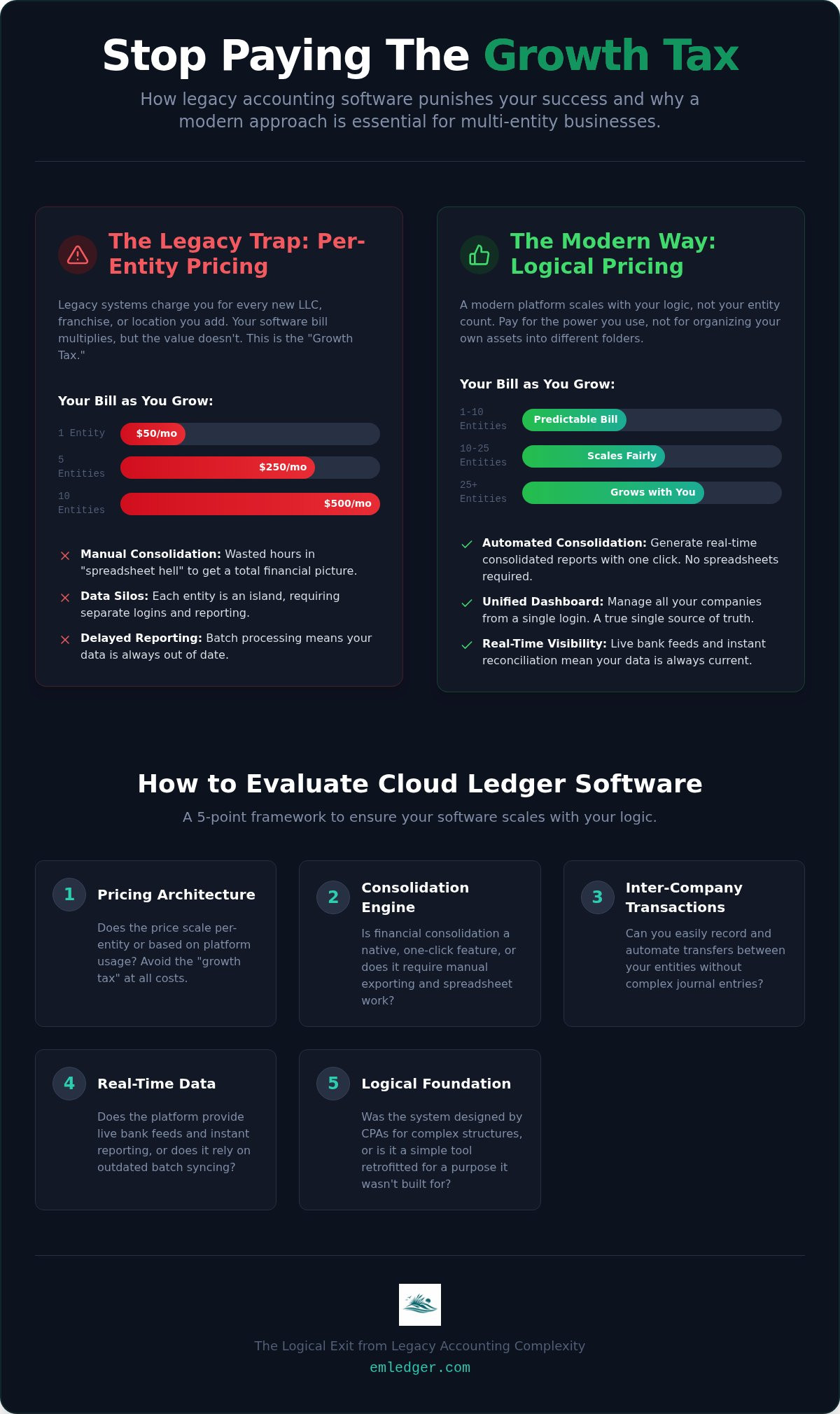
How to Evaluate Cloud Ledger Software: A 5-Point Framework
Choosing software based on a slick user interface or AI-powered gimmicks is a mistake. You need a tool that respects your business logic and handles the heavy lifting of multi-entity management without the ego. Use this 5-point framework to evaluate cloud ledger software before you sign another contract that drains your resources.
- Step 1: Check the Pricing Architecture. Is it per-user, per-entity, or per-tier? If the provider charges for every new LLC you launch, they're taxing your success. Look for a model that scales based on your actual data needs, not your legal structure.
- Step 2: Verify Multi-Entity Capabilities. Does it handle inter-company eliminations natively? If you have to move data to a spreadsheet to remove internal transfers, the software is failing you. Native logic is non-negotiable.
- Step 3: Assess the Consolidation Speed. Can you generate a group report in seconds or does it take hours? Real-time visibility means seeing the big picture instantly. If there's a delay, your data is already stale.
- Step 4: Audit the Integration Depth. Does it sync with your specific banks and inventory needs? A ledger that doesn't talk to your other tools creates manual work. Ensure the API connections are robust and reliable.
- Step 5: Look for CPA-Led Design. Was it built by someone who actually understands a trial balance? Software designed by marketers looks pretty but breaks when things get complex. Choose a platform built by professionals who have been in the trenches.
Red Flags to Watch Out For
Hidden "add-on" fees are the first sign of a legacy trap. Some providers lure you in with a low base price then charge extra for basic features like bank reconciliation or multi-currency support. Watch out for steep learning curves that require hiring an expensive consultant just to set up your chart of accounts. Finally, check their data export policy. If it's hard to move your data between plans or out of the system, you're a hostage, not a customer.
The Scalability Test
Will this software still make sense when you have 5x the transactions and 3x the entities? Many founders pick a tool that works for one LLC but crumbles under the weight of a holding company. Your software should simplify your life as you grow, not make it more complicated. You can compare multi-entity solutions to see which platforms actually support expansion without the "Growth Tax."
Stop settling for legacy limitations and start using a system designed for your ambition. If you're ready for a logical exit from accounting complexity, view our fair pricing tiers and see how we scale with your business.
EmLedger: The Logical Exit from Legacy Accounting Complexity
EmLedger isn't just another SaaS tool. It's a refusal to accept a broken status quo. We built this platform because our founder, a CPA, was tired of watching ambitious operators get punished by the "Growth Tax." Legacy cloud ledger software providers shouldn't view your new LLC as a fresh revenue stream to be exploited. They should view it as a logical extension of your business. We designed EmLedger for the serial entrepreneur, the holding company founder, and the franchise owner who needs enterprise power without the corporate ego or the predatory pricing.
You shouldn't need a team of consultants to understand your total cash position. Our platform provides a unified interface for bank reconciliation across all your entities. It automates the "due to/due from" entries that typically kill productivity and create year-end nightmares. The result is total financial visibility, faster monthly closings, and books that are actually ready for a professional review. You get the clarity of a single ledger with the legal protection of multiple entities.
Choosing Your Path: Solo, Growth, or Scale
We don't believe in one-size-fits-all pricing that hides the true cost of expansion. Our tiers are built to match your stage of growth, not to trap you in a per-entity cycle. The Solo Plan provides essential ledger power for the single-entity founder who wants a professional foundation. As you expand, the Growth Plan unlocks consolidated reporting and multi entity accounting capabilities. For complex operators, our Scale Plan offers advanced inventory management and the full suite of inter-company transactions logic. You choose the tier that fits your complexity. We handle the rest.
Ready for a Better Way to Manage Your Books?
Stop settling for software that treats your success like a taxable event. It's time to manage your financials like the professional you are. You can read more about our philosophy in our guide on Accounting Software Without Per-Entity Pricing. If you're ready to see how logic-based accounting can transform your operations, See the EmLedger Features in Action today. Don't let legacy complexity hold your portfolio back. Switch to a cloud ledger software that scales as fast as you do.
Take Control of Your Financial Logic in 2026
Success isn't a taxable event. Your software provider shouldn't treat it like one. We've exposed the legacy "Growth Tax" for what it is: a predatory pricing model that punishes expansion. Choosing the right cloud ledger software means prioritizing business logic over corporate marketing fluff. You need native inter-company logic. You need real-time consolidated reporting. You need a platform that scales with your ambition, not your entity count.
EmLedger is the logical alternative. It's built by a CPA for real-world business operators who are tired of hidden costs. Our users save over 10 hours a month on manual spreadsheets through automated consolidated reporting. We've eliminated per-entity fees on our Growth and Scale plans to ensure your overhead stays predictable. Stop the manual consolidation hell. Start managing your portfolio with the precision it deserves.
Stop Paying the Growth Tax—Get Started with EmLedger
Take the next step toward total financial visibility. Your business deserves a clean, professional foundation.
Frequently Asked Questions
What is the difference between a general ledger and cloud accounting software?
A general ledger is the master record of every financial transaction your business makes. Cloud accounting software is the technology that hosts and manages that record. Legacy systems often lived on local hard drives and required manual backups. Modern cloud ledger software lives on secure, remote servers. It allows for real-time updates, automated bank feeds, and instant accessibility from any device. The software is the tool; the ledger is the data.
Does EmLedger support multi-entity accounting without per-company fees?
Yes, EmLedger eliminates the "Growth Tax" by using tiered plans instead of charging for every individual company you add. Our Growth and Scale plans allow you to manage multiple legal entities under a single subscription. You pay for the platform's features and your total transaction logic, not for the number of LLCs you own. It's a fair model designed to support expansion without financial penalties or administrative friction.
Can I consolidate financials from multiple LLCs into one report?
You can generate consolidated reports across all your entities with a single click. EmLedger replaces manual spreadsheet merging with automated logic that pulls data from every sub-entity instantly. This creates a master P&L or Balance Sheet that reflects your total cash position and liabilities. It removes the risk of manual entry errors and saves you the hours typically spent on VLOOKUPs and manual data entry.
Is my data secure in a cloud ledger system?
Your data is protected by enterprise-grade encryption and automatic, redundant backups. Professional cloud ledger software is generally more secure than local hard drives because it includes multi-factor authentication and constant security monitoring. We handle the complex infrastructure so you don't have to hire a dedicated IT team. Your financial records stay in a high-security environment that meets modern data protection standards and compliance requirements.
How does inter-company transaction automation work?
The system identifies transfers between your entities and creates matching entries in both sets of books automatically. It tracks "due to" and "due from" balances to keep your inter-company loans accurate without manual journal entries. When you run a consolidated report, the software performs eliminations to ensure internal revenue doesn't artificially inflate your total profit. It's professional-grade logic that keeps your books clean and your CPA happy.
Do I need a CPA to set up my cloud ledger software?
You don't need a CPA to set up EmLedger, but our platform is built by one to ensure the logic is sound. The interface is intuitive enough for a founder to navigate, yet robust enough for a professional to trust. We provide a clean chart of accounts structure that respects standard accounting principles. It's designed to be used by entrepreneurs who want to understand their own numbers without the corporate-speak.
Can I manage inventory across multiple locations with EmLedger?
Yes, our Scale Plan includes advanced inventory management designed for multi-location and multi-entity operations. You can track stock levels, movements, and valuations across different entities and physical sites in one unified interface. This ensures your ledger matches your physical reality at all times. It's the logical way to manage a complex supply chain without losing visibility or accuracy across your entire business portfolio.
What happens to my data if I decide to switch plans or platforms?
Your data belongs to you, and you can export it at any time. If you decide to switch plans or move to a different platform, we provide standard export formats that respect your financial history. We don't believe in data hostage situations or technical lock-in. Our goal is to earn your business every month through performance and fair pricing. You always have a clean, logical exit from our system.


