

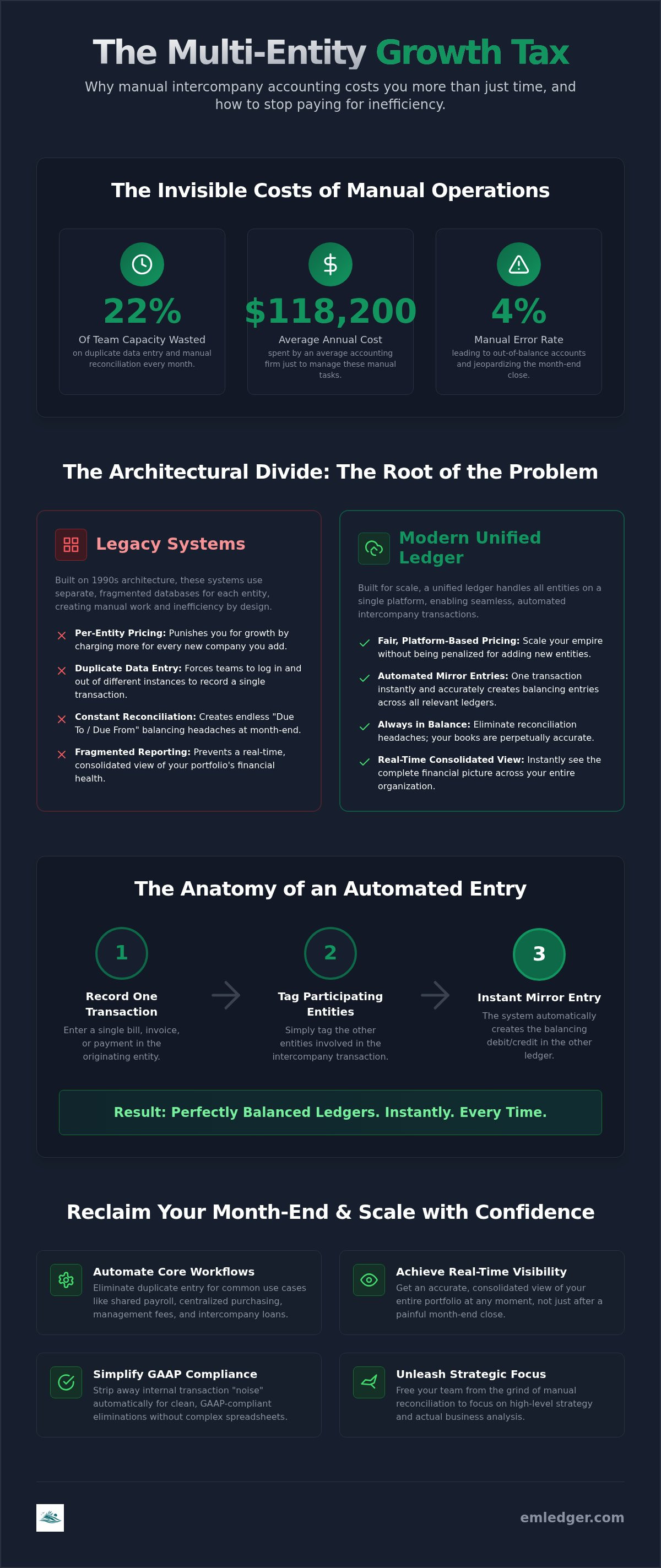
Every time you add a new entity to your portfolio, your accounting software sends you a bill. It's the multi-entity tax, a pricing model that punishes growth while offering nothing but more manual labor in return. If you aren't using automated intercompany accounting, you're likely stuck in a cycle of duplicate data entry that consumes up to 22% of your team's capacity every month. It's an inefficient system where manual error rates often hit 4%, leaving your books in a constant state of flux and your month-end in jeopardy.
You already know the frustration of chasing out-of-balance accounts and spending days on manual eliminations. It's a grind that leaves no room for high-level strategy or actual business analysis. This guide will show you how to eliminate that friction and regain total control over your multi-entity finances. We'll explore how to implement one-click entries, achieve real-time visibility across every branch, and finally stop the manual reconciliation scam for good.
Key Takeaways
- Stop paying the "growth tax" that legacy software charges for every new entity you add to your portfolio.
- Understand how automated intercompany entries create instant, balancing mirror transactions across multiple ledgers.
- Identify why fragmented database architectures are the root cause of out-of-balance accounts and manual reconciliation headaches.
- Simplify GAAP-compliant eliminations by stripping away internal noise without the need for high-priced enterprise software.
- Reclaim your month-end by eliminating duplicate data entry and achieving real-time visibility across your entire multi-entity structure.
The Invisible Cost of Manual Intercompany Transactions
Manual entry is a profit killer. Plain and simple. When you manage multiple entities, every manual transaction is a ticking time bomb. It isn't just a chore; it's a massive financial liability. One out-of-balance entry creates a ripple effect that distorts your consolidated reporting and forces your team into a defensive crouch. You aren't building a business. You're managing a mess.
This is the "Growth Tax." Legacy software providers love your success because they profit from it. Every time you expand, they charge you more. They want you to stay manual because it justifies their complex, per-entity pricing models. Without automated intercompany workflows, you're stuck paying for software that actively hinders your ability to scale. Implementing automated intercompany entries isn't just about speed; it's about accuracy and reclaiming your sanity.
The Spreadsheet Trap and the Month-End Nightmare
Spending 10 or more hours on Intercompany accounting every month-end is a failure of logic. It's a sign that your system is broken. Spreadsheets are where financial truth goes to die. They are fragile, disconnected, and prone to human error. If your financial data lives in a workbook named "Final_v3_COPY_DO_NOT_DELETE," you're one broken formula away from a reporting disaster.
The hidden cost is staggering. Research shows that manual reconciliation consumes 22% of an accounting firm's capacity. The average firm spends $118,200 per year on this task alone. You end up hiring more bookkeepers just to manage the volume of manual entries. This isn't scaling; it's bloating. You're adding overhead to fix problems that shouldn't exist in the first place.
Predatory Pricing: Why Your Software Wants You to Stay Manual
Legacy systems are built on 1990s architecture. They use separate databases for every entity. This fragmentation is the root cause of your accounting headaches. It forces you to "switch companies" just to record a simple transfer. These companies charge per entity because their code can't handle anything else. They position automation as a high-priced luxury reserved for the "Enterprise" tier.
It's a scam. At EmLedger, we built a different way. Our system was built by a CPA who understands the granular headaches of multi-entity management. The Inter-Company Transactions feature is a core part of how we operate. We offer one platform, multiple entities, and zero nonsense. You get real-time visibility without the predatory fees found on our pricing page. It's time to stop paying the growth tax and start using a system designed for operators who value their time.
How Automated Intercompany Entries Actually Work
Automated intercompany accounting is the instant, programmatic creation of balancing entries across multiple entities. It's the end of the manual "Due To/Due From" dance. In a legacy system, you record a payment in Entity A, log out, log into Entity B, and record the receipt. It's repetitive. It's slow. It's a waste of talent. With automated intercompany logic, one transaction triggers two ledgers simultaneously. We call these "Mirror Entries."
This isn't just about convenience. It's about compliance. Precise record-keeping is a legal requirement under U.S. regulations on intercompany transactions. If your sides don't match in real-time, you're building a house of cards. Synchronization must happen at the moment of entry, not at the end of the month in a batch process. Real-time sync ensures that your consolidated view is always accurate, not just "accurate enough" for a Tuesday.
The Anatomy of an Automated Intercompany Entry
The process starts with entity tags. When you enter a bill or an invoice, you tag the participating entities. The system recognizes the relationship immediately. It doesn't wait for a human to remember the offsetting entry. Instead, it generates the corresponding debit or credit in the receiving entity's ledger. Both sides balance instantly. No more hunting for that missing $500 transfer on the 30th. It's clean, logical, and mathematically sound.
Common Use Cases for Automation
The practical applications are endless for a growing empire. Consider shared payroll. If your holding company pays the staff for three different LLCs, the system should allocate those costs automatically. Centralized purchasing is another win. Buy inventory in bulk through one entity and distribute the costs across the subsidiaries without touching a single spreadsheet.
Automation also handles the "internal noise" of management fees and intercompany loans. These are often the first things to go out of balance in a manual system. By using automated intercompany tools, you ensure every loan has a matching liability and every fee has a matching expense. If you're tired of the manual grind, it's time to see how inter-company transactions can streamline your entire workflow.
Unified Ledgers vs. Fragmented Databases: The Architectural Truth
Most accounting software is a dinosaur. It's built on 1990s architecture that treats every business entity as a separate island. If you have to "switch companies" in your software just to view another set of books, your system is broken. It's a sign of a fragmented database structure that forces you to act as a human bridge between isolated silos. This fragmentation is the primary reason why automated intercompany workflows fail in legacy systems. You aren't automating; you're just managing a series of digital patches.
A Unified Ledger is the only rational solution. It provides a single logic layer where all entities coexist. This architecture allows for 100% accurate automated intercompany reconciliation because there is no gap to bridge. The data doesn't move between databases because it all lives in the same environment. It's a cleaner, faster, and more reliable way to run a multi-entity empire.
The Fragmented Database Flaw
Separate databases are the root cause of your accounting headaches. When entities live in isolation, they require manual "bridge" entries to communicate. This creates massive data integrity risks. If a sync fails or a user makes an error in one database, the entire consolidated picture is compromised. You're left chasing ghosts at month-end. Legacy giants like NetSuite and QuickBooks struggle with this because their core code wasn't built for you. It was built for single companies. They bolted on multi-entity features as an afterthought, and you're the one paying for that inefficiency with your time and sanity.
Consider the risks of isolated ledgers:
- Broken syncs that leave "Due To" and "Due From" accounts out of balance.
- Duplicate data entry that invites human error into every transaction.
- Zero real-time visibility across the portfolio without manual exports.
The EmLedger Unified Advantage
We built EmLedger on a single architecture. This means you can manage multi-entity accounting without ever leaving your dashboard. There's no logging out. There's no switching companies. You have total visibility and total control. This single-source-of-truth approach enables instant consolidated reporting. Because the data isn't fragmented, the consolidation is just a simple mathematical calculation that happens in real-time.
This is scalability that doesn't require a software migration every two years. Most businesses outgrow their software because the architecture can't handle the complexity of new entities. EmLedger is different. Whether you have two entities or twenty-five, the logic remains the same. It's a system designed for operators who value their time and refuse to pay the "growth tax" imposed by legacy software vendors.
Mastering Intercompany Eliminations Without the Enterprise Price Tag
Eliminations are not magic. They are simple subtraction. Legacy ERP providers treat them like a dark art to justify high prices and complex implementation fees. If Entity A sells services to Entity B, that revenue is just internal noise. GAAP requires you to strip away these intercompany profits and losses to present an honest picture to lenders and investors. You need clean consolidated financials, not a bloated bottom line based on internal transfers.
By using automated intercompany software, you create a dedicated elimination layer that works while you sleep. This layer identifies internal transactions and zeroes them out automatically. It handles intercompany loans and settlements in minutes instead of days. Intercompany loans are a classic trap for the manual accountant. One entity lends, another borrows, and suddenly your "Due To" doesn't match your "Due From." Automated intercompany tools ensure every settlement is tracked and every interest accrual is mirrored. You get the same accuracy as a $100,000 system without the predatory contract.
The 3-Step Elimination Framework
Logic should dictate your workflow, not software limitations. A professional elimination process follows a predictable path:
- Identify: Tag every transaction at the point of entry. No more guessing at month-end. If it's intercompany, the system knows it before the ink is dry.
- Calculate: The system sums every internal dollar across your entire group. It aggregates revenue, expenses, and asset transfers into a single view.
- Eliminate: One click generates the elimination ledger. This keeps your individual entity books clean for local filing while providing the consolidated truth for management.
This framework ensures your balance sheet reflects reality. It removes the risk of double counting assets or liabilities that only exist within your own ecosystem.
Audit-Proofing Your Intercompany Books
Auditors hate adjusting entries that lack source documentation. Manual spreadsheets are a massive red flag. With an automated system, every elimination has a clear audit trail back to the original transaction. This makes tax season significantly less painful. You aren't just guessing; you're proving. Automated software tracks the who, what, and when of every internal move, leaving no room for ambiguity.
Ensuring your entity management stays compliant with GAAP standards is non-negotiable for a growing empire. You need a system that enforces consistency across every ledger. Don't let your expansion become a liability. It's time to stop the manual grind and start using consolidated reporting that actually works for your business.
Scaling Your Empire with EmLedger Automation
Stop paying the "Growth Tax." It's a parasitic pricing model designed to punish your success. Legacy software companies want a piece of every new LLC you form. They charge you more for the "privilege" of adding an 11th entity to a system that already struggles to balance. It's a scam that forces you to choose between accurate data and a reasonable software bill. You didn't build a holding company to fund a software vendor's bloated marketing budget. You built it to scale.
EmLedger is the logical choice for serial entrepreneurs who value efficiency over corporate fluff. We don't punish you for expanding. Our automated intercompany architecture is built for the operator who wants to add entities without adding headcount. Research shows that manual bank reconciliation consumes 22% of an accounting firm's capacity. For a multi-entity business, that translates to thousands of dollars in wasted labor every year. By switching to automated intercompany workflows, you can recover that capacity and focus on your next acquisition.
Reclaim your time. Ask yourself what you would do with 10 extra hours every month. You could analyze new deals, optimize your tax strategy, or actually take a weekend off. Automation isn't just a feature. It's the only way to escape the manual reconciliation grind and lead your empire with clarity.
Why Founders Choose EmLedger Over Legacy Giants
Legacy giants like NetSuite charge thousands in monthly base fees plus implementation costs that can exceed $50,000. They make automation sound like a dark art. We make it common sense. EmLedger offers zero per-entity fees. You can scale from 10 to 20 entities without your software bill doubling. It's a rational calculation for a rational business owner.
Our CPA-built logic ensures that your inter-company transactions just work. There are no "bridge" entries or manual syncs. We've replaced the fragmented database model with a unified ledger that handles the complexity for you. It's professional-grade accounting stripped of the enterprise-level nonsense.
Your Next Logical Step
Evaluate your current manual overhead honestly. If your team is spending days on "Due To/Due From" accounts, you're losing money. You're also increasing your risk. Manual data entry has an error rate of 1-4%. In a multi-entity structure, those errors compound. Automation can reduce those processing errors by up to 90%.
Review the EmLedger features designed specifically for multi-entity growth. Whether you're on our Solo Plan, Growth Plan, or Scale Plan, you get the tools you need to stay in control. Check out our pricing and see the savings for yourself. It's time to stop the manual reconciliation scam and start scaling with a system that actually works for you.
Reclaim Your Month-End and Scale Without Friction
The manual reconciliation grind isn't a necessary evil. It's a symptom of outdated architecture and predatory pricing. You've seen how fragmented databases force your team into a cycle of duplicate entry and out-of-balance accounts. By implementing automated intercompany workflows, you remove the human error that kills your team's capacity. You stop acting as a bridge between silos and start acting as a leader of a unified empire.
EmLedger is CPA-designed for multi-entity founders who value their time. We've stripped away the "growth tax" and replaced it with logic that works. You get instant consolidated reporting and a no per-entity pricing model. It's time to stop paying for software that holds you back. Start using a system that scales as fast as your ambitions.
Your team deserves better than 10 hours of manual spreadsheet work every month. You deserve a clear, real-time view of your entire portfolio. View EmLedger Pricing and Stop the Growth Tax. It's the only rational choice for a growing business.
Frequently Asked Questions
What is automated intercompany accounting?
Automated intercompany accounting is the programmatic creation of balancing ledger entries across multiple legal entities. When you record a transaction in one entity, the software instantly generates the corresponding mirror entry in the other. This eliminates the need for manual data entry in separate databases. It's a logical architecture that treats your portfolio as a single ecosystem rather than a collection of isolated silos, ensuring your books balance every single time without manual intervention.
How does automated intercompany reconciliation save time?
It recovers up to 22% of your accounting capacity by removing the need for manual matching and verification. Instead of spending 10 or more hours every month-end chasing out-of-balance "Due To" and "Due From" accounts, the system ensures both sides balance at the point of entry. You move from a reactive, defensive posture to real-time financial visibility without hiring additional bookkeepers just to manage the volume of manual entries.
Does EmLedger support intercompany eliminations?
Yes, EmLedger provides a dedicated elimination layer to strip away internal profit and loss noise. This feature allows you to identify and zero out intercompany revenue and expenses with one click. It ensures your consolidated financials comply with GAAP standards by removing the double-counting of assets or liabilities that only exist within your internal group structure. It's a clean, automated way to produce honest financials for lenders and investors.
Do I need a CPA to set up automated intercompany entries?
No, the system is built with CPA-designed logic that is accessible to any business operator. While professional oversight is smart for tax strategy, the technical setup of automated intercompany workflows is intuitive. You simply tag the entities involved in a transaction. The software handles the complex debits and credits in the background, ensuring your ledgers remain mathematically sound. You get enterprise-level accuracy without the need for a high-priced consultant or specialized software training.
Can I track intercompany loans between my LLCs?
Absolutely. Tracking intercompany loans is a core function of the system. Every time one entity lends money to another, the software creates a matching asset and liability. This keeps your internal debt balances synchronized in real-time. You avoid the month-end nightmare of one LLC showing a loan receivable while the other has no matching payable on its books. It's a rational way to manage internal capital flows without the risk of out-of-balance ledgers.
How does automated intercompany affect consolidated reporting?
It makes consolidated reporting instantaneous and accurate. Because all transactions are mirrored and tagged at the source, the system doesn't need to perform complex data migrations or manual exports. You get a real-time, bird's-eye view of your entire portfolio's performance. This visibility is the logical result of an architecture that refuses to fragment your financial data into isolated databases. It turns consolidation from a multi-day ordeal into a simple, automated mathematical calculation.
Is there a limit to how many entities I can automate?
There is no functional limit to the number of entities you can manage. Our Scale Plan is designed specifically for high-volume operators with 11 to 25 entities, and we offer custom solutions beyond that. Unlike legacy software that punishes expansion with per-entity fees, our tiered pricing model encourages growth. You can add your next LLC without a predatory price hike. It's a system built for ambitious serial entrepreneurs who value transparency and scalability.
How do automated intercompany entries handle different currencies?
The system applies real-time exchange rates to ensure both sides of the transaction balance across different functional currencies. It automates the calculation of foreign exchange gains or losses during the reconciliation process. This ensures that your consolidated reports remain accurate even when your entities operate in multiple global markets. It removes the manual math usually required for multi-currency reconciliation, allowing you to manage a global empire with the same ease as a local one.


