

Every time you file a new LLC, your software provider gets a raise. It's a "Growth Tax" that punishes ambition. You're doing the hard work of scaling your portfolio, yet legacy platforms demand a linear price hike for every single entity you add. It's a logic-free model that leaves you stuck in a cycle of manual Excel consolidations and siloed data because the cost of a unified view is simply too high.
We agree that your software costs should be based on features and scale, not your legal structure. Finding accounting software without per-entity pricing is the only way to protect your margins as you grow. You shouldn't have to choose between financial clarity and a reasonable bottom line. It's time to stop paying enterprise-level ego fees for tools that should be standard in 2026.
This article will show you how to break free from the per-company subscription trap. You'll discover how to move toward a tiered pricing model that supports multiple LLCs without tripling your overhead every time you expand. We will also explore how automated consolidated reporting and inter-company transaction features can replace your manual spreadsheets, giving you back your time and your sanity.
Key Takeaways
- Identify the "Growth Tax" legacy platforms impose and why linear pricing models are a logical failure for multi-entity operators.
- Learn how to identify accounting software without per-entity pricing that scales based on your business volume, not your entity count.
- Replace manual month-end Excel consolidations with automated reporting that aggregates P&Ls and balance sheets across all your LLCs in real-time.
- Stop the "invisible profit killer" by automating inter-company transactions to ensure your due-to and due-from accounts always balance perfectly.
- Discover a CPA-built alternative to legacy software that offers tiered plans designed specifically for managing multiple businesses under one login.
The Hidden Cost of Growth: Why Per-Entity Pricing is a Scam
Scaling your business should feel like a victory. Instead, legacy software providers treat your success like a taxable event. Every time you register a new LLC for asset protection or launch a fresh brand, your software bill spikes. This is the "Growth Tax." It is a linear, relentless increase in overhead that has nothing to do with the value you receive. It is a logic-free model designed for one thing: maximizing the vendor's profit at the expense of your margins.
Legacy platforms like QuickBooks and Xero rely on per-entity pricing to inflate their Average Revenue Per User (ARPU). They know that once you're in their ecosystem, you're less likely to leave. They bank on your inertia. This model creates a psychological toll known as subscription fatigue. Serial entrepreneurs find themselves managing dozens of separate billing cycles and logins just to see their total cash position. Worse, these fees often discourage founders from using proper legal structuring. When a new entity costs an extra $600 a year in software alone, many business owners cut corners on asset protection. You shouldn't have to choose between legal safety and software affordability. Finding accounting software without per-entity pricing isn't just a cost-saving move; it's a strategic necessity for 2026.
The Math of the Growth Tax
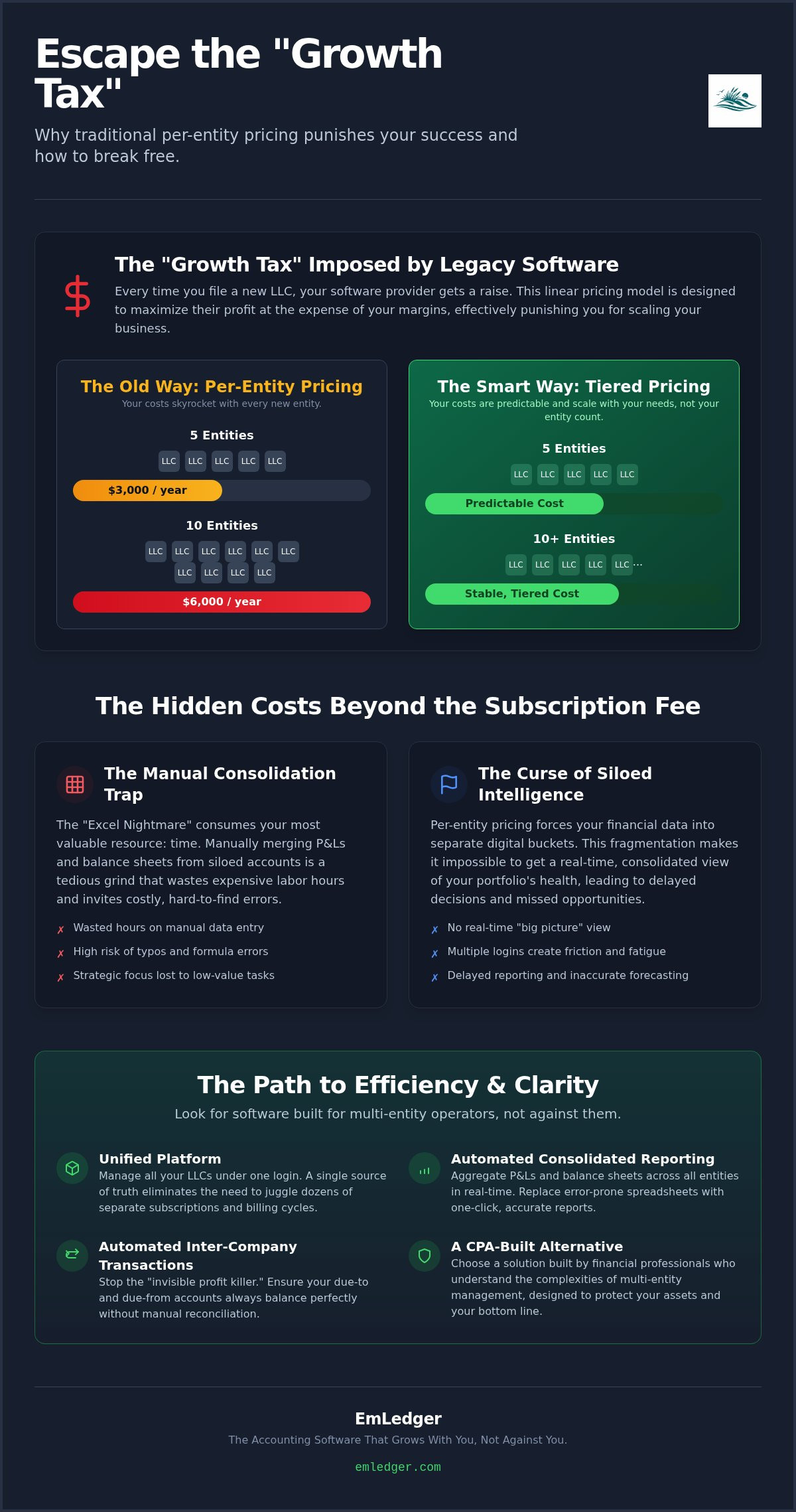
Let's look at the numbers. If you manage five entities on a standard $50 per month plan, you're burning $3,000 every year. That is $3,000 before you've paid a single employee or bought a cent of inventory. If you scale to 10 entities, that bill jumps to $6,000. In a unified tiered plan, your costs stay flat or increase marginally as you grow. The opportunity cost of these fees is staggering. That capital belongs in your marketing budget or your hardware upgrades. It does not belong in the pockets of legacy software CEOs who haven't updated their core architecture in a decade.
Siloed Data vs. Unified Intelligence
Per-entity pricing doesn't just hurt your wallet; it kills your efficiency. Your financial data ends up trapped in separate digital buckets. When your entities are siloed, you lose the ability to see the "big picture" in real time. Separate logins lead to missed errors. They cause delayed reporting. They force you to spend days in Excel just to understand your consolidated health. Larger corporations use complex Enterprise Resource Planning (ERP) systems to avoid this exact problem. You deserve that same level of unified intelligence without the enterprise-level price tag. A single source of truth across all your brands is the only logical way to operate. You can view the entity management features that allow for this level of control without the per-company penalty.
The Manual Consolidation Trap: Beyond the Subscription Fee
The subscription invoice is a distraction. The real drain on your resources happens after the bill is paid. When you use software that silos your entities, you're forced into the "Excel Nightmare." You spend days every month-end manually merging P&Ls. You export CSVs. You copy and paste. You pray the formulas don't break. It's a manual grind that wastes expensive labor hours and keeps you stuck in the weeds of data entry instead of high-level strategy.
"Free" or cheap software often carries the highest price tag in human capital. If your team spends ten hours a month consolidating data, you're paying a massive hidden salary for a task that should be automated. This manual entry also invites disaster. One typo in a spreadsheet can lead to a massive financial misstatement. You can't scale a business on a foundation of shaky data entry. Choosing accounting software without per-entity pricing isn't just about the monthly fee; it's about reclaiming your time and ensuring accuracy across your entire organization.
The Spreadsheet Chaos Factor
Tracking the complexities of intercompany transactions in a flat file is a recipe for failure. Due-to and due-from accounts rarely balance when managed by hand. Formulas drift. Links break. Data becomes stale the moment it's exported. Modern consolidated financial reporting software eliminates this risk by pulling data directly from the source. It automates the eliminations that usually take hours of mental gymnastics. This isn't a luxury; it's a requirement for any operator managing more than two entities.
Losing the "Big Picture" Perspective
Strategic decisions require real-time data. If you have to wait for a manual consolidation to see your total cash position, you're driving blind. You cannot pivot. You cannot reallocate capital. You cannot seize opportunities because your data is stuck in last month. Financial visibility is the ability to see all entity data in one dashboard. With a single click, you should see the health of your entire portfolio. Stop settling for fragmented views. It's time to switch to accounting software without per-entity pricing that treats your portfolio as a single, logical unit. You can explore how consolidated reporting changes the game for multi-entity operators who are tired of the spreadsheet trap.
What to Look for in Multi-Entity Accounting Software
Stop settling for software that treats your LLCs like separate, unrelated customers. If you're managing a portfolio, you need a platform that understands the relationship between your companies. You need accounting software without per-entity pricing that functions as a single command center. Legacy vendors want you to believe that "multi-entity" is a premium enterprise feature. It isn't. It is a basic requirement for any modern operator who values logic over legacy limitations.
The first non-negotiable is a unified dashboard. You shouldn't need a password manager just to check your bank balances across five different brands. One login. One screen. Full control. Next, look for automated consolidation. Real-time P&L and Balance Sheet aggregation shouldn't be a manual export or a third-party plugin. It should be the core functionality. If your software doesn't eliminate inter-company transactions automatically, it's not multi-entity software. It's just a collection of siloed ledgers. Finally, demand tiered pricing. Your costs should scale based on your business complexity and transaction volume, not the number of legal wrappers you use for asset protection.
Entity Management Without Friction
For holding companies and franchises, entity management must be frictionless. You need the ability to toggle between different brands or locations without logging out and back in. It's about operational velocity. You also need role-based access control. Your manager at Location A shouldn't see the books for Location B. Your regional director should see the consolidated view of their specific group. This is how you maintain security while empowering your team to move fast. It is a common-sense approach to hierarchy that legacy platforms ignore to protect their per-seat and per-entity revenue models.
Professional Grade Inventory and Reconciliations
E-commerce brands face a unique challenge: inventory that often spans across multiple entities or warehouses. Your inventory management systems must provide a global view of stock levels to prevent over-selling and optimize procurement. Simultaneously, you need bank reconciliation software that can handle dozens of accounts at once. Don't waste time reconciling one entity at a time. Batch it. Automate it. Move on to higher-value tasks. When you're ready to scale, your data should move with you. Moving from a Solo Plan to a Growth Plan should be a simple billing update, not a data migration project. You're building a business, not a software integration firm.
Efficiency Gains: Automated Inter-Company Transactions
Managing multiple LLCs creates a complex web of internal loans, shared expenses, and management fees. In legacy systems, these are the "invisible profit killer." You spend more time reconciling internal transfers than you do analyzing external growth. This is a logical failure. Your software should understand that your entities are related. If you're using accounting software without per-entity pricing, you shouldn't just be saving on subscription fees. You should be gaining a massive boost in operational velocity through automation.
When your entities are siloed, every internal transfer requires manual entry in two different ledgers. You record the expense in one. You record the income in the other. You hope the "due to" and "due from" accounts match at the end of the month. They rarely do. This creates a massive audit risk and a reconciliation nightmare that scales with every new entity you add. A modern, unified ledger solves this by treating your entire portfolio as a single, intelligent ecosystem.
Eliminating the "Due To / Due From" Headache
The solution is inter-company transaction software that functions with mirror-entry logic. When you record a transaction in Entity A that involves Entity B, the software should automatically create the corresponding entry in the second entity. No manual cross-referencing. No logging out and back in. The "due to" and "due from" accounts stay in perfect balance because they are managed by the same underlying logic. This saves bookkeepers dozens of hours every month. It turns a complex corporate structure into a manageable, transparent network. You can see how this works by exploring the inter-company transaction features designed for high-growth operators.
Automated Eliminations for Clean Reporting
To see your "true" profit, you must eliminate inter-company revenue. If Entity A charges Entity B a management fee, that isn't external profit. It's just moving money from your left pocket to your right. Combined reporting simply mashes the data together, often double-counting this internal revenue. Consolidated reporting is different. It uses automated inter-company reconciliation to strip away these internal layers. This gives you a clear view of your actual performance with outside customers. It keeps your books audit-ready and ensures your financial statements reflect reality, not just internal accounting gymnastics. Stop fighting your software and start using a system built for the way you actually do business.
EmLedger: Built by CPAs for Multi-Entity Operators
EmLedger didn't start in a boardroom. It started in the ledger of a frustrated CPA who was tired of watching clients get fleeced. We saw founders building brilliant multi-entity portfolios only to be penalized by their own tools. Legacy platforms treat every new LLC like a fresh revenue stream for themselves. They don't care about your consolidated health. They only care about their per-company subscription count. We decided to build accounting software without per-entity pricing because the old way is mathematically lazy and ethically bankrupt. It's time for a system that rewards growth instead of taxing it.
Tiered pricing is the only logical model for 2026. It respects your resources. It values your efficiency. Instead of multiplying your software bill by your entity count, we scale based on the complexity of your operations. This is about fairness. It's about transparency. It's about giving you a professional-grade platform that doesn't treat your legal structure as a piggy bank. You've done the hard work of building a portfolio; your software should be the engine that drives it, not the anchor that slows it down.
Choosing the Right Plan for Your Stage
You need a plan that fits your current reality, not an enterprise-level ego trip. We’ve designed our tiers to grow alongside your portfolio without any hidden traps. Our transparent pricing ensures that your software costs remain predictable as you scale. You can open a new LLC for asset protection today without worrying about a bill hike tomorrow. We offer three primary paths for operators:
- Solo Plan: Perfect for the founder launching their first few entities and looking for a clean, logical start.
- Growth and Scale: Engineered for established holding companies and franchises that require advanced automation and higher transaction volume.
The EmLedger Advantage
We aren't just another software company. We are accountants who build software. This means our CPA-designed logic ensures your books are always professional-grade and audit-ready. We don't distract you with marketing fluff or useless features. We focus on core accounting power. This includes automated consolidated reporting and inventory management that actually functions across multiple entities. Stop paying the "Growth Tax" to legacy vendors who haven't updated their core architecture in a decade. Join the movement of operators who demand logic, fairness, and transparency. See how EmLedger handles your multiple entities for one fair price.
End the Growth Tax and Reclaim Your Margins
The "Growth Tax" ends here. You've seen the math. Per-entity pricing isn't a business model; it's a penalty for success. Every new LLC you launch should represent a strategic win, not a linear hike in your software overhead. By moving to accounting software without per-entity pricing, you reclaim your margins and your time. You trade the Excel nightmare for automated clarity. You trade siloed data for a single, unified source of truth.
EmLedger was built by a CPA who understands the trenches of multi-entity management. We don't do corporate speak. We do logic. Our platform includes consolidated reporting as a standard feature, not a premium add-on. It is a no-nonsense tiered pricing structure designed for real operators who value transparency. It is time to stop paying for separate logins and start paying for performance. Your portfolio deserves a system that scales as fast as you do.
Stop paying the growth tax, view EmLedger pricing now.
Frequently Asked Questions
Does accounting software without per-entity pricing actually exist?
Yes, EmLedger is built specifically to provide accounting software without per-entity pricing. While legacy platforms like QuickBooks and Xero charge you for every single legal wrapper, we use a tiered model based on features and total scale. This approach eliminates the linear "Growth Tax" that punishes you for properly structuring your assets. It's a logical shift that treats your portfolio as a single, unified ecosystem.
Can I manage 10 different LLCs under one EmLedger subscription?
You can manage multiple entities under a single subscription based on your plan level. For instance, our Growth Plan is designed for operators managing up to 10 entities. You don't need 10 separate logins or 10 separate bills hitting your credit card every month. You simply toggle between entities from one unified dashboard. It's a clean, efficient way to maintain control without the administrative headache of siloed accounts.
How does consolidated reporting work if my entities have different bank accounts?
Consolidated reporting aggregates data from all connected accounts into a single, unified view. Each entity maintains its own bank reconciliation and ledger, but the system pulls that data into a combined P&L and Balance Sheet in real time. You don't have to manually merge spreadsheets or export CSVs. The software handles the heavy lifting, ensuring your total cash position is always visible with one click.
Is it difficult to migrate from QuickBooks or Xero to a multi-entity platform?
Migration is a straightforward process of exporting your trial balances and importing them into our system. We don't believe in data hostage situations. Our team understands the granular details of legacy migrations and helps you move your data quickly. You'll move from fragmented silos to a professional-grade environment without losing your historical integrity. It is a logical exit from the per-company penalty model.
Will my bookkeeper be able to use EmLedger easily?
Your bookkeeper will find the interface intuitive because it follows standard double-entry accounting principles. We didn't reinvent accounting; we reinvented the pricing and the multi-entity workflow. Because it's built by a CPA, the logic is sound and the features are where they should be. Your team will spend less time logging in and out of different accounts and more time on high-value financial analysis.
What is the difference between the Solo, Growth, and Scale plans?
The plans are tiered based on the number of entities and the depth of features your business requires. The Solo Plan is for single-entity founders. The Growth and Scale plans are built for holding companies, franchises, and complex portfolios. These higher tiers include advanced features like automated inter-company transactions and consolidated reporting. You choose the tier that matches your operational complexity, not just your entity count.
Can I handle inter-company loans and transfers automatically?
Yes, our inter-company transactions feature uses mirror-entry logic to keep your books in balance. When you record a transfer in one entity, the software automatically creates the corresponding entry in the other. This eliminates the "due to/due from" nightmare that plagues manual bookkeepers. It ensures your inter-company eliminations are clean and your consolidated reports are audit-ready without any manual intervention.
Does EmLedger offer inventory management across multiple companies?
EmLedger provides integrated inventory management that allows you to see stock levels across your entire organization. This is critical for e-commerce brands and multi-location businesses that share stock or warehouses. You get a global view of your assets without jumping between different logins. It's about unified intelligence. You manage your stock, your sales, and your entities from a single, logical command center.


