

Every new entity you add shouldn't feel like a financial penalty. Most multi-entity operators are trapped in a cycle of "spreadsheet gymnastics" that hide the true health of their business. You're likely spending twenty hours a month stitching together reports that are outdated the second they're finished. This isn't just a nuisance; it's a structural risk to your decision-making. Moving to automated consolidated financial statements isn't a luxury for 2026. It's a requirement for any business that values its time and accuracy.
You know the drill. Month-end arrives and you're buried in browser tabs, fixing broken formulas and chasing inter-company mismatches. It's exhausting, and it's unnecessary. In this guide, you'll learn how to eliminate manual reporting errors and gain real-time visibility across all your business entities with automated consolidation. We'll explore how to achieve zero-effort inter-company eliminations and implement a scalable system that doesn't charge you a "growth tax" for every new LLC you open. It's time to stop paying for the privilege of seeing your own data.
Key Takeaways
- Stop viewing reporting as a delayed history lesson and leverage automated consolidated financial statements for real-time visibility across every entity you own.
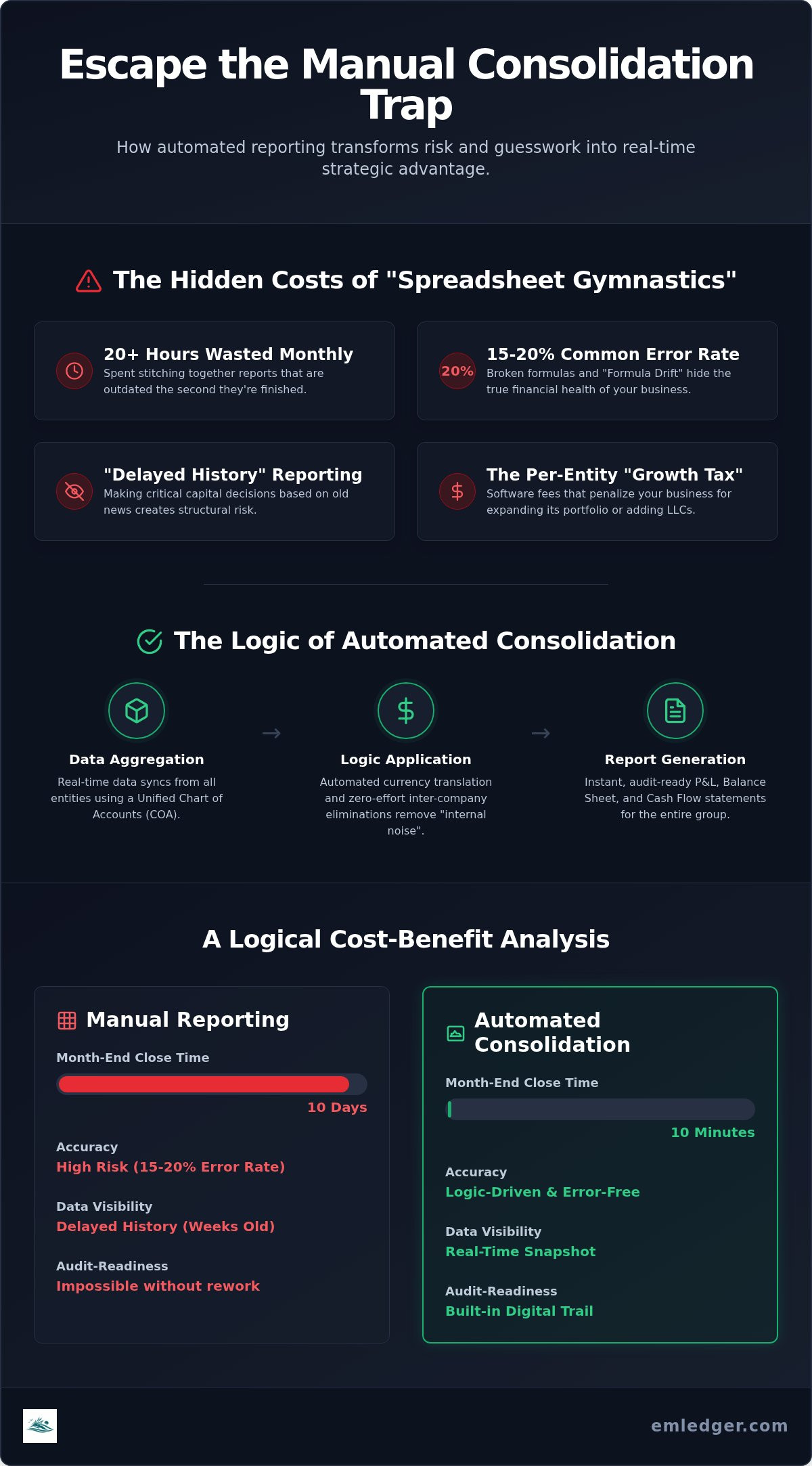
- Slash your month-end close from ten days to ten minutes by replacing manual spreadsheet gymnastics with logic-driven data aggregation.
- Neutralize the 15-20% error rate common in complex manual workbooks through automated inter-company eliminations and unified Chart of Accounts mapping.
- Reject the "growth tax" of per-entity software fees that penalize your business for expanding its portfolio or adding new holdings.
- Build a scalable financial engine by establishing clear inter-company rules that handle complexity without adding unnecessary administrative headcount.
The Manual Consolidation Trap: Why Spreadsheets are Killing Your Growth
Stop pretending your Excel workbook is a strategy. If you're still clicking 'Export to CSV' to see how your holdings are performing, you aren't managing a business; you're managing a hobby. A Consolidated financial statement shouldn't be a static historical record. True automated consolidated financial statements provide a real-time data sync that pulls directly from your entities. It's the difference between looking at a live GPS and a paper map from 1994. One tells you where you are; the other tells you where you used to be.
You know you've outgrown the manual approach when the 'Month-End Dread' sets in. Look for these three red flags: your inter-company loans never balance on the first pass, you're logging into five different accounts just to check cash, and your reporting is consistently fifteen days late. This delay creates a "Delayed History" that makes agility impossible. You're making critical decisions based on old news, which is a structural risk to your business health.
The emotional toll is just as high as the financial one. Spreadsheet anxiety is that knot in your stomach when a lender asks for a report and you aren't 100% sure the formulas are right. It's the burnout CPAs feel when they spend more time troubleshooting cells than providing strategic advice. It's a weight that founders shouldn't carry, yet many accept it as a cost of doing business. It isn't.
The Hidden Cost of "Manual" Accuracy
Senior accountants shouldn't spend forty hours a month as data entry clerks. It's an expensive waste of talent. Manual systems suffer from 'Formula Drift,' where a single added row breaks a VLOOKUP three tabs away. By the time you catch the error, the board meeting is over. Manual consolidation makes audit-readiness impossible. An auditor wants a digital trail, not a 50MB Excel file held together by hope and complex macros.
Visibility: The Difference Between Guessing and Growing
Delayed reporting is a growth killer. Without a 'Snapshot Reality' of your total cash flow, you'll make poor capital allocation decisions. You might keep cash idle in one entity while another starves for inventory. This 'Blind Spot' hides inter-company imbalances until they become tax liabilities. True consolidated reporting eliminates inter-company transactions instantly. Visibility gives you the confidence to move capital where it creates value.
How Automated Financial Consolidation Works: The Technical Reality
The technical process behind automated consolidated financial statements isn't magic. It's a series of logical data movements designed to eliminate human error. First, the system performs real-time data aggregation. This relies on a unified Chart of Accounts (COA) where every entity speaks the same language. Without this, you're just comparing apples to oranges. Second, for international holdings, the software handles automated currency translation using current market rates. This replaces the manual lookup and conversion errors that plague traditional spreadsheets. Financial reporting automation ensures these steps happen in seconds, not days.
The final stages are where the heavy lifting occurs. The system applies pre-set logic to identify and remove inter-company transactions automatically. Once the data is clean, it generates the primary reports you actually need: the P&L, Balance Sheet, and Statement of Cash Flows. You get a finished product that's ready for stakeholders without the usual forty hours of manual labor. It's a streamlined workflow that turns accounting from a bottleneck into a competitive advantage.
Solving the Inter-Company Elimination Puzzle
Inter-company eliminations are the removal of "internal noise" from your external totals. If Entity A sells a service to Entity B, that isn't a real sale for the group. It's just moving money from one pocket to another. Using inter-company transaction software ensures you aren't double-counting revenue or inflating your assets. It's a common trap that leads to massive overstatements and bad tax planning. In 2026, GAAP requires that all inter-company profits and balances must be fully eliminated to ensure the consolidated statements represent the group as a single economic entity.
Unified vs. Fragmented Ledgers
Most legacy players offer "consolidation" as a clunky add-on. They try to bridge fragmented ledgers with a middleman software layer. This is a recipe for data corruption. EmLedger’s architecture is built as a native multi-entity ledger from day one. This ensures data integrity across 10 or even 50 LLCs. This structure allows you to perform bank reconciliation at the entity level for operational accuracy while reporting at the group level for strategic clarity. It's a logical exit from the complexity of managing multiple logins and disconnected databases. If you're scaling fast, you can compare our plans to see which fits your current entity count.
Automated vs. Manual Reporting: A Logical Cost-Benefit Analysis
The math is simple. If your month-end close takes ten days, you're driving your business through a rearview mirror. By the time you see the numbers, the opportunity to pivot has already passed. Manual systems are inherently slow and dangerously fragile. Most complex spreadsheets carry error rates between 15% and 20%. In contrast, automated consolidated financial statements reduce that error margin to less than 1% while slashing the time-to-close from ten days to ten minutes. You aren't just saving time; you're buying accuracy.
Manual processes rely on human intervention at every step. This creates a bottleneck that stifles growth. When data is siloed in disconnected workbooks, your total cash flow remains a mystery until the final cell is reconciled. Automation removes this friction. It provides a clean, logical path from transaction to report without the risk of a broken formula or a missed export. You get a single source of truth that updates in real-time, allowing you to allocate capital based on facts rather than gut feelings.
Stakeholders and lenders don't want to see an Excel file that was "last modified" two weeks ago. They want live data. Presenting automated reports signals that your business is professional, transparent, and ready for scale. It builds a level of confidence that manual workbooks simply cannot match. If you can't produce a consolidated P&L at the push of a button, you're telling the market that you don't have a handle on your operations.
The "Growth Tax" Calculation
Per-entity pricing is a scam that penalizes serial entrepreneurs for being successful. Legacy software providers often charge upwards of $300 per month for every new entity you add. If you manage ten holdings, you're paying $3,000 monthly just for the privilege of keeping your books. This is a "Growth Tax" designed to extract value from your expansion. EmLedger rejects this model. Our Scale Plan uses flat-tier logic that supports your growth instead of taxing it. You can read more about why we believe this industry standard is broken in our analysis of The Multi-Entity Tax: Why Per-Company Pricing is a Scam.
Scalability: Preparing for Your Next 5 Entities
Technical debt compounds. Starting with a manual process might seem cheap today, but it becomes an expensive nightmare as you grow. Every new LLC adds a layer of complexity that manual spreadsheets can't handle. We call this the "Fragility Factor." If the person who built your master spreadsheet leaves the company, your reporting capability dies with them. Automation turns your accounting from a structural liability into a competitive advantage. It ensures that your five-hundredth entity is as easy to manage as your first. Stop building a house of cards and start building a scalable financial engine.
5 Steps to Implementing Automated Consolidation in Your Business
Transitioning to automated consolidated financial statements is a logical upgrade, not a complex overhaul. It requires a move from feeling your way through spreadsheets to enforcing strict data logic. Most operators fail because they try to automate a mess. Don't be that person. Follow these five steps to exit the spreadsheet trap and reclaim your time.
First, you must clean up your Chart of Accounts (COA). If Entity A calls an expense 'Travel' and Entity B calls it 'Marketing,' your consolidation will break. Second, establish clear inter-company relationship rules. Decide now how loans and service fees flow between entities. Third, connect your bank feeds to a multi-company bank reconciliation tool. This ensures your entity-level data is accurate before it hits the group level. Fourth, set up automated elimination journals to strip out internal noise. Finally, verify the initial output against your old manual reports. This sanity check ensures your logic is sound before you retire the workbooks for good.
Standardizing Your Chart of Accounts
A messy COA is the primary killer of automated reporting. You cannot map what you haven't defined. Use a unified numbering system that works for both your Service LLCs and your Real Estate holdings. A Master COA in 2026 is a centralized, hierarchical template that enforces naming and numbering consistency across all sub-ledgers while allowing for entity-specific local accounts. This structure ensures that every transaction is categorized correctly the moment it happens.
Training Your Team for Real-Time Closing
Stop viewing the 'close' as a monthly event. Shift your team's mindset to continuous accounting. Use automated inter-company entries to reduce the manual bookkeeping workload by 80% or more. The founder's role changes too. Instead of chasing spreadsheets, you should spend ten minutes a week reviewing consolidated dashboards. This real-time oversight allows you to spot cash flow trends before they become crises. If you're ready to stop the manual grind, explore our automated reporting features today.
EmLedger: The No-Nonsense Solution for Multi-Entity Reporting
Most software companies treat automated consolidated financial statements as a luxury add-on reserved for the Fortune 500. They want you to believe that viewing your total cash flow is a "premium" privilege. We disagree. At EmLedger, we built a platform for multi-entity operators because we were the operators. We've lived through the broken formulas, the midnight reconciliations, and the frustration of paying for five different software subscriptions just to run one business. This isn't just accounting software. It's a logical exit from the spreadsheet chaos that's currently holding your growth hostage.
Our Consolidated Reporting feature isn't a secondary module or a clunky integration. It's a core pillar of the architecture. We've removed the technical barriers that make traditional reporting feel like a chore. You get a unified view of your entire portfolio without the manual exports or the version control nightmares. It's time to stop the spreadsheet madness and start seeing your real numbers in real-time. You've built a business to scale; your software shouldn't be the thing that stops you.
Designed for the Growth Stage
If you're managing more than two LLCs, you've likely realized that legacy tools weren't built for you. EmLedger is the logical QuickBooks Online alternative for entrepreneurs who value speed over fluff. We've prioritized the features that actually move the needle: multi-company bank reconciliation, integrated inventory management, and automated inter-company settlements. Because a CPA founded this platform, the logic is sound. The empathy is baked into the code. We know the granular headaches of multi-layered management because we've been in the trenches ourselves.
Your First Consolidated Report in Minutes
Enterprise ERPs promise "total visibility" after a six-month implementation cycle and a six-figure consulting bill. That's a joke. Our "Straight-Shooting" promise is different: you can see your first consolidated P&L in minutes, not months. Whether you're on our Growth or Scale plans, the setup is intuitive and the results are instant. Our "Solo to Scale" pricing logic ensures you can add your next five entities without your software bill exploding. Check out the EmLedger Pricing tiers and decide which path to transparency makes the most sense for your portfolio. Stop guessing. Start growing.
Stop Guessing and Start Scaling
Manual consolidation isn't just slow; it's a structural risk that hides the truth of your business health. You've seen the data. Spreadsheets carry a high error rate that manual checks simply can't catch. By the time you finish a manual report, it's already a historical artifact rather than a strategic tool. Moving to automated consolidated financial statements allows you to reclaim twenty hours a month while gaining real-time visibility across your entire portfolio. It's the logical exit from a system that rewards complexity over clarity.
You don't have to accept the industry's "growth tax" or pay per-entity fees that penalize your success. We built EmLedger with real-time inter-company logic and a CPA's attention to detail to ensure your data stays accurate as you scale. It's time to stop the spreadsheet gymnastics and start making decisions based on facts. End the spreadsheet trap. Start your EmLedger Scale Plan today. Your next entity should be an opportunity, not an administrative burden. Build your scalable financial engine now.
Frequently Asked Questions
What are automated consolidated financial statements?
Automated consolidated financial statements are real-time, unified reports that aggregate data from multiple entities without human intervention. Instead of exporting CSV files and stitching them together in a workbook, the software pulls directly from each sub-ledger to create a single source of truth. This ensures your P&L and Balance Sheet are accurate the moment a transaction is recorded. It turns reporting from a manual chore into a live strategic tool.
How does automation handle inter-company eliminations?
Automation handles inter-company eliminations by applying logic-based rules to identify transactions between your own entities. When Entity A bills Entity B, the software flags these entries and offsets them automatically on the consolidated report. This removes the "internal noise" of moving money between pockets, ensuring your group-level revenue and assets aren't artificially inflated. It's a clean, rational way to handle complex internal accounting.
Can I consolidate entities with different charts of accounts?
You can consolidate entities with different charts of accounts by using a centralized mapping system. While a unified Chart of Accounts is ideal, modern software allows you to map unique local accounts to a standardized group-level template. This ensures that a "Marketing" expense in one LLC and "Advertising" in another both land in the correct category on your consolidated P&L without manual reclassification.
Is automated consolidation better than using Excel?
Automated consolidation is vastly superior to Excel because it removes the structural risk of broken formulas and version control issues. Manual spreadsheets are static, historical, and prone to human error. Automation provides a "Snapshot Reality" that is always current, allowing you to make capital allocation decisions based on live data rather than month-old guesses. It's the only logical choice for a scaling business.
How much does automated consolidation software cost in 2026?
Software costs in 2026 vary, but you should reject any model that charges a "per-entity" fee. Legacy providers often use this pricing to tax your success as you grow. Look for flat-tier plans that allow you to scale your portfolio without your software bill exploding. The goal is to find a rational calculation of value that respects your resources rather than an emotional marketing trap.
Does EmLedger support multi-currency consolidation?
Yes, EmLedger supports multi-currency consolidation for businesses with international holdings. The system automatically translates foreign currency transactions into your primary reporting currency using real-time market rates. This eliminates the manual lookup errors and exchange rate fluctuations that typically plague spreadsheet-based global reporting. It's a clean, logical solution for managing a borderless business without the usual technical headaches.
How long does it take to set up automated reporting for 5+ LLCs?
Setting up automated reporting for 5+ LLCs takes minutes, not the months required by enterprise ERP systems. Once you connect your bank feeds and define your inter-company rules, the system begins syncing data immediately. There are no long implementation cycles or expensive consulting fees. It's designed to be deployed quickly by busy professionals who value their time and need immediate visibility.
Is automated reporting GAAP compliant?
Automated reporting is fully GAAP compliant when the system enforces correct elimination logic and maintains a digital audit trail. By removing manual entry, you actually reduce the risk of non-compliance caused by human error or formula drift. A logical software architecture ensures that your consolidated statements meet all professional standards while remaining ready for a clean, efficient audit at any time.


