

Why are you being penalized for your own success? Every time you close a deal and spin up a new LLC, legacy software giants send you a fresh bill for $140 a month. It's a "growth tax" that turns scaling into a financial punishment. Choosing the right accounting software for real estate investors shouldn't feel like paying a toll for every new asset you acquire. You started with one property and a simple spreadsheet. Now you're managing a portfolio, and your Saturday mornings are spent manually consolidating messy inter-company loans that never quite balance. You know this manual trap is unsustainable.
You deserve a logical exit from this complexity. We've analyzed the 2026 landscape to help you escape the manual reporting cycle and regain real-time visibility across your entire portfolio. You'll discover how to automate inter-company transaction tracking and move to a predictable pricing model that actually supports your expansion. We're breaking down the framework for multi-entity accounting that lets you scale without the overhead bloat. It's time to stop paying for the privilege of growing your business. Let's look at the numbers that actually make sense for your bottom line.
Key Takeaways
- Stop paying a "growth tax" every time you add an LLC by switching to a pricing model that rewards expansion instead of penalizing it.
- Learn why the best accounting software for real estate investors must provide one-click consolidated reporting across your entire holding company.
- Eliminate the headache of manual inter-company loan tracking with automated tools that keep your balance sheets in sync across all entities.
- Move beyond the limitations of entry-level apps and the bloated costs of enterprise suites with a logical, CPA-built solution designed for founders.
- Streamline your monthly reporting by centralizing bank feeds and automating the multi-entity reconciliation process to reclaim your time.
Why Generic Real Estate Accounting Fails for Multi-Entity Investors
Think of your accounting software for real estate investors as the financial engine of your portfolio. If that engine stalls every time you add a new asset, you aren't actually scaling. You're just working harder to stay in the same place. Most people begin real estate investing with a single property and a basic spreadsheet. It feels manageable at first. But when you hit five or ten properties, the "spreadsheet trap" closes. Formulas break. Version control vanishes. You find yourself spending entire weekends manually reconciling entries that should be automated. Spreadsheets are static tools in a dynamic market. They can't handle the multi-layered complexity of a serious portfolio.
The current industry standard is built on a "Growth Tax" model. It's a predatory pricing structure that penalizes you for every new LLC you create. This isn't just a minor inconvenience; it's a strategic bottleneck. Legacy software companies want you to believe that more entities require more money for the exact same set of tools. It's a logical fallacy. The value of the software doesn't multiply based on your legal structure. Your software should be a partner in your growth, not a parasite on your profits. You need a system that rewards your expansion instead of viewing it as a fresh billing opportunity.
The Problem with Per-Entity Pricing Models
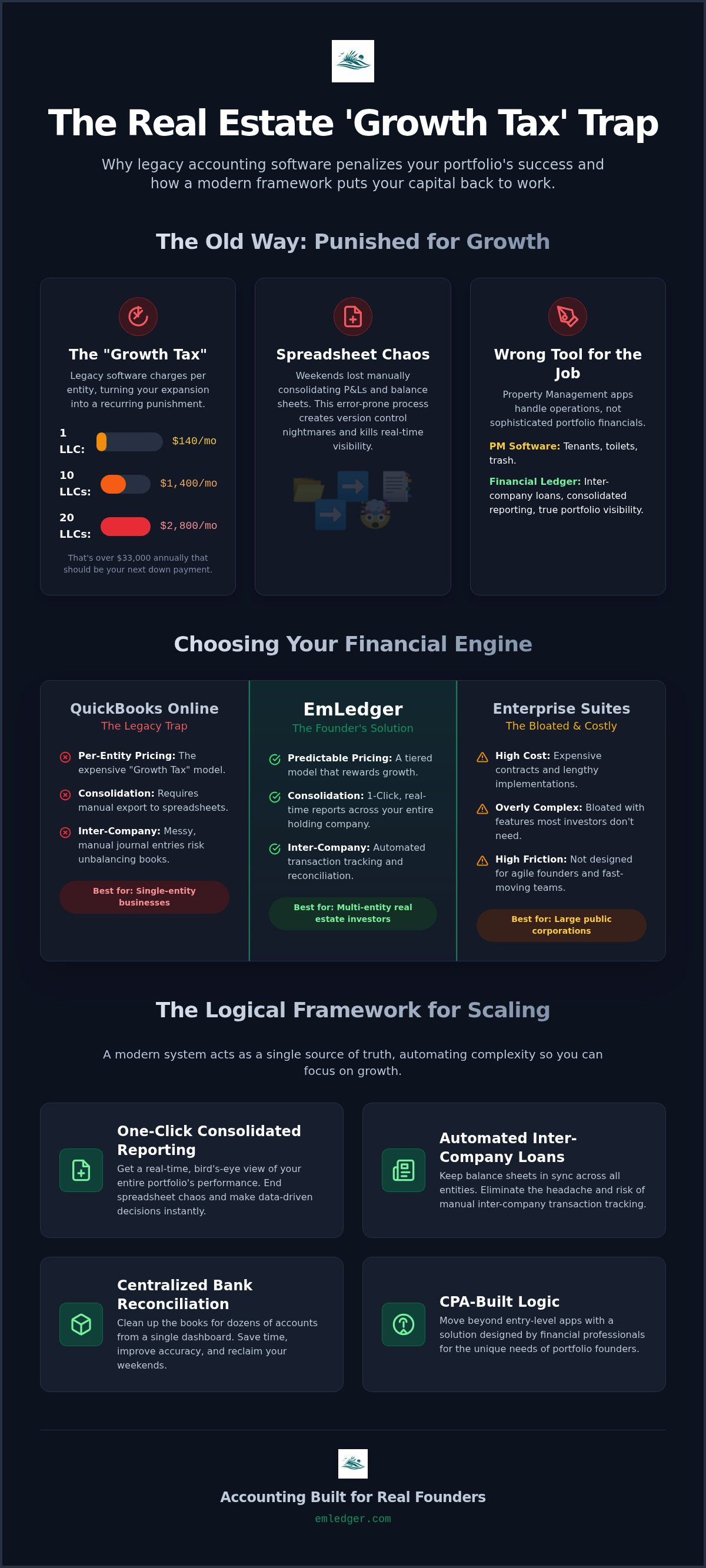
Do the calculation yourself. If a popular platform like QuickBooks Online Plus charges $140 per month per entity, your software costs for ten LLCs hit $1,400 per month. That is $16,800 annually. For twenty LLCs, you're looking at over $33,000 every year just to record your transactions. That is capital that should be going toward your next down payment, not a software subscription. These legacy giants trap you in a high-cost ecosystem. They know that once you've set up five entities, the switching costs feel too high. It's an intentional trap. A fair system uses multi-entity accounting logic to provide a predictable, tiered structure that respects your resources.
Property Management vs. Financial Accounting
Property management software is for tenants, toilets, and trash. It isn't a substitute for a professional general ledger. Many investors fall into the trap of using "lite" accounting modules inside their PM apps. These tools are often functionally shallow. They can't handle messy inter-company transfers or provide the consolidated reporting required for a holding company. If you want real-time visibility across your entire portfolio, you need a dedicated financial engine. You don't use a screwdriver to drive a nail. Don't use operational software to manage your sophisticated financial stack. Separate the two and gain the clarity you've been missing.
Essential Features for Real Estate Holding Companies
If you're managing a holding company, your needs are radically different from a single-family landlord. You aren't just tracking expenses; you're managing a complex web of capital, debt, and equity. Effective accounting software for real estate investors must act as a single source of truth for your entire operation. This means moving beyond basic bookkeeping and into advanced financial architecture. You need a system that understands the relationship between your parent company and its subsidiaries without forcing you to perform manual data entry gymnastics.
Most accounting systems force you to log in and out of separate company files to reconcile bank accounts. It's a massive waste of time. A logical system allows for multi-company bank reconciliation from a single dashboard. You should be able to clean up books across dozens of accounts without losing your flow. This isn't just about convenience; it's about accuracy. When you can see every account in one place, you're less likely to miss a transaction or double-count an expense.
Consolidated Reporting: The End of Spreadsheet Chaos
Manual consolidation is the number one time-waster for growing investors. You pull a P&L from LLC A, another from LLC B, and spend hours stitching them together in a spreadsheet that's prone to error. Professional consolidated financial reporting software provides real-time visibility with zero manual effort. One click should give you a bird's-eye view of your portfolio's performance. This clarity is essential for quarterly investor updates or making quick decisions on your next acquisition. You don't have time to wait for a bookkeeper to "clean up the files" just to see if you're profitable.
Inter-Company Ledger Management
Managing the "due to/due from" nightmare is where most investors fail. You move cash from your holding company to a subsidiary to cover a repair, but the entry only happens on one side. Your books stop balancing. By using an automated inter-company transactions feature, you ensure that every transfer creates a balancing entry on the other side. No more messy year-end adjustments. No more guessing where the cash went. This automation keeps your inter-company loans transparent and audit-ready.
When you're looking for a refinance or a new line of credit, lenders don't want a stack of disorganized reports. They want a consolidated P&L and Balance Sheet that proves your portfolio's health. This level of professional reporting makes you "bankable." It shows you have a handle on your financial engine. If your current setup can't produce these reports instantly, you're leaving money on the table. You might want to explore these core features to see what a professional stack looks like for a serious founder.
Comparing the Giants: QBO vs. NetSuite vs. EmLedger
Choosing accounting software for real estate investors usually feels like a choice between two extremes. On one side, you have entry-level apps that break under pressure. On the other, you have enterprise ERPs that require a six-figure salary just to operate. QuickBooks Online is the industry default, and for a single LLC, it's fine. But as of August 2026, the QBO Plus plan costs $140 per month. If you have ten entities, you're burning $1,400 monthly just to keep the lights on. You're also stuck logging in and out of ten separate files. It's a manual nightmare disguised as a "standard" solution.
NetSuite and Sage Intacct represent the enterprise ego. NetSuite 2026.2 offers impressive AI assistants and modular power, but the $999 monthly base fee is just the entry price. Once you add user licenses and implementation costs, your annual spend can easily exceed $30,000. Most real estate holding companies don't need a system built for global manufacturing. They need a logical way to manage properties, debt, and equity. EmLedger was built by a CPA to fill this massive gap in the market. It provides the multi-entity power of an ERP with the simplicity of a modern cloud app.
The Cost of Scalability
Analyze the total cost of ownership over a five-year growth period. A "cheap" starter plan is often bait. As your portfolio expands to 25 entities, the QBO "Growth Tax" swells to $3,500 per month. In contrast, EmLedger's Scale plan handles those same 25 entities for $199 per month. That is a massive delta in capital that could be used for acquisitions instead of software subscriptions. You can see the full breakdown of how we stack up in this EmLedger vs. The Giants comparison. Logic dictates that your software costs should flatten as you scale, not accelerate.
Implementation Speed and Complexity
Enterprise software often takes six months to deploy. You have deals to close and lenders to satisfy today. You don't have time for a "phased rollout" or expensive consultants. EmLedger uses a "no-nonsense" approach to setting up a multi-entity chart of accounts. You can scale from Solo to Growth plans instantly. There are no data migration headaches because the system is built to grow with you. We've stripped away the corporate bloat to focus on functional utility. You get professional-grade ledgers without the enterprise-level ego.
Automating the Real Estate Paper Trail
Automation in 2026 is about logic, not fluff. If you're manually inputting data from 20 different bank accounts, you're inviting human error into your financial engine. Effective accounting software for real estate investors must solve the "paper trail" problem at the source. It starts with a centralized hub for every bank feed in your portfolio. Instead of logging into dozens of portals, you pull everything into one stream. This is the first step toward reclaiming your time and ensuring your data is actually accurate.
Once the data is in, the real work happens at the inter-company level. Most platforms leave you to figure out the "due to/due from" entries on your own. This is where books become messy and audits become expensive. By setting up automated inter-company loan tracking, you ensure that every dollar moved between LLCs is accounted for on both sides of the ledger. It's a closed loop. No more balancing acts. No more "where did this $5,000 go?" conversations with your bookkeeper at tax time. You gain a self-balancing system that scales with your ambition.
Bank Reconciliation at Scale
High-volume transaction handling is the benchmark for professional bank reconciliation software. You shouldn't have to hunt for missing transactions across multiple LLC accounts. Automated matching identifies recurring expenses and suggests reconciliations based on historical data. This keeps your books tax-ready 365 days a year. It isn't just about speed; it's about maintaining a clean, audit-proof history for every asset you own. When your bank feeds are reconciled daily, you have the confidence to make capital calls or distributions at a moment's notice.
Inventory and Asset Tracking
For fix-and-flip or development projects, your ledger needs to do more than track rent. You need to manage building materials and capitalized costs with precision. Integrating inventory management with your general ledger allows you to track project profitability in real time. Capitalized inventory for real estate development in 2026 refers to the accumulation of direct material, labor, and overhead costs associated with a property intended for sale, which are recorded as assets on the balance sheet rather than immediate expenses. This distinction is critical for maintaining an accurate picture of your project's net worth before the final sale.
Stop fighting your data and automate your inter-company ledger today. You built your portfolio to create freedom, not to create a second job as an accountant. Let the logic of a CPA-built system handle the math so you can focus on the next deal.
The EmLedger Solution: Accounting Built for Real Founders
EmLedger was born from a simple realization. Legacy accounting software is built to extract maximum fees from successful operators. Every time you open a new LLC, they open your wallet. We built a platform that rejects this "Growth Tax" philosophy. As a CPA-led team, we understand that multi-entity accounting isn't just about more files; it's about better logic. You need a system that natively handles "due to/due from" entries without requiring a manual adjustment every Friday afternoon. This is the accounting software for real estate investors who are tired of being penalized for their ambition.
Our architecture is designed to grow with you. We've stripped away the corporate bloat and replaced it with functional utility. You get professional-grade ledgers, automated bank feeds, and consolidated reporting that actually works. We don't hide features behind enterprise paywalls. Whether you're managing your first rental or your fiftieth commercial property, the logic remains the same. You deserve a partner that helps you scale without eating your margins. It is time to stop settling for tools that weren't built for your specific legal structure.
Choosing the Right Plan for Your Portfolio
We've structured our tiers to match the natural lifecycle of a real estate business. You can start small and move fast. Our Solo Plan is perfect for the investor who is just getting their feet wet with a single entity. It provides the foundation you need without the overhead. When you hit that growth spurt and start stacking properties, moving to the Growth Plan is a logical step. It supports the complexity of multiple assets while keeping your costs predictable and your data organized.
For large holding companies and franchises, the Scale Plan is the ultimate financial engine. It provides the robust power needed to manage dozens of entities under one roof. You gain the ability to run consolidated P&Ls across your entire portfolio in seconds. This isn't just about saving money on subscriptions. It's about saving hundreds of hours of manual labor every year. You can finally stop playing data entry clerk and start acting like a CEO. The visibility you gain will change how you evaluate your next acquisition.
Ready to Stop Paying the Growth Tax?
Transitioning from spreadsheet chaos to financial clarity shouldn't take months. You can set up your first three entities in less than 10 minutes. Our onboarding process is designed to be lean and efficient. You can bring over your historical data without losing context or integrity. We've built the tools to ensure your transition is seamless. Stop letting legacy software dictate your profit margins. It's time to choose a system that rewards your growth instead of taxing it. View EmLedger Pricing today and take control of your financial stack.
Take Control of Your Financial Engine
You didn't build a real estate empire to spend your life acting as a manual data entry clerk. The spreadsheet trap and predatory per-entity pricing models belong to the past. Successful scaling requires a financial system that rewards your growth instead of taxing it. By choosing the right accounting software for real estate investors, you gain the power of one-click consolidated reporting and automated inter-company transactions. You move from messy "due to/due from" entries to a self-balancing ledger that actually makes sense.
EmLedger is the logical middle ground for founders who have outgrown basic apps but refuse to pay enterprise-level ego prices. It is a CPA-built platform that understands the granular headaches of multi-layered management. You get no-nonsense multi-entity pricing and a professional stack that works as hard as you do. Stop fighting your software and start trusting your data. Your portfolio is ready to expand. It's time your financial engine was ready too.
Stop paying the Growth Tax; Switch to EmLedger today
Frequently Asked Questions
What is the best accounting software for real estate investors with multiple LLCs?
EmLedger is the most logical choice for investors managing multiple LLCs because it offers a tiered pricing structure instead of charging a fee for every new entity. Most legacy platforms penalize your success by sending a fresh bill for every legal structure you create. You need a system that allows you to manage all entities under one login with a unified chart of accounts. This approach provides a professional framework for portfolio expansion without increasing your administrative overhead.
Can I use QuickBooks for multiple real estate entities?
You can use QuickBooks, but you'll be forced to pay for a separate subscription for every single LLC you own. This creates a massive financial burden and a manual reporting nightmare as you scale. To see your total portfolio performance, you must export data from every file and stitch it together in a spreadsheet. It's an inefficient, high-cost ecosystem that traps you in manual labor. Serious investors typically look for specialized solutions that handle multi-entity logic natively.
How do I handle inter-company loans in my accounting software?
Inter-company loans should be handled via automated "due to/due from" entries that create balancing transactions across both ledgers simultaneously. Manual entry is the fastest way to break your books and create an audit nightmare. When you move cash between a holding company and a subsidiary, the software must record the liability and the asset in one motion. This automation ensures your inter-company accounts always balance and remain ready for lender review without a massive year-end cleanup.
What is consolidated financial reporting for real estate?
Consolidated financial reporting is the process of combining the financial results of multiple subsidiaries into a single set of parent company statements. For your portfolio, this means viewing your total cash flow, debt, and equity across all LLCs in one click. It eliminates the need for manual spreadsheet consolidation that often leads to errors. Reliable accounting software for real estate investors provides this visibility in real time, allowing you to prove your portfolio's health to banks instantly.
Is there accounting software that doesn’t charge per entity?
EmLedger offers tiered plans based on ranges of entities rather than a predatory flat fee for every individual LLC. Legacy providers use per-entity pricing to maximize their own profits at your expense. A fair model provides the same robust toolset for a predictable monthly cost, regardless of whether you have three properties or ten. This transparent approach allows you to accurately forecast your software expenses as you scale your portfolio and acquire new assets for your holding company.
How do I track inventory for real estate flips?
Track flip inventory by capitalizing direct materials and labor costs as assets on your balance sheet until the property sells. You shouldn't expense these costs immediately because they are part of the property's cost basis. Professional software integrates inventory management with your general ledger to track every dollar spent on a renovation. This ensures you have a precise picture of your project's net worth and taxable gain upon disposition. Avoid using basic expense trackers for complex development projects.
Do I need separate bank accounts for every real estate LLC?
Yes, you must maintain separate bank accounts for every LLC to avoid "piercing the corporate veil" and losing your liability protection. Co-mingling funds is a major legal risk that can expose your personal assets. While managing multiple accounts is a headache, the right software centralizes your bank feeds for efficient reconciliation. You get the legal protection of separate entities without the operational friction of logging into dozens of different banking portals every single week.
What features should a real estate holding company look for in software?
A real estate holding company needs consolidated P&Ls, automated inter-company transaction tracking, and multi-entity bank reconciliation. You are managing a capital structure, not just rent collection. Look for a system that provides a bird's-eye view of your debt-to-equity ratio across the entire portfolio. The best accounting software for real estate investors focuses on these high-level financial metrics while automating the granular bookkeeping tasks that typically eat your time and sanity.


