

Your spreadsheets are lying to you. Research indicates that 88% of spreadsheets contain errors, yet many multi-entity operators still bet their entire strategy on them. It's a dangerous game. By the time your team finishes manual data entry, the reports are already obsolete. You're left chasing phantom liquidity while making high-stakes decisions based on financial fiction. In 2026, with IFRS 18 and new FASB updates requiring retrospective restatements, this manual approach isn't just slow; it's a liability. Effective consolidated cash flow reporting shouldn't feel like a monthly root canal.
We know you're tired of the manual grind. Finance teams currently spend 80% of their time on data collection rather than strategic analysis. You need data you can actually trust for investors and lenders. This article shows you how to eliminate manual consolidation errors and gain real-time cash visibility across all your business entities. We'll break down the path to automated inter-company eliminations and give you the logical framework to exit the spreadsheet chaos for good.
Key Takeaways
- Identify the dangers of phantom liquidity and why separate entity bank balances don't reflect your actual group wealth.
- Understand the three essential pillars of consolidated cash flow reporting to track movements across operations, investing, and financing.
- Learn how to handle inter-company eliminations to prevent double-counting revenue and ensure your external financial position is accurate.
- Transition from manual monthly batches to real-time visibility by standardizing your chart of accounts across all subsidiaries.
- Gain the data confidence required to satisfy investors and lenders by eliminating the high error rates common in manual spreadsheets.
The Phantom Liquidity Crisis: Why Single-Entity Reporting Fails Multi-Company Operators
Most operators treat their businesses like isolated islands. That's a strategic failure. While individual balance sheets have their place, Consolidated financial statements provide the only true view of your group's health. Specifically, consolidated cash flow reporting is the aggregation of every cash movement across your entire portfolio into a single, unshakeable source of truth. Without it, you aren't managing a business; you're managing a series of expensive blind spots.
You check the bank balance of Entity A. It looks healthy. You check Entity B; it's flush. But if Entity A owes Entity B a six-figure sum for management fees or inter-company loans, your total cash isn't what it seems. This is Phantom Liquidity: the dangerous illusion of wealth created by ignoring the strings attached to your capital. You think you have the runway to hire or expand, but the cash is actually tied up in inter-company debt that cancels itself out. It's a logic failure that leads to sudden insolvency.
Spending 20 hours a month wrestling with Excel isn't doing the books. It's a waste of your most finite resource: time. Manual consolidation is a slow, error-prone process that turns your finance team into data entry clerks. By the time they finish, the data is cold. Decisions made on old data are just guesses in expensive suits. You need a system that reflects reality, not a history project.
The Downside of Siloed Financial Data
Siloed reports hide systemic risks. If one subsidiary is bleeding cash and surviving on loans from another, you won't see the rot until the whole structure collapses. There is a massive lag between data collection and the moment you can actually make a move. The consolidation gap is the time lost between month-end and report delivery. This gap kills agility. It prevents you from moving capital where it's actually needed to fuel growth or extinguish fires.
Who Needs Consolidated Cash Flow Visibility?
This isn't just for the Fortune 500. It's for the operators on the ground who are tired of the spreadsheet chaos. If you manage more than one entity, you need this visibility. It's the difference between scaling an empire and babysitting a collection of liabilities. Specifically, this is vital for:
- Holding companies managing diverse portfolios where cash must remain fluid across different industries.
- Franchise owners with multiple locations who need to compare performance and cash velocity in real-time.
- Serial entrepreneurs using accounting software for serial entrepreneurs to scale without adding administrative bloat.
To maintain this fluidity across international borders, many operators utilize fintech solutions like Ellicash to manage cross-border transfers and global investment assets from a single, unified account.
The Anatomy of a Consolidated Cash Flow Statement: Operations, Investing, and Financing
A consolidated statement isn't just a bigger version of a single-entity report. It's a different animal. You're tracking three distinct gears that must grind together: Operating, Investing, and Financing. When these gears slip, your visibility vanishes. In 2026, relying on static data is a choice to remain blind. Effective consolidated cash flow reporting requires a standardized chart of accounts across every subsidiary. Without a unified language, your data is just noise. If Entity A records "Revenue" while Entity B records "Sales Income," your consolidation process will always be a manual translation project rather than a rational calculation.
Real-time reporting is the only way to track these movements accurately. Cash often flows from Operating activities in a mature entity to Investing activities in a startup subsidiary. Alternatively, Financing cash raised at the group level might be pushed down to cover Operating deficits elsewhere. Tracking these cross-pillar movements as they happen ensures you aren't just moving money in a circle while losing value. You can gain this level of clarity through consolidated reporting tools built for high-velocity decision making.
Operating Activities Across the Group
This is your engine. It's the cash coming from customers and the cash going to suppliers. For a multi-entity operator, this gets messy fast. You're dealing with different payroll cycles, varying tax jurisdictions, and fragmented vendor lists. Trying to reconcile this in a spreadsheet is a logic failure. Modern consolidated financial reporting software solves this by pulling live feeds into a single dashboard. It stops the guessing game by aggregating receipts and payments automatically. It turns a week-long manual task into a real-time pulse check on your group's health.
Investing and Financing: The Growth Drivers
Investing tracks your future. It's the cash spent on new equipment for Subsidiary A or the property acquired by Subsidiary B. Financing is about your capital structure. You need to know if you're taking on debt at the group level or through entity-specific loans. Inter-company transfers often live here as financing activities, and they must be tracked with surgical precision. Even the most complex entities, such as those documented in the Financial Statements of the United States Government, rely on these same three pillars to maintain order. If you want to scale, you must manage these drivers with the same rigor, ensuring every asset acquisition and loan is visible across the entire group.
Inter-Company Eliminations: The #1 Hurdle in Consolidated Cash Flow Reporting
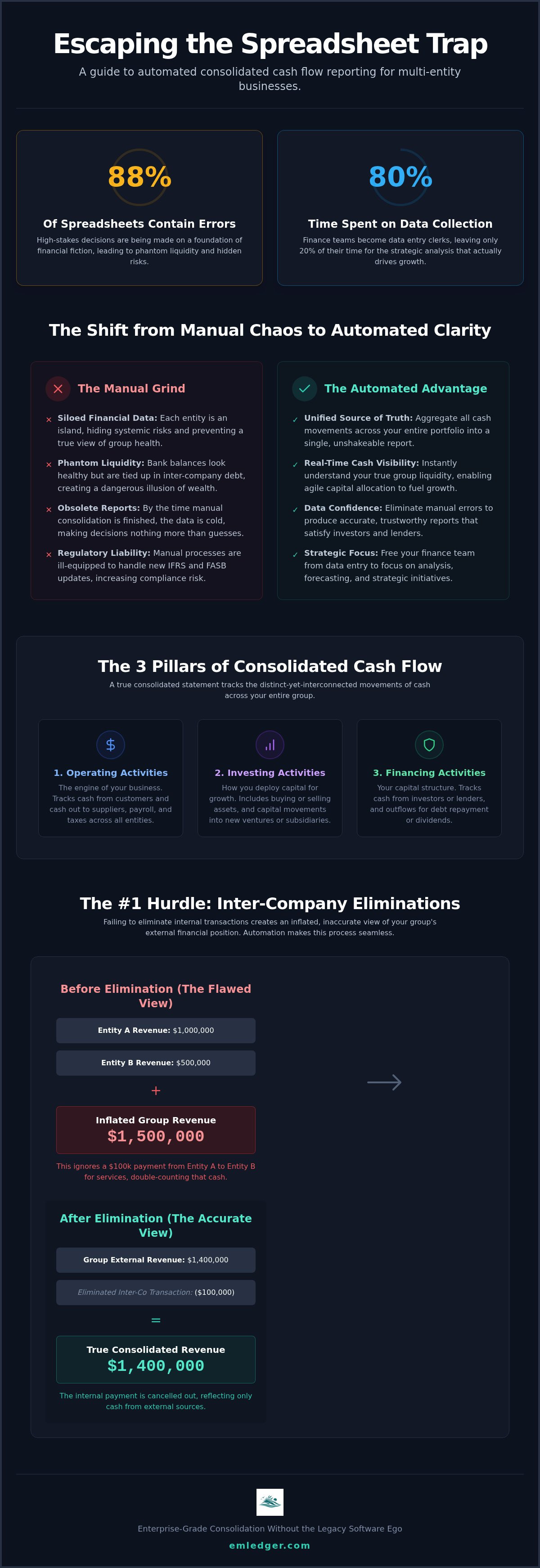
Inter-company transactions are the noise that drowns out your signal. If you move $50,000 from your holding company to a subsidiary to cover payroll, your group didn't generate $50,000 in new cash. It just moved a pile of money from one pocket to another. Failing to strip these internal movements out is a fundamental accounting failure. It leads to double-counting revenue and ignoring the very liabilities that could sink you. In the eyes of regulators, precision is mandatory. The standards for Consolidated statements of comprehensive income and cash flows are clear: you must present the group as a single economic entity.
Manual reconciliation is a sanity killer. It forces bookkeepers to hunt through disparate ledgers, matching entries like a high-stakes game of memory. One missed tag and your consolidated cash flow reporting is worthless. It's a logic trap that creates the illusion of growth while hiding systemic debt. For any operator serious about scaling, automated inter-company reconciliation isn't a luxury. It's a survival requirement. Without it, you're just guessing at your group's actual liquidity.
Common Elimination Scenarios
Most operators trip over the same three hurdles. First, inter-company loans and the resulting interest payments. These should net to zero at the group level. Second, management fees charged by a parent company. These aren't external revenue; they're internal shifts. Third, internal inventory transfers. If Entity A sells stock to Entity B, no cash has actually entered the ecosystem. You must eliminate:
- Inter-company loans: Removing the loan asset and the corresponding liability from the group view.
- Interest payments: Eliminating the interest income in one entity and the interest expense in the other.
- Management fees: Canceling the parent's revenue against the subsidiary's operational expense.
The Tech Solution for Inter-Company Chaos
The legacy way is slow. The logical way is automated. Modern ledgers use auto-tagging to identify inter-company entries the moment they're created. It's a "one entry, two books" philosophy. When you record a transaction in Entity A, the system automatically creates the mirror entry in Entity B. This eliminates manual effort and ensures your consolidated cash flow reporting remains accurate in real-time. You can explore the technical details of these inter-company transaction features to see how logic replaces labor. Stop babysitting your spreadsheets. Start trusting your data.
Moving from Monthly Batches to Real-Time Cash Visibility
Monthly batch processing is a legacy habit that kills momentum. If you only see your cash position every 30 days, you're driving a car by looking in the rearview mirror. You need a live dashboard. Transitioning to real-time consolidated cash flow reporting requires a methodical shift from manual labor to logical automation. It isn't a complex mystery. It's a series of five tactical steps that replace the manual grind with functional utility.
- Step 1: Standardize your Chart of Accounts (COA) across all entities to ensure everyone speaks the same financial language.
- Step 2: Implement a unified multi-entity accounting software that acts as your single source of truth.
- Step 3: Connect all bank feeds to a single reconciliation hub to see cleared funds across the group instantly.
- Step 4: Automate the elimination rules for recurring inter-company transfers so they vanish from the group view without manual intervention.
- Step 5: Schedule automated reporting delivery to stakeholders, ensuring they have fresh data before they even ask for it.
Standardization: The Foundation of Speed
Mixing accounting methods is a logic failure. If Entity A uses Cash accounting while Entity B uses Accrual, your consolidation is a fiction. Unified fiscal calendars are equally non-negotiable. You can't compare a 4-4-5 calendar to a standard monthly one without creating a data mess. A Master COA simplifies reporting by ensuring every transaction across every subsidiary maps to a single, group-level category. It eliminates the need for manual mapping. It ensures your data is ready for analysis the moment it's recorded.
Automation of Bank Reconciliation
Manual reconciliation is the primary cause of the month-end crunch. It turns your finance team into forensic investigators instead of strategic partners. By implementing dedicated bank reconciliation software, you match group-level cash to real-time bank balances automatically. This removes the lag. It ensures your consolidated cash visibility is based on hard bank data, not optimistic ledger entries. Stop chasing receipts and start making moves. You can get real-time visibility now by switching to a system built for multi-entity logic.
EmLedger: Enterprise-Grade Consolidation Without the Legacy Software Ego
Legacy software providers have a favorite trick. They call it per-entity pricing. We call it a "Growth Tax." If you own ten companies, they want you to pay ten separate subscriptions. It's an arbitrary penalty for your ambition. EmLedger was built by a CPA who spent years watching serial entrepreneurs get fleeced by these legacy giants. We decided to build a better way. Our philosophy is simple: you should pay for the power of the platform, not for the number of LLCs you have the vision to manage.
This isn't just about saving money. It's about logical efficiency. When you use QuickBooks or Xero, consolidated cash flow reporting usually requires a secondary, expensive reporting app just to bridge the gap between your entities. EmLedger removes the middleman. We provide enterprise-grade visibility without the enterprise-grade ego or the bloated price tag. You can compare your current "Growth Tax" against our model and see the rational alternative for yourself.
Why EmLedger Wins for Multi-Entity Operators
Most accounting systems treat multi-entity structures as an afterthought. They force you to log in and out of different accounts just to see your bank balances. EmLedger offers native consolidated reporting as a core feature, not a bolt-on. This means your inter-company eliminations and group-level cash flows are calculated the moment you record a transaction. There is no waiting for a sync or a manual export.
We also provide robust entity management for complex structures. Whether you are managing holding companies or a portfolio of e-commerce brands, the system adapts to your hierarchy. You get one hub, one login, and one clear view of your total liquidity. It's the logical exit from the spreadsheet chaos we discussed in earlier sections. It's built for those who value their time as much as their capital.
Ditching the Growth Tax in 2026
The math is straightforward. In the legacy world, scaling from 1 to 10 entities means your software bill decuples. That's a logic failure. With EmLedger’s tiered plans, including Solo, Growth, and Scale, you pay for the features and volume you actually use. You can scale your portfolio without your overhead spiraling out of control. It's a disruptive approach that puts the operator first.
Our plans are designed to grow with you. If you're a serial entrepreneur starting your second venture, our entry tiers keep it lean. As you build an empire, the Scale plan provides the automated tools to keep your data clean and your investors confident. It's time to stop paying the legacy tax. View Pricing and Start Scaling today.
Take Command of Your Multi-Entity Growth
Spreadsheets are for startups with one entity and too much free time. You have neither. Relying on manual data entry leads to phantom liquidity and obsolete reports. You can't scale a portfolio when you're stuck in the month-end crunch. By standardizing your chart of accounts and automating eliminations, you turn your financial data into a strategic weapon. Mastering consolidated cash flow reporting is the only way to gain the data confidence that investors and lenders demand in 2026.
It's time to ditch the legacy software ego. EmLedger provides a CPA-designed platform that respects your resources. We've eliminated per-entity pricing fees to stop the growth tax. You get automated inter-company eliminations as a core feature, not a hidden add-on. Logic wins. Accuracy wins. Efficiency wins. Stop the spreadsheet chaos and get real-time consolidated reporting with EmLedger.
You've built something significant. Now, give yourself the tools to actually lead it. Your empire deserves a clear view.
Frequently Asked Questions
What is the difference between a cash flow statement and a consolidated cash flow report?
A standard cash flow statement tracks the movement of money for a single legal entity. In contrast, a consolidated report aggregates cash movements across every subsidiary in your group as if they were one single business. It strips away internal noise to show your true liquidity to the outside world.
How do inter-company eliminations affect consolidated cash flow?
Eliminations remove internal transfers that don't change the total wealth of your group. If you don't eliminate these, you'll double-count revenue and hide systemic debt. Accurate consolidated cash flow reporting requires removing these 'pocket-to-pocket' moves to reveal your actual external cash position.
Can I generate consolidated cash flow reports in QuickBooks Online?
No, QuickBooks Online does not offer native consolidation. You're forced to export data to spreadsheets or pay for expensive third-party reporting apps. This fragmented approach creates a 'Growth Tax' that penalizes you for owning multiple LLCs and increases the risk of manual entry errors.
Why is cash flow consolidation harder for multi-currency businesses?
Currency fluctuations create translation gains or losses that don't represent actual cash entering or leaving your accounts. You must use consistent exchange rates across all entities. Without a unified system, your consolidated cash flow reporting will reflect accounting adjustments rather than physical cash availability.
How often should a holding company run consolidated cash flow reports?
You should run them in real-time. Monthly reporting is a history project that only tells you where you were 30 days ago. Real-time visibility allows you to move capital between entities to fuel growth or extinguish fires before they become crises.
What are the biggest mistakes in manual cash flow consolidation?
The most common failures are double-counting inter-company transfers and using inconsistent charts of accounts. Many operators also ignore the 'consolidation gap.' Making high-stakes decisions based on two-week-old spreadsheet data is a logic failure that leads to insolvency.
Does EmLedger support automated inter-company settlements?
Yes, EmLedger uses a 'one entry, two books' logic to handle settlements. When you record a transaction in one entity, the system automatically creates the mirror entry in the corresponding subsidiary. This eliminates the manual reconciliation grind and ensures your ledgers always stay in balance.
Is consolidated reporting available on the EmLedger Solo plan?
No, the Solo plan is built for single-entity operators. Consolidated reporting is a core feature of our multi-entity tiers, including the Growth and Scale plans. These plans are designed for operators who need to aggregate data across multiple subsidiaries without the legacy software ego.


