

Your software should be an engine for expansion, not a tax on your ambition. Most legacy platforms operate on a predatory per-entity pricing model that penalizes you for every new LLC you spin up. If you are a multi-unit operator in 2026, you already know the sting of paying more just because you are successful. Finding a modern franchise accounting software shouldn't mean choosing between your profit margins and your data visibility.
You're likely tired of spending three days every month buried in Excel just to consolidate your financials. It is a waste of your time and a risk to your accuracy. You deserve real-time visibility across every unit without the manual headache or the hidden fees legacy vendors demand. This article breaks down how to escape the spreadsheet trap. You will learn how to automate consolidated reporting, handle inter-company transactions cleanly, and secure a predictable cost structure that actually rewards your growth.
Key Takeaways
- Identify and eliminate the predatory "Growth Tax" by rejecting accounting models that penalize your expansion with per-entity fees.
- Trade days of manual Excel consolidation for automated reporting that provides an instant, accurate view of your entire portfolio.
- Streamline inter-company transactions and eliminations to maintain audit-ready books without the inflated CPA bills.
- Select a franchise accounting software that treats multi-entity management as a standard utility rather than a premium luxury.
- Standardize your Chart of Accounts to create a logical, scalable foundation for adding new locations without increasing your administrative overhead.
What is Franchise Accounting Software (and Why Legacy Options Fail)?
Legacy software vendors have a dirty secret. They don't want you to grow too fast because their business model depends on your expansion. True franchise accounting software is more than just a digital ledger; it is a specialized system designed to manage the complex multi-ledger requirements of the franchise business model. While standard small business tools focus on a single set of books, franchise platforms handle dozens or hundreds of distinct legal entities simultaneously. In 2026, with multi-unit operators owning roughly 54% of all franchise units, the demand for logic over legacy has reached a breaking point. Operators are walking away from the "Growth Tax" and moving toward systems that actually respect their margins.
The "Growth Tax" is a predatory industry standard where software companies charge you a full subscription fee for every new LLC you create. It is a penalty for success. If you open five new locations, your software bill shouldn't quintuple. This pricing model exists because legacy giants built their tech on old foundations that can't handle multiple entities in one environment. They force you to buy a new "seat" for every unit, creating a massive financial and administrative burden that has no logical connection to the value you receive.
The Hidden Cost of Per-Entity Pricing
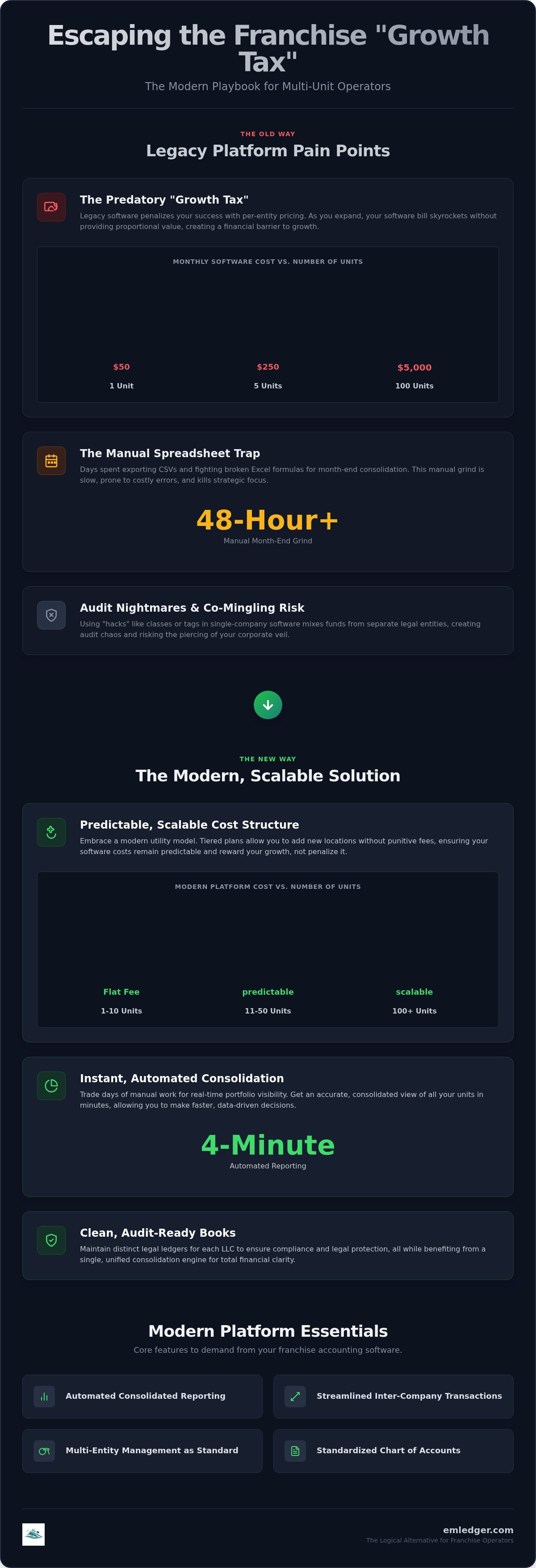
A $50 monthly bill for your first location is a rounding error. By the time you reach 100 units, that same software costs you $5,000 every single month. You aren't getting 100 times more features. You aren't getting 100 times more support. You are simply paying a tax on your own ambition. This creates a psychological barrier that makes serial entrepreneurs hesitate before signing their next lease. We believe accounting is a utility, not a percentage of your success. Your software costs should be predictable, flat, and scalable. EmLedger was built to kill the per-entity pricing scam by offering tiered plans that allow you to add locations without asking for permission from your software vendor's sales team.
Multi-Entity vs. Single-Location Ledgers
Many operators try to dodge these fees by "hacking" a single-company ledger using classes, tags, or tracking categories. This is a recipe for an audit nightmare. Mixing funds from separate legal entities into one file creates co-mingling risks that can pierce your corporate veil. You need separate books for every LLC to maintain legal protection and clean tax filings. However, you also need a unified reporting layer so you can see your total performance in seconds. True franchise accounting software provides this balance: distinct legal ledgers with a single, automated consolidation engine. If you are still trying to bridge this gap with spreadsheets, you are paying the Multi-Entity Tax in lost time and increased risk.
Mastering Financial Consolidation and Inter-Company Transactions
Manual consolidation is a profit killer. It transforms your role from a strategic visionary into a high-paid data entry clerk. If you manage multiple units, you need to see your total cash position across all 20 or 50 locations in a single click. Without franchise accounting software, you are likely stuck in a loop of exporting CSV files, mapping charts of accounts, and praying your Excel formulas don't break. This is not just a waste of time; it is a risk to your business intelligence. Real-time visibility is the only way to catch operational leaks before they become catastrophic. True consolidation turns a collection of individual units into a scalable, high-performance portfolio.
Eliminating the Manual Spreadsheet Trap
The 48-hour month-end close is a relic of a slower era. In 2026, waiting two days to see your numbers is unacceptable. Manual spreadsheets are magnets for human error, especially when building multi-unit P&L statements. One wrong cell reference can hide a bleeding location for months. Automated reporting eliminates this risk by pulling data directly from every ledger into a unified view. You get a 4-minute automated report instead of a 48-hour manual grind. If you want to see how this works in practice, explore our Consolidated Reporting Features.
Modern operators also face the technical hurdle of ASC 606 revenue recognition standards. These rules complicate how you record initial fees and royalties across your network. Handling these requirements across dozens of entities requires a system that understands the nuances of franchise financials. When your software automates these calculations, you spend less on CPA hours and more on your next acquisition.
Automated Inter-Company Eliminations
Inter-company eliminations are the process of removing transactions between related entities to prevent inflated financials. If Location A lends $10,000 to Location B, your consolidated report shouldn't show that as $10,000 in new revenue. It is a wash. Legacy software often forces you to track these transfers manually, leading to double-counting and messy balance sheets. EmLedger handles Inter-Company Transactions logically by automatically flagging and eliminating these entries. It ensures your consolidated books represent the actual health of your enterprise, not an accounting fiction. If you're ready to stop the spreadsheet madness, consider how a dedicated entity management tool can clean up your books.
Key Features to Demand from a Franchise Ledger
Legacy software providers love to upsell you on "modules." They treat basic necessities like inventory or bank reconciliation as premium add-ons. For a multi-unit operator, these aren't extras; they are the baseline for survival. You need a franchise accounting software that integrates these functions into the core ledger. When your inventory and bank data sit in separate silos, you lose the ability to spot "the bleed," those small, recurring losses that eat your margins across 50 locations. A logical platform should provide a single source of truth without requiring a dozen third-party integrations. To achieve this level of integration for specific service sectors, you can discover Encore Salon & Spa Software to see how all-in-one management tools benefit salons and grooming boutiques.
Integrated Inventory and Bank Reconciliation
App fatigue is a real productivity killer for serial entrepreneurs. Juggling five different logins just to see your cash position is a failure of logic. Your Inventory Management must be tied directly to your general ledger. This ensures that every stock movement reflects on your balance sheet in real time. Similarly, Bank Reconciliation for multi-entity structures should be a streamlined process, not a manual scavenger hunt. You shouldn't have to lose your sanity managing 50 bank accounts. The software should do the heavy lifting of matching transactions across your entire network, allowing you to close your books with confidence and speed.
Real-Time Multi-Location Visibility
Understanding the foundational business principles of franchising means recognizing that your units are not identical clones; they are individual profit centers with unique variables. You need the power to compare Unit A against Unit B instantly. If one location has a cost of goods sold 3% higher than the rest of your portfolio, you need to know today, not at the end of the quarter. This visibility allows you to identify underperforming franchises before they become liabilities. Our Franchise Use Cases demonstrate how top operators use this data to drive portfolio-wide efficiency and maintain strict operational standards.
Finally, your ledger must offer sophisticated role-based access. You shouldn't have to choose between total transparency and data security. Give your unit managers access to their specific location's data while you maintain the high-level "big picture" view of the entire enterprise. This decentralizes the workload without sacrificing control. Combine this with a predictable pricing model that respects your unit count, and you have a system built for 2026 and beyond. It is time to stop paying for software that punishes your success and start using a tool that fuels it. To further empower your strategic vision, you can discover Jembe.intelligence for the cultural intelligence and consumer data required to scale effectively in any market.
How to Transition to Scalable Franchise Accounting
Stop treating your accounting migration like a root canal. It is a strategic move to reclaim your margins and professionalize your portfolio. The first step is a cold, hard audit of your current "Growth Tax." Add up every per-entity fee you paid to your legacy software vendor last year. That total is the price of your current inefficiency. Transitioning to modern franchise accounting software follows a logical, four-step path: audit, standardize, map, and migrate. Do not dump messy, inconsistent data into a new system. Clean your books at the source so your new ledger can perform as intended.
Standardizing the Chart of Accounts
Every unit in your system must speak the same financial language. If Location A records "Rent" as an operating expense while Location B lists it as an occupancy cost, your consolidation is dead on arrival. A standardized Chart of Accounts is a consistent list of categories used across all entities to ensure data can be merged accurately. This standardization is the engine of automated reporting. It allows you to roll up 50 separate P&L statements into one master view in seconds. Without it, you are just moving your manual spreadsheet headaches from one platform to another.
Once your categories are aligned, map your inter-company relationships. Identify which entities lend to each other and which management company handles the overhead. Once this logic is mapped, select a tiered plan based on your 12-month expansion goals. Whether you are starting with the Solo Plan for a new venture or moving straight to the Growth or Scale plans for a massive portfolio, your costs must remain predictable. Execute a phased migration. Start with the holding company to get the top-level reporting layer right, then roll out to individual units. This minimizes disruption and ensures your "big picture" visibility is established early.
Implementing Role-Based Access Control
You need to empower your location managers without giving them the keys to the vault. Securing your data is a matter of logic, not just trust. Use a "need to know" framework for your financial data. Managers should have unit-level access to drive local performance, while you maintain the exclusive view of the entire enterprise. This prevents data leaks and protects sensitive high-level strategy. Explore our Entity Management Features to see how we handle these granular permissions. It is time to stop the bleed and start scaling with a system that respects your boundaries. Compare our tiered plans and find your exit from the per-entity pricing scam.
EmLedger: The Logical Alternative for Franchise Operators
EmLedger is the no-nonsense choice for serial entrepreneurs who are tired of being treated like a cash cow by their software vendors. We didn't build this to offer tax filing or audit services. We built this to solve a specific, granular headache: managing a multi-entity portfolio without the "Growth Tax." It is a franchise accounting software designed by a CPA who understood that the multi-unit struggle is real and unnecessary. We value logic over marketing fluff, much like how Gemba provides a streamlined banking infrastructure for non-banks to launch their own branded financial services. Our platform is a disruptive alternative for those who demand transparency and functional utility.
Solo, Growth, and Scale: Tiers That Make Sense
Our pricing model is a rational calculation, not a predatory trap. You choose the plan that fits your current unit count and expansion goals. Whether you are starting small or managing a massive network, the logic remains the same: predictable costs and clean financials. You can see which plan fits your current unit count on our Pricing page. We focus entirely on the software utility. We don't hide costs behind "audit prep" or "tax filing" fees because those aren't software problems. They are service problems. Our tiered subscription model respects your margins and rewards your ambition.
Why Founders are Switching from QuickBooks Online
Founders are abandoning legacy giants because the math no longer adds up. When you compare EmLedger against the giants, the difference is clear. Legacy platforms are built for single-location small businesses; they are not true franchise accounting software. They force you into a "tax" on every new LLC you open. Some of our users have reported cutting their software bills by 60% simply by switching to a platform that doesn't penalize their success. You can see the side-by-side breakdown in our Comparison Guide.
Stop paying for the privilege of growing your business. Choose the logical exit from complexity. It is time to treat your accounting as a utility that fuels your scale rather than a tax that drains your margins. EmLedger provides the clean, professional, and scalable foundation your portfolio deserves. Make the switch and stop the bleed today.
Reclaim Your Margins and Scale Without Penalty
You've built a portfolio to create wealth, not to subsidize your software provider's bottom line. Legacy vendors have spent years taxing your expansion with predatory per-entity fees. It's an industry standard that ends now. By standardizing your financial language and automating inter-company eliminations, you move from managing a stressful job to overseeing a high-performance portfolio. Finding the right franchise accounting software means choosing a partner that values your scale as much as you do.
EmLedger was built by a CPA specifically for multi-unit founders who are tired of the spreadsheet trap. We include consolidated reporting in every plan because we believe total visibility is a fundamental right, not a premium upgrade. Our disruptive pricing model ensures your software costs remain a rational utility that supports your growth rather than a tax that drains it. It's time to stop being penalized for your own success and start using a ledger that respects your ambition.
Stop paying the Growth Tax; View EmLedger Pricing
Your next location should be a cause for celebration, not a calculation of new software fees. Take control of your financials today and build a scalable enterprise that actually works for you.
Frequently Asked Questions
Is franchise accounting software different from regular accounting software?
Yes, the underlying architecture is fundamentally different. Standard platforms focus on single-ledger entry for one business. True franchise accounting software handles multiple distinct legal entities within a unified environment. It automates the complex rollup of data that usually requires hours of manual spreadsheet manipulation and error-prone data entry.
Why is per-entity pricing considered a 'Growth Tax' for franchises?
It is a tax because it scales with your success, not your software usage. Legacy vendors charge a full subscription for every new LLC you create. This model forces you to pay more simply because you are expanding your footprint. It creates a financial barrier to growth that has no logical connection to the software's functional utility.
Can I manage multiple LLCs under one EmLedger account?
Yes, that is the core purpose of our platform. Whether you use the Growth or Scale plan, you manage your entire portfolio from a single dashboard. You maintain separate legal books for every LLC to protect your corporate veil while enjoying a unified reporting layer for the entire holding company.
Does EmLedger handle inter-company loans and eliminations automatically?
Yes, it eliminates the double-counting nightmare that plagues multi-unit operators. EmLedger identifies transfers and loans between your locations and automatically removes them from consolidated totals. This ensures your enterprise-wide P&L reflects actual external revenue rather than internal paper movements that inflate your numbers.
How long does it take to consolidate reports for 10+ franchise locations?
Consolidating 10 or even 50 locations happens in seconds. You select your entities, click a button, and the system rolls everything up into a single view. The manual 48-hour month-end close is a relic of the past. You get real-time visibility across your entire franchise accounting software stack without the spreadsheet errors.
Can my bookkeeper or CPA use EmLedger with me?
Yes, you can invite your financial team to collaborate directly within the platform. This streamlines the audit trail and ensures your CPA has the clean, standardized data they need. It stops the endless cycle of exporting, emailing, and re-importing CSV files every month.
Does EmLedger offer payroll or tax filing services?
No, we do not provide payroll processing, audit services, or tax filing. We are a pure accounting software utility. We focus on providing the most efficient multi-entity ledger and consolidated reporting tools. We believe in doing one thing exceptionally well rather than charging you for bloated, mediocre service add-ons.
How does role-based access work for my location managers?
It operates on a strict "need to know" basis to protect your sensitive data. You can assign managers to specific units so they only see the financials relevant to their location. This empowers them to drive unit-level performance while you retain the exclusive "big picture" view across the entire portfolio.


