

Most multi-entity accounting setups are built on a lie. You were told that as you grow, your software would scale with you. Instead, you're stuck paying a "growth tax" in the form of manual spreadsheet work and per-entity fees that triple your overhead. It's a broken system that rewards complexity and penalizes your success. It's time to stop accepting inefficiency as a cost of doing business.
You know the month-end routine. Your ledgers are out of balance. You're hunting for a single transaction across five different tabs. You're managing a house of cards that one typo could bring down. It's frustrating, it's slow, and it's entirely unnecessary. Modern inter-company reconciliation tools have changed the math for 2026. They replace manual guesswork with automated precision and bring logic back to your balance sheet.
This article shows you how to eliminate manual errors and stop the "growth tax" on your operations. You'll learn how to achieve real-time visibility across all entities and automate elimination entries with ease. We'll explore a scalable path to multi-entity management that keeps your data clean and your costs predictable as you expand.
Key Takeaways
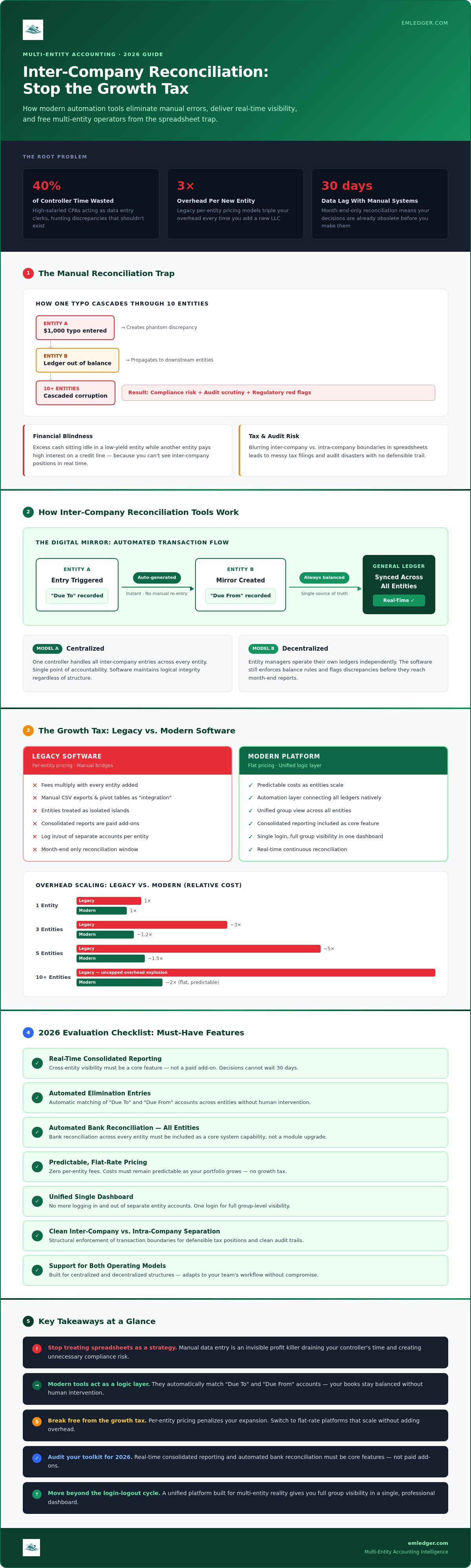
- Stop treating spreadsheets as a viable strategy. Manual data entry is an invisible profit killer that drains your controller's time and creates unnecessary compliance risks.
- Modern inter-company reconciliation tools act as a logic layer for your business. They automatically match "Due To" and "Due From" accounts to ensure your books stay balanced without human intervention.
- Don't pay the "growth tax" imposed by legacy software. Break free from per-entity pricing models that penalize your expansion and triple your overhead every time you add a new LLC.
- Audit your toolkit for 2026 requirements. Your system must provide real-time consolidated reporting and automated bank reconciliation across all entities as a core feature, not a paid add-on.
- Switch to a platform built for multi-entity reality. Move beyond the tedious cycle of logging in and out of separate accounts with a unified system designed by professionals who understand the trenches.
The Manual Reconciliation Trap: Why Spreadsheets are Killing Your Profit
Spreadsheets are the ultimate comfort zone for accountants, but they've become a silent parasite on your bottom line. When you manage multi-entity operations through manual entry, you aren't just "keeping the books." You're paying an invisible profit killer. High-salaried CPAs and controllers spend 40% of their time acting as data entry clerks, hunting for discrepancies that shouldn't exist. This is the manual spreadsheet tax. It's a drain on your most expensive human capital and a complete waste of professional expertise.
Manual inter-company reconciliation tools are often just complex Excel formulas waiting to break. The math of human error is unforgiving. A single $1,000 typo in Entity A creates a phantom discrepancy in Entity B. By the time you attempt to consolidate ten or more entities, that one mistake has cascaded through every ledger. You don't just have an "out of balance" problem. You have a compliance risk that invites audit scrutiny and regulatory red flags. In 2026, reconciliation is no longer a "month-end event." It's a real-time necessity. If your data is thirty days old, your decisions are already obsolete.
The High Cost of Financial Blindness
Delayed reconciliations lead to catastrophic capital allocation decisions. If you don't have a clear view of your inter-company positions, you're flying blind. You might hold excess cash in a low-yield entity while another entity pays high interest on a line of credit. This inefficiency is a choice. Your team dreads the first week of the month because the "Close" has become a manual battle against broken tabs and unlinked cells. You're trading strategic analysis for manual labor, and that's a trade that guarantees stagnation.
Inter-Company vs. Intra-Company: Knowing the Difference
Clarity starts with precise terminology. Inter-company transactions occur between two distinct legal entities. Intra-company transactions happen within the silos of a single entity. Confusing the two is a fast track to messy tax filings and audit disasters. When these boundaries blur in a spreadsheet, you lose the ability to track "Due To" and "Due From" accounts with any degree of certainty. This complexity is why many operators are moving toward Consolidated Financial Reporting Software. It provides the logical structure needed to separate these layers, ensuring that your tax position remains defensible and your audit trail stays clean. Without specialized inter-company reconciliation tools, you're just guessing at your true financial health.
What are Inter-Company Reconciliation Tools and How Do They Work?
Most legacy accounting systems treat your entities like isolated islands. They force you to build manual bridges using CSV exports and pivot tables. Modern inter-company reconciliation tools function as the automation layer that sits between these separate ledgers. They aren't just digital notebooks. They are logic engines designed to ensure that every dollar moving between your LLCs is accounted for, balanced, and ready for consolidation. It's the difference between managing a mess and managing a system.
The core mechanism is simple but powerful. Every "Due To" entry in one entity must have a corresponding "Due From" entry in another. When these numbers don't match, you have an out-of-balance ledger. These tools identify these discrepancies in real-time. They flag the errors before they can infect your month-end reports. Whether you use a centralized model where one controller handles all entries or a decentralized model where entity managers operate independently, the software maintains the logical integrity of the group. It's a rational solution to a chaotic problem.
The Anatomy of an Automated Transaction
Think of an automated transaction as a digital mirror. When you trigger an entry in Entity A, the system instantly generates the logical "mirror" entry in Entity B. This happens at the point of origin. There's no manual re-typing. There's no risk of a transposition error. The General Ledger remains the single version of truth because the data is synced across your entire ecosystem. You can see how this streamlines operations by reviewing the Inter-Company Transactions feature. One action leads to two balanced results. It's efficient, it's clean, and it's the only way to scale without adding headcount.
Elimination Entries: The "Secret Sauce" of Consolidation
Consolidation delays are rarely caused by complex math. They're caused by noise. If Entity A pays Entity B for management services, your group hasn't actually generated revenue. You've just moved cash from one pocket to another. Manual eliminations are the primary cause of close-process delays because they require a human to find and zero out every internal transaction. Inter-company reconciliation tools automate this entire process by stripping away the internal noise to reveal your true consolidated performance.
GAAP-compliant eliminations follow a strict, logical path. First, the software identifies all transactions occurring between related entities. Second, it creates offsetting entries to zero out those internal balances. Third, it generates a report that reflects only your external economic reality. It's a calculated process that turns a week-long manual grind into a five-minute review. If you want to stop the manual struggle, it might be time to standardize your entity management.
The Growth Tax: Why Legacy Software Fails Multi-Entity Operators
Scaling your business shouldn't feel like a punishment. Yet, for most multi-entity operators, every new LLC brings a fresh software bill. This is the "Per-Entity Scam." Legacy providers treat your growth as a cash cow, tripling your costs simply because you opened a new entity. It's a blatant growth tax that penalizes success. If your inter-company reconciliation tools are truly efficient, the incremental cost of adding a tenth entity should be negligible. Instead, legacy systems force you into expensive enterprise tiers that offer more ego than utility.
The problem is structural. Legacy systems were built for single-company silos. They were designed in an era where one business meant one ledger and one bank account. They don't understand the reality of serial entrepreneurship. You're left trapped between two bad options. You can stay in the "Small Business" lane and drown in manual work, or you can jump to "Enterprise" software that costs six figures and requires a full-time consultant to manage. Neither option is logical. You need a system built by people who have actually sat in the controller's chair.
QuickBooks and Xero: The Multi-Entity Ceiling
Logging in and out of ten different accounts is a productivity nightmare. It's a slow, repetitive dance that saps your team's energy. QuickBooks and Xero are excellent for single companies, but they hit a hard ceiling when you add complexity. Their "integrations" are often just digital duct tape. They move data, but they don't sync logic. This friction is why ambitious operators are moving toward QuickBooks Online Alternatives that treat multiple entities as a single, unified ecosystem.
Scalability Without the Penalty
Expansion should be a mathematical advantage, not a financial burden. Software should encourage you to add entities, not charge you a premium for doing so. This is why modern inter-company reconciliation tools must be built on a scalable pricing model. Whether you are on the Solo, Growth, or Scale plan, the goal is transparent, predictable cost. It's a rational exit from the complexity of legacy pricing. You can review the EmLedger Pricing to see a model that actually respects your resources. Stop paying for your software provider's overhead and start investing in your own growth.
Evaluation Checklist: Must-Have Features for 2026
Choosing inter-company reconciliation tools shouldn't feel like a guessing game. You don't need "enterprise pillars" or vague consulting frameworks. You need a functional shopping list of features that actually solve the manual spreadsheet tax. If a platform doesn't offer real-time visibility and automated logic, it isn't a tool. It's just a digital filing cabinet. In 2026, the standard for multi-entity management has shifted from "capable" to "automated."
Your evaluation should start with four non-negotiable requirements. First, real-time consolidated reporting across every ledger. Second, automated bank reconciliation that handles multiple entities simultaneously. Third, precise inter-company loan tracking with automated interest calculations. Fourth, multi-location inventory management that integrates directly with your accounting layer. If you're missing even one of these, you're still paying the growth tax. It's time to demand more from your tech stack.
Reporting and Visibility
Do you get a consolidated P&L with one click? If you have to export data to Excel to see your group's performance, your system is broken. You need the ability to drill down from a high-level consolidated view directly into a specific transaction in a sub-entity. This transparency is the difference between guessing and knowing. Check out the Consolidated Reporting feature to see how real-time visibility should actually function. Data silos are for legacy companies. Modern operators demand a single, unified truth.
Bank and Inventory Integration
Multi-company bank reconciliation is where most controllers lose their minds. Logging into ten different bank portals to match transactions is a waste of human potential. You need a system that pulls all feeds into one interface, allowing you to clear books in half the time. Similarly, your inventory must scale with your entity structure. If Entity A sells to Entity B, the inventory count and the accounting entry must move in perfect sync. This isn't a "nice-to-have" add-on. It's a core requirement for any rational business. Explore the Bank Reconciliation feature to see how to reclaim your team's time. Stop managing complexity and start automating your multi-entity accounting today.
EmLedger: The Logical Choice for Inter-Company Management
EmLedger wasn't born in a corporate boardroom. It was built in the trenches by a CPA who was tired of the manual spreadsheet tax and the "Growth Tax" logic of legacy providers. We didn't need another bloated ERP. We needed a system that understood multi-entity reality. EmLedger provides unified entity management that eliminates the need to log in and out of separate accounts. It is the rational exit from the chaos of fragmented data.
We provide enterprise-grade inter-company reconciliation tools without the enterprise ego or the six-figure price tag. Our platform is designed for growth-stage businesses that require precision but refuse to pay a penalty for expansion. You get a single version of the truth across your entire ecosystem. It's a professional solution for operators who value logic over marketing fluff. By centralizing your operations, you turn a week of manual work into a few clicks.
Tailored for Your Industry
Complexity looks different in every sector, but the solution is always the same. Holding Companies use EmLedger to track inter-company loans and debt with surgical precision. Property Managers rely on us to keep entity-level ledgers clean while maintaining a consolidated view of the entire portfolio. Even franchises managing 100+ locations find they can run their entire operation effortlessly from a single dashboard. Legacy software is a tax on your time; logic is the rebate.
Ready to Stop the Manual Grind?
The transition from spreadsheet chaos to automated sanity is simpler than you think. You can start with our Solo Plan if you're a founder just beginning your multi-entity journey. It offers professional-grade accounting features without the "per-entity" fees that stifle your progress. As you scale, our Growth and Scale plans provide the additional muscle needed for high-velocity operations. Stop acting as a data entry clerk and start acting as a strategic leader. It is time to Experience No-Nonsense Accounting with EmLedger.
Reclaim Your Logic and Scale Without Friction
The manual spreadsheet tax is a choice, not a requirement. You've seen how fragmented data drains your profit and how legacy software penalizes your expansion with per-entity fees. It's time to stop accepting broken systems as the cost of doing business. Modern inter-company reconciliation tools must provide a clear, automated path to clean books. Anything less is just digital clutter that slows your momentum.
EmLedger offers a rational exit from the complexity. Built by a CPA specifically for multi-entity operators, our platform includes consolidated reporting in every plan. We don't believe in hiding essential features behind enterprise paywalls. Our no-nonsense pricing ensures your software costs remain predictable as your footprint grows. You deserve a system that respects your resources and rewards your success.
Stop paying the growth tax. Explore EmLedger features today.
You built your business to scale. It's time your accounting software finally caught up with your ambition.
Frequently Asked Questions
What is the difference between inter-company and intra-company reconciliation?
Inter-company reconciliation happens between two distinct legal entities, such as a parent company and its subsidiary. Intra-company reconciliation occurs between different departments or locations within the same legal entity. Confusing these two isn't just a clerical error; it's a compliance disaster. You need a system that recognizes these legal boundaries to ensure your tax filings remain defensible and your audit trail stays clean.
Can inter-company reconciliation be fully automated in 2026?
Yes, full automation is the new baseline for 2026. Modern inter-company reconciliation tools mirror every transaction at the point of origin. This eliminates the need for manual "Due To" and "Due From" entries. You stop acting as a data entry clerk and start acting as a reviewer. It's a logical shift from reactive cleanup to proactive financial management.
How do inter-company reconciliation tools handle different currencies?
Currency fluctuations are managed through automated exchange rate feeds that sync in real-time. The software converts transactions at the point of entry and tracks realized gains or losses. This removes the manual conversion guesswork that typically leads to out-of-balance ledgers. It ensures your consolidated reports reflect true economic reality regardless of where your entities are located.
What happens if inter-company accounts do not balance at month-end?
An out-of-balance ledger at month-end is a red flag for auditors and a nightmare for your team. It forces you into a manual search for typos across multiple spreadsheets. This delay prevents a timely close and stalls strategic decision-making. High-quality inter-company reconciliation tools flag these errors immediately, allowing for instant correction rather than a month-end crisis.
Why is per-entity pricing considered a "growth tax" for multi-entity businesses?
Per-entity pricing is a growth tax because it treats your expansion as a revenue opportunity for the software provider. It's an arbitrary fee that ignores the actual cost of data processing. You're essentially being fined for opening a new LLC. A logical pricing model should scale with your business volume, not your entity count. Stop paying the penalty for being successful.
Is inter-company reconciliation software only for large enterprise companies?
Automation isn't just for the giants. In fact, small to mid-sized multi-entity operators often feel the pain of manual work more acutely. You don't need a six-figure enterprise budget to access professional precision. Modern tools are designed to provide scalable, high-level functionality for any business that has outgrown the single-ledger limitations of legacy software.
How does EmLedger handle inter-company loan tracking?
EmLedger automates the entire lifecycle of inter-company loans through built-in tracking and interest calculation. It creates a single version of the truth for every internal debt. You don't have to manage separate spreadsheets for loan schedules. The system ensures every settlement is documented, balanced, and ready for audit. It's a rational solution for complex holding structures and serial entrepreneurs.
What are inter-company elimination entries and why are they necessary?
Elimination entries zero out internal transactions during the consolidation process. They ensure that moving money from one pocket to another doesn't appear as new revenue on your group reports. Without these entries, your financial statements are mathematically false and commercially useless. Automation ensures these eliminations happen instantly, giving you a clear view of your true external performance.


