

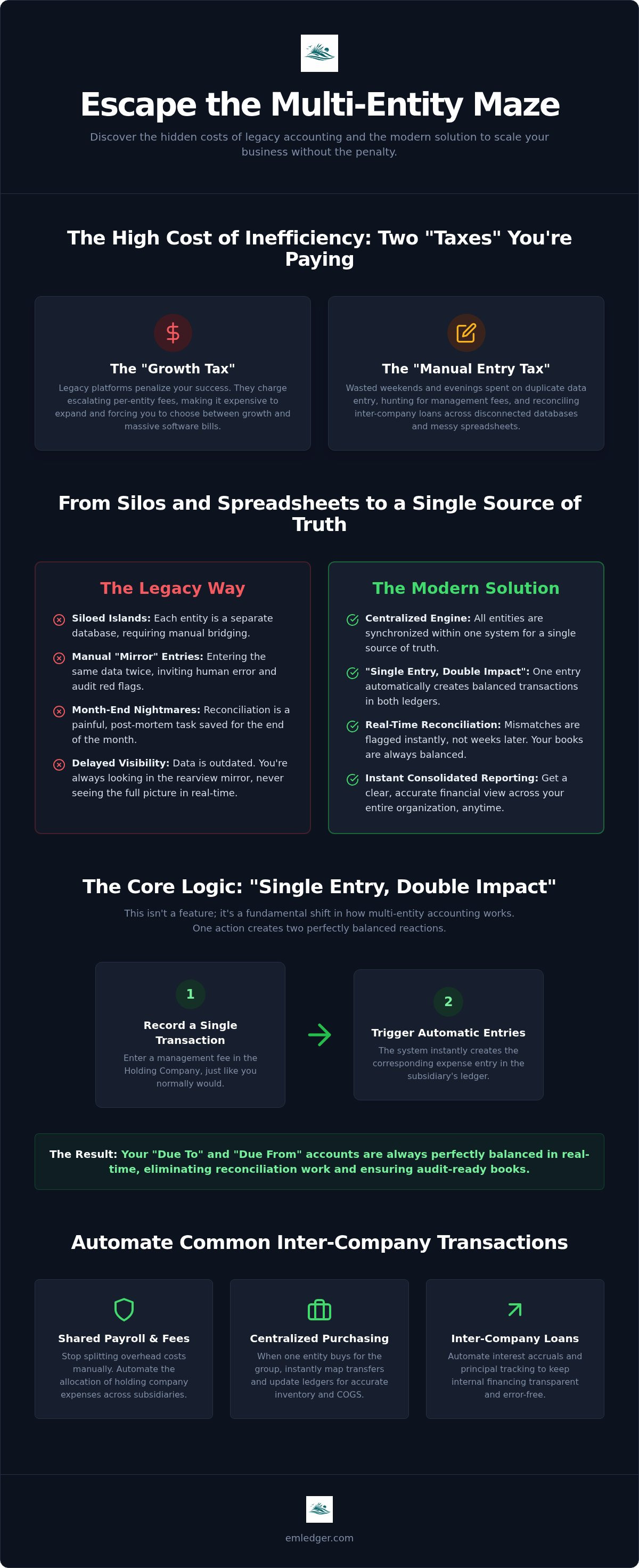
Scaling your business shouldn't feel like a punishment. Most legacy accounting platforms treat your success as a taxable event, charging you more for every new entity you add. It's a growth tax that forces you to choose between manual labor and massive software bills. If you're spending weekends reconciling inter-company loans or hunting for management fees across separate databases, you're paying a manual entry tax you never signed up for. Implementing inter-company transaction management software is the only logical exit from this complexity. It isn't a luxury feature. It's a fundamental requirement for the modern operator who values efficiency over busywork.
We understand the pain of a month-end close that drags into week three. You want real-time visibility, not a secondary data entry job. This article will show you how to automate inter-company accounting, eliminate duplicate entries, and scale without the legacy software surcharge. We'll explore how automated eliminations can streamline your consolidated reporting and why a logical pricing model is the fair way to grow. Stop fighting your software and start using a system built for the trenches. It's time to reclaim your time and your bottom line.
Key Takeaways
- Ditch the "growth tax" of legacy software that penalizes your success with per-entity fees.
- Discover how inter-company transaction management software synchronizes financial activity across entities to end manual duplicate data entry.
- Master the "Single Entry, Double Impact" logic to automate reconciliation and ensure your ledgers remain balanced in real-time.
- Build a scalable framework by standardizing your Chart of Accounts and establishing clear policies for inter-company loans and management fees.
- Transition to a CPA-built platform that provides instant consolidated reporting and a logical exit from accounting complexity.
What is Inter-Company Transaction Management Software?
Legacy accounting systems are fundamentally broken for multi-entity operators. They treat every LLC as a siloed island, forcing you to bridge the gaps with manual labor. This architectural flaw is where the "manual entry tax" begins. True inter-company transaction management software is the automated synchronization of financial activities between related entities. It's not just a digital ledger. It is a centralized engine that ensures every action in one entity triggers a corresponding, balanced reaction in another. By integrating Inter-company accounting logic directly into the workflow, this software replaces manual guesswork with mathematical certainty.
The status quo is a mess of spreadsheets and "mirror" entries. Modern software solves this by focusing on three core pillars: transaction creation, real-time reconciliation, and automated elimination. The primary goal is simple. You want a faster, error-free month-end close. You shouldn't need a team of three bookkeepers just to verify that Entity A's receivable matches Entity B's payable. Logic dictates that if the data exists in one place, it should exist everywhere it needs to be. Anything less is just administrative waste.
Common Inter-Company Transactions You Must Automate
If you're still typing these into separate databases, you're losing money. A professional-grade inter-company transactions engine should handle these without human intervention:
- Shared Payroll and Management Fees: Stop splitting overhead costs manually. Automate the allocation of holding company expenses across your subsidiaries.
- Centralized Purchasing: When one entity buys inventory for the group, the software should instantly map the transfers and update the respective ledgers.
- Inter-company Loans: Capital management shouldn't be a headache. Automate interest accruals and principal tracking to keep your internal financing transparent.
The High Cost of Manual "Mirror" Entries
Entering the same data twice is a recipe for reconciliation nightmares. It's a redundant process that invites human error at every keystroke. When Entity A records a receivable that Entity B forgets to enter, your balances become lopsided. These discrepancies don't just slow down your close; they create audit red flags. Tax authorities look for consistency. If your internal records don't match, you're practically inviting a deep-dive investigation into your transfer pricing and entity structure.
Manual errors lead to tax complications that are expensive to fix. You don't just pay in time; you pay in potential penalties and professional fees. Automated inter-company transaction management software acts as a logical shield. It ensures that every transaction is balanced from the moment of entry. It eliminates the "he-said, she-said" of multi-entity bookkeeping. You get a clean set of books, a faster close, and a scalable foundation that doesn't break when you add your next LLC.
How Automated Inter-Company Reconciliation Works
Reconciliation shouldn't be a post-mortem task you save for the end of the month. That's a legacy habit born from software that wasn't built for multi-entity management. Professional inter-company transaction management software operates on a "Single Entry, Double Impact" logic. It’s a simple premise: a transaction isn't complete until both sides of the ledger are balanced. When you record a management fee in your holding company, the system doesn't wait for you to remember the corresponding entry in the subsidiary. It triggers a balanced entry in both ledgers simultaneously. It’s a logical necessity, not a luxury. One entry. Two ledgers. Zero manual effort.
Automated matching identifies trading partner mismatches in real-time. If there is a discrepancy in dates, amounts, or account mapping, the system flags it before it becomes a month-end nightmare. You don't have to hunt through hundreds of rows in a spreadsheet to find why your "due to" doesn't equal your "due from." Centralized visibility gives you a single source of truth across every LLC you own. One dashboard shows you every balance, ensuring you aren't flying blind. This is why automated inter-company reconciliation is the only way to scale without adding headcount.
Real-Time Validation vs. Batch Processing
Waiting for the end of the month to reconcile is a legacy mistake that kills cash flow visibility. Batch processing belongs in the 90s. Modern accounting requires enforcing policy at the point of entry. By validating transactions as they happen, you prevent "unbalanced" entries from ever hitting your books. This gives you instant visibility into your "due to/due from" balances across the entire organization. You know your exact cash position at any given moment, making it easier to manage consolidated reporting and internal liquidity.
Automated Eliminations for Consolidated Reporting
Internal profits and debts aren't real revenue. They're just money moving from your left pocket to your right. For a clean consolidated view, these must be eliminated. Legacy systems force you into a manual spreadsheet trap to calculate these "wipe outs," which is a massive waste of resources. Transitioning to consolidated financial reporting software automates this entire process. Your consolidated P&L and Balance Sheet should reflect actual external performance. If your inter-company transaction management software isn't handling eliminations automatically, you're still paying a manual entry tax.
The Growth Tax: Why Legacy Software Pricing is a Scam
Success shouldn't come with a surcharge. Most legacy accounting platforms operate on a "per-entity" fee model that acts as a literal tax on your growth. If you're a serial entrepreneur managing multiple brands, adding a new LLC shouldn't triple your software bill. It’s a predatory practice designed to trap you as you scale. This is where inter-company transaction management software should offer a logical exit, not another recurring expense that eats your margin. Logic dictates that your software costs should reflect your stage of business, not the number of tax IDs you own.
The math is simple but painful. Legacy systems that charge hundreds of dollars per month for every single entity are effectively taxing your ambition. If you have ten entities, you shouldn't be paying thousands in software fees just to keep the ledgers open. This "per-entity" scam ignores the reality of modern business structures where entities often share resources, overhead, and ownership. At EmLedger, we've replaced this outdated model with tiered pricing. It’s a fair approach that allows you to manage multiple entities without the constant fear of the next invoice.
Why Per-Entity Pricing Stifles Innovation
Founders often hesitate to launch a new entity because the software overhead is too high. This psychological barrier kills innovation. When every new project requires a budget meeting just to justify the accounting software cost, the system is broken. Legacy giants like NetSuite and Sage Intacct are notorious for "nickel and diming" growing brands. They capitalize on your complexity by charging for:
- Individual subscriptions for every legal entity.
- Additional fees for consolidated reporting modules.
- Surcharges for basic inter-company mapping features.
Our stance is clear. We believe accounting software for growth stages should encourage expansion, not penalize it. You need a platform that scales alongside your vision, providing a predictable cost structure that respects your resources.
The "CPA-Built" Advantage
Generic ERPs are built by developers who have never closed a month-end for a multi-entity group. EmLedger is different. It’s built by a CPA who has been in the trenches and understands the granular headaches of management fees and loan interest. We’ve stripped away the corporate marketing fluff to focus on functional utility. We didn't build this for "enterprise stakeholders" sitting in a boardroom. We built it for the Straight-Shooting Expert who values transparency and logic. When you use inter-company transaction management software designed by a professional who knows the struggle of balancing "due to/due from" accounts, you get a tool that works for you. It’s a clean, logical exit from the complexity and cost of legacy software.
Building a Scalable Inter-Company Framework
Logic dictates that your financial framework is only as strong as its foundation. If your entities don't speak the same language, your software cannot bridge the gap. Building a scalable system requires more than just buying a tool; it requires a disciplined approach to data structure. You need a process that eliminates ambiguity and replaces it with mathematical certainty. Anything less is just a digital version of your existing spreadsheet chaos. To end the manual entry tax, you must follow a structured implementation path that prioritizes functional utility over corporate complexity.
- Step 1: Standardize your Chart of Accounts. Mapping entries between entities is impossible if "Management Fees" in Entity A are called "Administrative Services" in Entity B. Enforce a unified account structure across your entire organization to ensure clean data mapping.
- Step 2: Establish clear inter-company policies. Define the rules for management fees and loan interest before the first entry is made. Transparency at the start prevents reconciliation nightmares at the end.
- Step 3: Implement automated settlement workflows. Don't let transaction volume clog your system. Use automation to reduce the noise and keep your ledgers lean.
- Step 4: Audit your "due to/due from" accounts weekly. Waiting for the month-end close to find errors is a legacy mistake. Real-time visibility requires frequent validation.
- Step 5: Leverage professional software. Stop doing the heavy lifting manually. Use multi-entity accounting software to handle the synchronization and eliminations automatically.
Mastering Inter-Company Loans and Interest
Tracking principal and interest shouldn't involve manual spreadsheet calculations. It's a waste of your professional capacity. In the United States, transfer pricing is regulated under Section 482 of the Internal Revenue Code. As of 2026, global tax authorities have increased scrutiny on these transactions, demanding audit-ready frameworks that prove economic substance. Your inter-company transaction management software must ensure that loan entries are balanced and auditable across both entities. By using automated entries to handle recurring monthly interest charges, you eliminate the risk of lopsided balances and potential tax penalties.
Netting and Settlements: Reducing the Noise
Netting is the logical consolidation of multiple transactions into a single net settlement. Instead of sending fifty individual payments back and forth between subsidiaries, you settle the difference. This reduces bank fees. It simplifies cash management. It saves your bookkeeper hours of redundant work. Automating this process ensures that your cash flow remains fluid and your records stay clean. If you're ready to stop paying the "manual entry tax" on every internal transfer, it's time to automate your inter-company transactions with a system built for growth.
EmLedger: Professional-Grade Inter-Company Management
EmLedger isn't just another accounting tool. It's a disruptive alternative to the bloated, overpriced legacy systems that treat multi-entity businesses like cash cows. We built this because we were tired of seeing founders penalized for their success. Our inter-company transaction management software was designed from the ground up by a CPA to eliminate the manual entry tax. It's about functional utility. It's about logical scalability. It's about giving you back your time without draining your bank account. We’ve replaced the corporate-speak of enterprise ERPs with a platform that actually solves the granular headaches of the business operator.
The inter-company transactions engine is the core of our platform. It doesn't just record data; it synchronizes your entire financial ecosystem. We offer tiered plans to fit your current reality. Our Solo plan is for the focused operator. The Growth plan handles up to ten entities. The Scale plan supports up to twenty-five. Every plan includes the same professional-grade features. We’ve stripped away the corporate fluff to provide a "No-Nonsense" approach to financial transparency. You get the same powerful engine regardless of your size. You deserve a system that values your resources as much as you do. Logic dictates that your software should support your growth, not tax it.
The Logical Exit from Multi-Entity Complexity
Most small-to-mid businesses are stuck with consolidated reporting tools that are either too expensive or too basic. EmLedger provides a logical exit. Our platform integrates inventory management and bank reconciliation directly into the multi-entity workflow. This keeps your books clean and your audits painless. When you move inventory between subsidiaries, the system handles the entries. When you reconcile a shared bank account, the system maps the transactions. It’s the comprehensive financial solution multi-entity founders have been waiting for. No more siloed data. No more manual workarounds. Just clean, consolidated truth.
Ready to Stop Paying the Growth Tax?
The choice is simple. You can keep paying the per-entity penalty to legacy giants, or you can switch to a platform built for your growth. Explore the features that make EmLedger a disruptive force in the industry. We believe in fair pricing. We believe in functional software. We believe your accounting system should be an asset, not a liability. Stop fighting the manual entry tax and start scaling with confidence. Your inter-company transaction management software shouldn't be a source of frustration. Check out our pricing page today and see how we’ve killed the growth tax for good. It's time for a better way to manage your empire.
Scale Your Empire Without the Manual Entry Tax
The manual entry tax is a choice. You can continue to lose hours to redundant data entry, or you can embrace a system built for multi-entity logic. By implementing inter-company transaction management software, you eliminate the friction that stalls growth. You move from hunting for discrepancies to making data-driven decisions. Real-time consolidated reporting isn't a luxury for the enterprise; it's a necessity for every ambitious founder. It's time to stop treating your entities like siloed islands and start treating them like a unified empire.
EmLedger provides a CPA-built platform that rejects predatory industry norms. We don't believe in per-entity pricing scams that punish you for every new LLC you launch. We believe in functional utility and transparent scalability. You've done the hard work of building your business. Your software should be the engine that drives you forward, not the anchor that holds you back. Reclaim your resources. Focus on your vision. Let logic handle the ledgers.
Stop paying the Growth Tax; View EmLedger Pricing
Your success is the ultimate goal. Build it on a foundation that respects your time and your bottom line.
Frequently Asked Questions
How does inter-company transaction software reduce audit risk?
It provides a verifiable, real-time audit trail for every internal transfer. Automated inter-company transaction management software ensures that every entry in Entity A has a perfectly matching counterpart in Entity B. This consistency satisfies tax authorities looking for economic substance. It prevents the manual discrepancies and "mirror entry" errors that typically trigger deep-dive investigations into your transfer pricing.
Can I manage inter-company transactions for 10+ LLCs on one platform?
Yes, you can manage dozens of entities on a single dashboard. EmLedger’s Scale plan is specifically built for operators managing between 11 and 25 entities. It centralizes your data so you can see all inter-company balances in one place. You don't have to log in and out of separate databases or pay individual subscription fees for every LLC you own.
What is the difference between inter-company reconciliation and elimination?
Reconciliation is the process of matching "due to" and "due from" balances to ensure they align across ledgers. Elimination is the final step in consolidated reporting where internal revenues and expenses are wiped out. While reconciliation ensures your individual books are accurate, elimination ensures your consolidated P&L only reflects transactions with external parties. Both are essential for a clean close.
Does EmLedger support consolidated P&L and Balance Sheet reporting?
Yes, EmLedger provides real-time consolidated financial reporting across all your entities. The software automatically aggregates data and applies necessary eliminations based on your inter-company mappings. You get a clean, bird’s-eye view of your group’s actual performance. You don't have to manually combine balance sheets in Excel or fight with broken spreadsheet formulas every month.
Why is per-entity pricing considered a "Growth Tax"?
Per-entity pricing is a growth tax because it penalizes you for expanding your business structure. Legacy software companies charge you a full subscription for every new LLC you register, regardless of your actual transaction volume. This model turns your accounting software into a mounting overhead cost. It actively discourages innovation and multi-brand scaling by taxing your success.
How do automated inter-company entries prevent lopsided balances?
Automated entries use "Single Entry, Double Impact" logic to record both sides of a transaction simultaneously. When you record a management fee in the parent company, the inter-company transaction management software immediately creates the corresponding expense in the subsidiary. This prevents the common human error where one side of a loan is recorded but the other is forgotten or entered incorrectly.
Is EmLedger suitable for holding companies and franchises?
EmLedger is designed specifically for holding companies, franchises, and property managers who deal with multi-entity complexity. It handles the intricate "due to/due from" relationships inherent in these structures. Whether you are allocating shared payroll costs or tracking centralized inventory transfers, the platform provides the logical framework needed to manage multi-layered organizations without the administrative bloat.
Do I need a CPA to set up my inter-company transaction workflows?
You don't need a CPA to use the software, but the platform itself is CPA-built to ensure professional standards. The workflows are designed to be intuitive for business operators while maintaining the rigorous logic required for clean books. If you have a standardized Chart of Accounts, the initial setup is straightforward. It doesn't require a technical accounting degree to get started.


