

Your spreadsheet isn't a strategy; it's a ticking time bomb. Most inventory management systems on the market today are designed to trap you in a cycle of manual data entry and predatory per-entity pricing. If your stock levels don't live directly inside your ledger, you aren't running a business; you're managing a series of expensive guesses. You know the frustration of syncing data between multiple LLCs while your software provider demands a fresh fee for every new entity you add. It's a tax on your ambition. It's inefficient, it's expensive, and it's unnecessary.
We agree that growth shouldn't be penalized by greedy software models. This guide shows you how to choose a system that integrates with your accounting and scales without the predatory fees. You'll learn the framework for achieving real-time stock accuracy, automating your financial reporting, and managing multiple business units under one roof. We are moving past the era of fragmented data and logic-free pricing. Here is the blueprint for a consolidated, transparent operation that respects your bottom line.
Key Takeaways
- Stop relying on spreadsheets. Learn why manual data entry is a liability that prevents your business from scaling effectively.
- Avoid the "Software Frankenstein." Discover why integrated logic is superior to connecting multiple standalone apps that don't talk to your ledger.
- Scale without predatory fees. Find out how to select inventory management systems that support multiple LLCs without taxing your growth.
- Audit your operations. Follow a logical framework to purge ghost inventory and map inter-company workflows for total visibility.
- Turn inventory into a financial discipline. Move from periodic manual counts to real-time perpetual accuracy for instant P&L reporting.
The Inventory Management Myth: Why Most Systems Fail the Growth Test
Inventory management isn't just about counting boxes in a warehouse. It is the systematic control of stock from acquisition to final sale. But the industry has lied to you. It has sold you on the idea that "all-in-one" means simple, when usually it just means "expensive and disconnected." Most founders start with a spreadsheet. They end up in a manual data-entry nightmare. This is where the "Growth Tax" begins. Legacy inventory management systems often punish your success. They demand a fresh fee for every new warehouse, every new location, and every new LLC you add to your portfolio. It's predatory. It's illogical. It's a barrier to your scale.
The Spreadsheet Ceiling: When "Good Enough" Becomes Dangerous
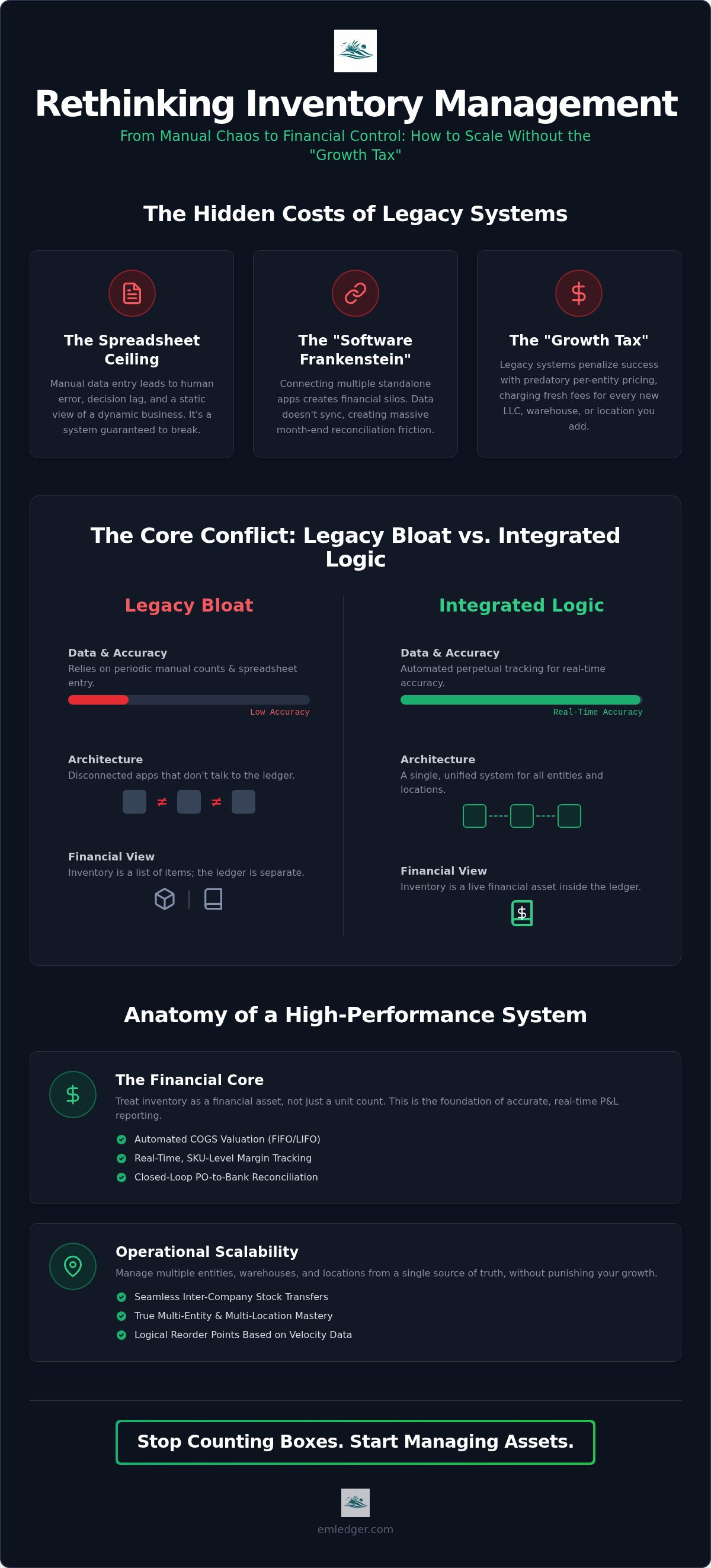
"Good enough" is a dangerous phrase in financial management. Spreadsheets are static. Your business is not. Manual tracking carries a massive hidden cost in the form of human error. One mistyped SKU or one forgotten line item cascades through your entire supply chain. Then there's the lag time. Yesterday's stock data is useless for today's decisions. If you're waiting for a manual update to know if you can fulfill an order, you've already lost the sale. At its core, inventory management is a financial integrity tool, not just a list of items in a room.
The Disconnect Between Warehouse and Ledger
Your CPA likely hates your standalone inventory software. Why? Because standalone apps are financial silos. They track quantities but fail to track value with precision. This creates massive friction during month-end reconciliations. You're left chasing inter-company transfers and trying to justify why your physical counts don't match your general ledger. High-performance inventory management systems must bridge this gap. You need to move from "counting boxes" to "managing assets." If your inventory system doesn't live inside your ledger, you're just maintaining a digital version of a clipboard. It's time to demand a system that treats your inventory as the liquid asset it actually is. Your software should support your growth, not tax it through complexity and hidden fees.
Anatomy of a High-Performance Inventory Management System
A real system doesn't just list what's on the shelf. It tracks the financial pulse of every unit. While many founders search for the best inventory management software based on a sleek user interface, the real winners look at the accounting architecture under the hood. High-performance inventory management systems prioritize perpetual tracking over periodic manual counts. Periodic counts are an admission of failure. They suggest you've lost control of your data between audits. Perpetual tracking ensures your books are accurate every second of the day, reflecting the true state of your business without the need for a weekend-long warehouse shutdown.
The Financial Core: COGS and Valuation
Accuracy starts with the Cost of Goods Sold (COGS). If your system doesn't automate FIFO or LIFO valuation, you're setting yourself up for a tax-season disaster. Manual COGS calculations are where profits go to die. An integrated system links purchase orders directly to bank reconciliation workflows. This creates a closed loop. Every dollar spent on stock is tracked from the moment it leaves your bank account until the final product leaves your warehouse. Real-time margin tracking at the SKU level isn't a luxury. It's a requirement for survival. If you don't know your exact margin on a Tuesday afternoon, you can't make the right pricing decisions on Wednesday morning.
Operational Scalability: Multi-Location Mastery
Managing one warehouse is easy. Managing three warehouses, four retail points, and stock in transit across two different LLCs is where legacy software breaks. You need inventory management systems that actually understand multi-entity structures. This means handling inter-company transactions and stock transfers without manual journal entries. It means setting logical reorder points based on real velocity data, not gut feelings. Capital shouldn't be tied up in stagnant boxes. It should be moving. True visibility requires a system that talks to your bank and your ledger simultaneously. If you're tired of the "Software Frankenstein" approach, it's time to look at a consolidated reporting framework that treats your inventory as a live financial asset rather than a warehouse headache.
Legacy Bloat vs. Integrated Logic: Choosing Your Architecture
Architecture is destiny. Choosing the wrong foundation for your inventory management systems is like building a skyscraper on sand. Most vendors push you toward two extremes: the bloated enterprise monster or the fragile standalone app. Both are fundamentally flawed. Both cost you more than they should. One traps you in complexity; the other traps you in a web of brittle integrations. Neither respects your bottom line.
The Real Cost of Enterprise Software
Enterprise ERPs are marketed as the "gold standard" for a reason. That reason is usually to justify six-figure implementation fees. These systems thrive on complexity. They are designed for companies with massive IT departments and even larger budgets. You'll encounter hidden fees for training, maintenance, and the inevitable "consultant trap" where you pay an expert just to run a basic report. You shouldn't need a PhD to check your stock levels. These platforms use complexity as a feature to justify predatory per-entity pricing. If you are searching for Multi-Entity Accounting Software, you need a system that scales with your logic, not your seat count.
Per-user and per-entity pricing models are a scam. They are designed to tax your success. Adding a new warehouse or a new LLC shouldn't double your software bill. It's an arbitrary cost that has nothing to do with the actual value provided. It's a penalty for growing your business.
The Logic of Integration
On the other side of the spectrum, standalone apps offer a cheap entry point. But they quickly create a "Software Frankenstein." You end up with a mess of integrations that barely talk to each other. One software update breaks the connection between your warehouse and your bank reconciliation. Your data becomes fragmented. Your visibility vanishes. Logic dictates a different path: the accounting-first system.
An accounting-first approach provides a single source of truth. It reduces your software stack and saves your sanity. When your inventory lives inside your ledger, financial reporting becomes a byproduct of your operations, not a separate, manual project. Modern Inventory Management Systems focus on this integrated logic. They eliminate the friction of inter-company transfers and provide real-time visibility without the enterprise bloat. You deserve a system built for multi-entity founders who value transparency over corporate-speak. It's time to stop paying the growth tax and start using a system that actually makes sense.
Implementing Inventory Control Without the "Growth Tax"
Implementation isn't a software install; it's a process overhaul. Most inventory management systems fail because they're built on a foundation of bad data. You can't automate a mess. You need a logical roadmap that prioritizes financial integrity over flashy features. Start by auditing your current stock and purging "ghost inventory." These are the phantom items that exist on your spreadsheet but haven't been seen in the warehouse for months. If you don't clear the deck now, you're just moving your problems into a more expensive digital room.
Follow these five steps for a clean transition:
- Step 1: Audit your data and delete every SKU that hasn't moved in two years.
- Step 2: Map your inter-company workflows to define exactly how stock moves between LLCs.
- Step 3: Select a plan-Solo, Growth, or Scale-that matches your current volume without taxing your future expansion.
- Step 4: Automate the low-hanging fruit by connecting bank feeds and setting up auto-generated purchase orders.
- Step 5: Review consolidated reports weekly to identify where your margins are leaking.
Data Integrity: The Foundation of Scale
Bad data in a new system is just automated chaos. If your SKU naming conventions are inconsistent across different entities, your consolidated reporting will be a fiction. You need a single, unified language for your products. This clarity allows you to track a unit from the initial purchase order to the final sale across any business unit you own. The Growth Tax is the collection of unnecessary per-entity software fees designed to penalize you for expanding your footprint. By establishing data integrity early, you bypass the need for expensive consultants to "fix" your reporting later. It's about building a system that works for you, not one that requires a full-time employee just to maintain it.
The Multi-Entity Roadmap
Managing multiple LLCs shouldn't feel like running several different companies with no connection. You need a roadmap that leads to a single source of truth. This means choosing Consolidated Financial Reporting Software that handles the heavy lifting of inter-company eliminations and transfers. Your team needs a "no-nonsense" system that values logic over marketing fluff. When everyone follows the same workflow, training becomes simple and errors vanish. You can finally stop chasing spreadsheets and start making decisions based on real-time financial data. If you're ready to escape the manual data-entry trap, explore our transparent pricing plans and see how logical inventory management actually works.
EmLedger: The Only Inventory System Built for Multi-Entity Founders
EmLedger isn't just another software choice. It's a rejection of legacy bloat. We built this platform because we were tired of watching founders struggle with fragmented inventory management systems that don't talk to their accounting. It was built by a CPA who lived through the pain of manual consolidations and the frustration of "Software Frankenstein" setups. We've stripped away the corporate fluff to deliver a system that values logic and financial integrity above all else. This isn't about counting boxes; it's about mastering your assets. Our approach is direct. Our logic is sound. We believe software should be a bridge to growth, not a barrier.
The EmLedger Difference: Accounting-First Inventory
Our inventory module is built directly into the ledger. It isn't a third-party bolt-on that requires a fragile API to function. When you buy stock, the transaction hits your bank feed and your inventory sub-ledger simultaneously. This creates a seamless loop for automated bank reconciliation. You don't have to spend your weekends matching purchase orders to bank statements. The system does the heavy lifting for you. This integrated logic ensures that your P&L is always accurate and your balance sheet reflects reality. Most systems force you to reconcile between two different databases. EmLedger eliminates that friction entirely. You can view our transparent options on the EmLedger Pricing page to see how we've eliminated the hidden costs of scaling.
Scaling Without Friction
Growth shouldn't be a penalty. Most legacy providers use a per-entity pricing model that acts as a tax on your expansion. We don't. Whether you're on the Solo, Growth, or Scale plan, our pricing respects your journey. Our architecture is designed to handle complex holding company structures and dozens of LLCs under one roof. You get direct access to consolidated P&L statements and balance sheets without the manual spreadsheet trap. You can track inter-company transactions with a single click. You can manage stock across multiple locations without losing your sanity. We've replaced the "Growth Tax" with a logical pathway to scale. It's time to stop the bleeding. It's time to move toward a system that actually makes sense for your business. Stop the bleeding and start scaling with EmLedger.
Take Command of Your Assets and Your Growth
You've seen the trap. Legacy software providers want to tax your success with per-entity fees and fragmented integrations. Spreadsheets are a liability, not a strategy. Standing in the way of your scale are outdated inventory management systems that ignore the financial reality of your ledger. It's time to reject the status quo and move toward a system built for the trenches. You deserve a platform that treats your inventory as a live financial asset rather than a warehouse headache.
EmLedger was built by a CPA who understands the granular pain of multi-entity management. We offer real-time consolidated reporting and automated bank reconciliation without the predatory per-entity fees. You get a direct, logical line to your inter-company transactions and financial integrity. No more manual data entry. No more expensive guesses. Just clean, professional accounting that supports your ambition instead of penalizing it. It's time to stop the bleeding and start scaling with a system that actually makes sense for real founders.
Get the No-Nonsense Inventory System for Your Multi-Entity Business. Your business deserves a foundation built on transparency and logic. Take the first step toward a more efficient future today.
Frequently Asked Questions
What is the best inventory management system for multiple LLCs?
The best system for multiple LLCs is one that treats your entities as a unified portfolio rather than a series of billable accounts. You need a platform that offers multi-entity accounting and consolidated reporting without predatory per-entity fees. EmLedger is built specifically for this scenario. It allows you to manage stock across various legal structures while maintaining a single, logical ledger. Most inventory management systems fail here by taxing your growth instead of supporting it.
Do I really need a separate inventory system if I have accounting software?
You don't need a separate system if your accounting software includes native inventory logic. Bolt-on applications often create financial silos that hide your true margins. A separate app requires a fragile integration that can break and leave your data fragmented. Using an integrated system ensures your warehouse data and your ledger are always in sync. This eliminates the need for manual reconciliation and provides real-time visibility into your actual business performance.
How does inventory management affect my consolidated financial reporting?
Inventory management provides the raw data for your Cost of Goods Sold and asset valuations. If this data is trapped in a standalone app, your consolidated financial reporting becomes a manual nightmare. You're forced to export spreadsheets and manually eliminate inter-company transfers. An integrated system automates these eliminations. It ensures that your consolidated balance sheet reflects the true value of your stock across every entity without the risk of double-counting or human error.
Can I track inventory across multiple locations with EmLedger?
Yes, you can track stock across warehouses, retail points, and transit without extra fees. EmLedger is designed for multi-location mastery. It allows you to see exactly where your assets are at any given moment. This level of visibility is essential for preventing stockouts and avoiding capital tie-up. Unlike legacy providers, we don't believe you should be penalized for expanding your physical footprint. Your software should scale as fast as your operations do.
What is the "Growth Tax" in inventory software pricing?
The "Growth Tax" is a predatory pricing model where software vendors increase your bill every time you add a new entity, location, or user. It's a penalty for success. These legacy inventory management systems extract more value from you as you scale, even if the software's utility remains the same. We reject this logic. Your software costs should be predictable and rational, not a variable expense that punishes your ambition and complicates your financial planning.
How do inter-company transactions work with inventory systems?
Inter-company transactions should be automated movements of value and quantity between your various LLCs. In a high-performance system, a transfer from Entity A to Entity B automatically updates both ledgers and adjusts stock levels in real time. This removes the need for manual journal entries that often lead to accounting errors. It ensures that your internal supply chain is as transparent as your external one, keeping your inter-company accounts perfectly balanced at all times.
Is it possible to automate inventory bank reconciliation?
It's absolutely possible if your system is built with an accounting-first architecture. By linking your purchase orders directly to your bank feeds, the software can match transactions automatically. This eliminates the tedious process of hunting down receipts and matching them to bank statements. Automated bank reconciliation for inventory ensures your cash flow data and stock levels are always aligned. It's a common-sense solution that saves hours of manual labor every month.
What is the difference between perpetual and periodic inventory systems?
Perpetual systems track every transaction in real time, while periodic systems rely on manual counts at the end of a period. Periodic systems are backward-looking and prone to error. They leave you blind to your actual stock levels for weeks at a time. Perpetual systems provide instant accuracy and real-time margin tracking. If you want to make data-driven decisions on a Tuesday, you can't rely on a count that only happens once a month.


