

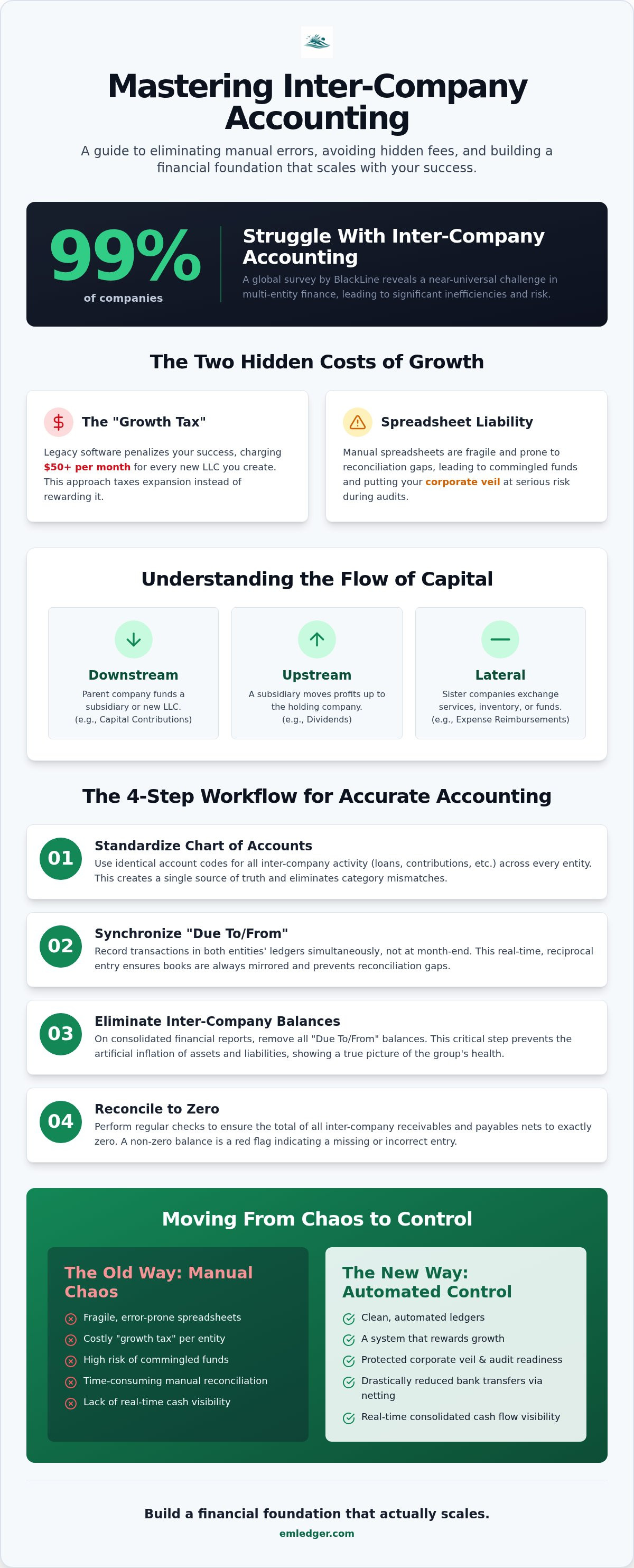
99% of companies struggle with inter-company accounting, according to a global survey by BlackLine. It's a staggering figure that highlights a fundamental flaw in how we handle multi-entity finance. You've felt it too. Every time you add a new LLC, your legacy software hits you with a "growth tax" of $50 or more per month. Meanwhile, your manual spreadsheets are riddled with reconciliation gaps that put your liability protection at risk. Learning how to manage inter-company transfers shouldn't feel like you're being penalized for your own success.
You deserve clean, automated ledgers and real-time visibility into your consolidated cash flow. We agree that the current industry standard is broken. This guide will show you how to stop the spreadsheet bleeding and master the logic of internal movements without the technical debt. We'll explore the latest 2026 regulatory updates, including IFRS and OECD changes, and provide a scaling path that rewards growth instead of taxing it. It's time to move beyond the manual errors and build a financial foundation that actually scales.
Key Takeaways
- Master the logic of flow. Understand upstream, downstream, and lateral transfers to keep your multi-entity books logically sound.
- Learn how to manage inter-company transfers with a standardized chart of accounts. It is the only way to kill manual reconciliation gaps for good.
- Reject the industry growth tax. Stop paying legacy software providers a premium just for being successful and adding new entities.
- Implement inter-company netting. Drastically reduce physical bank transfers while maintaining real-time visibility into consolidated cash flow.
- Protect your corporate veil. Move beyond fragile spreadsheets that lead to commingled funds and audit nightmares.
What Are Inter-Company Transfers and Why Do They Break Your Books?
Inter-company transfers are the financial exchanges between entities under the same parent umbrella. They represent the circulatory system of your business. If the flow stops or leaks, the whole body suffers. Understanding Intercompany accounting isn't just about balancing books. It is about maintaining the integrity of your corporate structure. When you don't know how to manage inter-company transfers, you aren't just making an accounting mistake. You are creating a legal liability.
Manual tracking is an invisible profit killer. It forces you to waste hours on "due to" and "due from" entries that should take seconds. A global survey by BlackLine found that 99% of companies experience difficulties with their inter-company processes. Friction like this prevents you from seeing your actual cash position. It turns your growth into a logistical nightmare. You end up managing spreadsheets instead of managing your business.
- Loans: Funds moved with a clear expectation of repayment and interest.
- Capital Contributions: Permanent equity injections used to bolster a subsidiary's balance sheet.
- Expense Reimbursements: Pass-through costs where one entity covers a bill for another sister company.
The Flow of Capital: Upstream vs. Downstream
Capital moves in three distinct directions. Upstream transfers move profits from a subsidiary up to the holding company. Downstream transfers happen when the parent company funds a new venture or LLC. Lateral transfers involve sister companies exchanging inventory or services. Each direction has different tax implications. Each requires a specific ledger logic to remain compliant with standards like the 2026 IFRS updates. Mixing these up is a fast track to an audit. Logic must dictate the entry, not convenience.
The Risk of Commingling and Liability
Separate bank accounts are the bare minimum. They are not a shield. If your ledger entries don't perfectly mirror physical cash movement, you risk "piercing the corporate veil." This legal failure makes you personally liable for business debts. It happens when auditors see commingled funds and messy records. Clean entries are your only defense. Implementing automated inter-company reconciliation is the logical way to maintain legal separation. It ensures every entity stands on its own two feet while you keep a bird's-eye view of the whole operation. Don't let a lack of knowledge on how to manage inter-company transfers destroy the liability protection you worked so hard to build.
The 4-Step Workflow for Accurate Inter-Company Accounting
Legacy software providers want you to believe that multi-entity accounting is a dark art. They use this complexity to justify "growth taxes" and per-entity fees. The reality is simpler. It's about logic. If you want to know how to manage inter-company transfers without losing your mind, you need a repeatable workflow that doesn't rely on human memory or fragile spreadsheet formulas. You need a system where data flows as fast as your capital.
Standardizing your chart of accounts is the first line of defense. If Entity A categorizes a transfer as "Intercompany Loan" but Entity B records it as "Other Income," your consolidated reports will be a mess. You need a unified mapping that forces consistency across every LLC you own. This isn't just about clean books. It's about having a single version of the truth that survives an audit. Follow these four steps to regain control over your internal economy.
- Standardize: Use identical account codes for inter-company activity across the board.
- Synchronize: Record the transaction simultaneously in both the "Due To" and "Due From" ledgers.
- Eliminate: Execute the elimination process to prevent "double-counting" revenue on consolidated reports.
- Reconcile: Perform monthly checks to ensure the total inter-company balance is exactly zero.
Step 1 & 2: Identification and Real-Time Recording
Waiting until month-end to record transfers is a recipe for disaster. It leads to forgotten entries, lost receipts, and massive reconciliation gaps that take days to fix. You need "Due To/From" accounts that mirror each other exactly. Due to/from accounts are the reciprocal ledger entries that track what one entity owes to or is owed by another sister company within the same group. When these accounts don't match, your balance sheet is a lie. Real-time recording ensures that both sides of the transaction are captured while the details are fresh. It's the only way to scale without the "growth tax" of manual cleanup.
Step 3 & 4: Elimination and Reconciliation
Elimination is the process of removing internal noise from your consolidated P&L reporting. If Entity A sells services to Entity B, that revenue isn't "real" at the group level. You must eliminate it to prevent artificial inflation of your profit margins. This logic applies to inter-company loans and expense sharing alike. Finally, enforce the "Zero-Sum" rule. At the end of every month, the total of all "Due To" accounts must perfectly offset the "Due From" accounts. If the net balance isn't zero, you have a leak. Finding that leak in a spreadsheet is a nightmare. Using automated inter-company tools turns this manual slog into a push-button verification. Mastering how to manage inter-company transfers means moving from reactive cleanup to proactive control.
Why Spreadsheets Are a Liability for Multi-Entity Transfers
Many founders start with Excel because it feels free. It isn't. You are paying for it with your time, your accuracy, and your liability protection. When you are trying to figure out how to manage inter-company transfers, a spreadsheet is a fragile bridge. One broken formula in a hidden tab can ruin your tax return or trigger an expensive audit. It’s a manual process that doesn't scale. It only breaks under the weight of your success.
Manual entries lead to "ghost" balances. These are the one-sided entries that haunt your balance sheet for years. Entity A records a $10,000 transfer, but Entity B’s bookkeeper misses the email. Suddenly, your consolidated cash flow is a work of fiction. This isn't just an accounting headache. It’s a strategic failure. You can't make informed decisions when your data is trapped in a version-control nightmare. You need a system that enforces the logic of every transaction.
The Fragility of Manual Consolidation
Managing 10+ LLCs via spreadsheet is a recipe for disaster. You end up with multiple versions of the "Final_Final_v2" file. The risk of error grows exponentially with every new entity you add. This is why multi-entity accounting software is an investment, not an expense. It replaces human error with logical automation. It ensures that every "Due To" has a corresponding "Due From" in real-time. Without this, you're just guessing at your actual net worth.
The 'Growth Tax' of Legacy Software
If you move away from spreadsheets, legacy software companies are waiting to penalize you. They charge a "growth tax." Why does adding a new LLC cost you $50 or more per month in "big name" software? There is no logical reason for it. The software isn't doing ten times more work for ten entities. They are simply taxing your success. It’s a predatory pricing model that actively discourages serial entrepreneurship and complex corporate structures. It makes no sense to pay more just because you're organized.
We built a better way. At EmLedger, our pricing logic is based on features and functionality, not a head-count of your companies. Whether you have four entities or fifteen, you shouldn't be penalized for expanding your portfolio. Our Growth and Scale plans are designed to support your ambition, not drain your bank account. Stop spending your Sundays in spreadsheet hell. Master how to manage inter-company transfers with a system that actually rewards your growth instead of treating it like a revenue stream for legacy vendors.
Optimization Strategies: Moving from Chaos to Control
If you've followed the basic workflow, you've stopped the bleeding. Now, it's time to optimize. Learning how to manage inter-company transfers efficiently means reducing the noise. Inter-company netting is a logical first step. Instead of Entity A sending $5,000 to Entity B, and Entity B sending $3,000 back, you net the difference. You make one physical bank transfer of $2,000. This reduces bank fees. It minimizes administrative overhead. It keeps your cash where it belongs: working for you.
Centralizing master data is equally critical. If your entities use different names for the same vendor, your consolidated reporting will be a fractured mess. Standardization isn't a suggestion; it's a requirement for clarity. You also need formal inter-company loan agreements. The IRS doesn't care about your "internal logic" if it isn't documented. Draft formal agreements for recurring transfers to satisfy audit requirements. This proves your entities are distinct legal actors and protects your corporate veil.
Establishing Centralized Treasury Standards
Standardizing your month-end close process is the only way to ensure group-wide accuracy. You can't have one entity closing on the 3rd and another on the 10th. Consistency is the foundation of logic. Set clear transfer pricing rules for internal services to avoid tax headaches. This is where automated inter-company entries become essential. If you own more than three entities, manual entry is no longer a viable strategy. It is a bottleneck that will eventually choke your growth.
Automating the Elimination Process
Inter-company eliminations are the act of removing internal transactions to show true external performance. Without this step, your revenue looks inflated and your expenses are lies. Modern software identifies matching entries and zeros them out automatically. You get a real-time consolidated balance sheet without clicking "export" ten times or wrestling with VLOOKUPs. This level of control is what separates a professional operator from a hobbyist. If you are ready to exit the chaos, explore how EmLedger automates your multi-entity transfers.
EmLedger: Inter-Company Management Built for Growth
Legacy software companies treat your success like a revenue stream. They charge a "growth tax" for every new entity you add. It is a predatory model that ignores the reality of modern business. We built EmLedger to break that cycle. It is the logical answer for founders who need to know how to manage inter-company transfers without being penalized for scaling. We offer no-nonsense entity management. You add LLCs based on your strategy, not your software budget.
EmLedger was built by a CPA who spent years in the trenches of multi-entity operations. It handles the granular headaches that general-purpose tools ignore. Our integrated inter-company tools record both sides of a transaction automatically. No more "ghost" balances. No more one-sided entries. You get real-time consolidated reporting that shows the health of your entire empire in a single click. It is a rational solution for a complex problem. You get the authority of an enterprise system with the agility of a startup tool.
From Solo to Scale: Pricing That Makes Sense
Our plans are designed to grow with you. The Solo Plan is perfect for the founder launching a second or third venture. It covers 1-3 entities for a flat, transparent fee. As you expand, the Growth and Scale Plans offer advanced inventory management and sophisticated reporting for high-velocity operators. The Growth Plan supports up to 15 entities. We don't hide behind complex sales calls or hidden surcharges. You can check out the EmLedger pricing to see the logic for yourself. We value transparency over marketing fluff.
Stop the Spreadsheet Bleeding Today
The common workflow of relying on basic accounting software alongside multiple spreadsheets is a liability. It is a slow-motion train wreck waiting for an audit. EmLedger replaces that chaos with a single, unified system. Our bank reconciliation works across multiple entities simultaneously. It ensures your "Due To" and "Due From" accounts stay in perfect sync. This is how to manage inter-company transfers like a professional. You gain the ability to close your books in hours, not weeks. Stop wasting Sundays on manual reconciliation. Start managing your inter-company transfers logically with EmLedger.
Build Your Empire on Logic, Not Spreadsheets
You've seen the risks. Fragile spreadsheets and predatory per-entity fees are holding your business back. Mastering how to manage inter-company transfers isn't just about clean ledgers; it's about protecting your corporate veil and gaining the clarity needed to scale. You shouldn't be penalized for adding a new LLC to your portfolio. Legacy software companies want to tax your success. We want to facilitate it.
EmLedger provides a clean exit from the chaos. Our platform was built by a CPA who understands the granular headaches of multi-layered management. We offer real-time consolidated reporting and a pricing model that actually makes sense. You get the tools to automate your workflow without the hidden costs of big-name software. It's time to stop the spreadsheet bleeding and start operating with total visibility. Your growth is a calculation, not a gamble. Take the logical step toward a more efficient financial future today.
Stop paying the Growth Tax; Get EmLedger for your multi-entity business
Frequently Asked Questions
What is an inter-company elimination and why is it necessary?
An inter-company elimination is the process of removing internal transactions from your consolidated financial statements. It's necessary because internal revenue isn't "real" profit at the group level. If you don't eliminate these entries, you artificially inflate your income and expenses. This creates a distorted view of your external performance. Accurate eliminations ensure your consolidated reporting reflects the actual health of your business empire.
How do I track inter-company loans without a CPA?
You can track loans by using reciprocal "Due To" and "Due From" accounts in your ledger. This is the foundation of how to manage inter-company transfers without a CPA. Every time you move money, you must record it as a liability for the receiver and an asset for the sender. Use a formal loan agreement to satisfy IRS audits. Automated tools ensure these entries match perfectly every time.
Is it illegal to move money between my own LLCs?
It isn't illegal to move money between your LLCs, but it is dangerous if done poorly. You must document every transfer as a loan, contribution, or reimbursement. Moving cash without a ledger entry is called commingling. This can lead to a court piercing your corporate veil. If that happens, your personal assets are no longer protected from business liabilities. Logic dictates clean documentation for every move.
Can I use one bank account for multiple businesses?
You can, but you shouldn't. Using one account for multiple entities is an invitation for an audit. It makes bank reconciliation a nightmare and blurs the lines between separate legal entities. Proper multi-entity management requires separate bank accounts for each LLC. This keeps your cash flow transparent. It ensures your liability protection remains intact while you learn how to manage inter-company transfers across your group.
What is the best software for managing 10 different LLCs?
EmLedger is the logical choice for managing 10 or more LLCs. Unlike legacy software, we don't charge a "growth tax" for every new entity you add. Our Growth and Scale plans offer automated inter-company entries and real-time consolidated reporting. It’s built specifically for operators who are tired of paying per-company fees. You get enterprise-level control without the enterprise-level price tag.
What happens if my inter-company accounts don't balance at month-end?
If your accounts don't balance, your financial reports are fiction. An imbalanced inter-company ledger means one entity recorded a transaction that the other didn't. This creates "ghost" balances that haunt your balance sheet. You'll spend hours hunting for the error in spreadsheets. It’s a sign that your manual process is failing. Automated reconciliation prevents these gaps by recording both sides of the transaction simultaneously.
How does inter-company netting save on bank fees?
Inter-company netting reduces bank fees by consolidating multiple internal payments into a single net transfer. Instead of sending five separate wires between sister companies, you calculate the net difference and move that amount once. This slashes transaction costs. It also reduces the administrative burden on your team. Netting turns a complex web of transfers into a clean, logical flow of capital.
What is the 'Growth Tax' in accounting software?
The "Growth Tax" is the predatory pricing model used by legacy accounting software. They charge you an extra monthly fee for every new LLC you add to your account. This penalizes you for being successful and organized. There’s no technical reason for these costs. It’s a way for big-name vendors to extract more profit from growing brands. We believe you should pay for features, not the number of entities you own.


