

Your software provider is taxing your growth. Every time you scale, open a new location, or launch a new legal entity, they hit you with a "per-entity" fee that eats into your hard-earned margins. It is a predatory industry standard that makes multi-entity inventory management for retail feel like a penalty rather than a strategy. You built a business to create value, not to fund a legacy software vendor's bloated bottom line.
You already know the drill. Sunday nights are spent in spreadsheet purgatory, manually reconciling inter-company stock transfers and chasing real-time visibility that never quite arrives. It is exhausting. It is inefficient. It is unnecessary. Managing stock across several LLCs shouldn't require a team of bookkeepers or a blank check for licensing fees. You deserve a system that scales at the speed of your ambition, not at the speed of your software budget.
This article promises a clean, logical exit from that complexity. You'll discover how to establish a single source of truth across all your entities, automate your consolidated reporting, and switch to a fair pricing model that doesn't punish you for winning. We are stripping away the marketing fluff to focus on the practical tools you need to manage a growing retail group with total clarity.
Key Takeaways
- Distinguish between simple multi-location tracking and true multi-entity inventory management for retail that spans legally distinct LLCs and brands.
- Identify and eliminate the "Growth Tax"—predatory per-entity software fees that penalize you for expanding your store footprint.
- Automate inter-company transactions to remove manual "due-to/due-from" entries and end the cycle of Sunday night spreadsheet reconciliation.
- Establish a Global Product Catalog to standardize SKUs across all entities, ensuring a single source of truth for your entire group.
- Transition from fragmented "shadow accounting" to a unified, CPA-designed system that scales at the speed of your ambition.
The Retailer’s Dilemma: Multi-Location vs. Multi-Entity Inventory
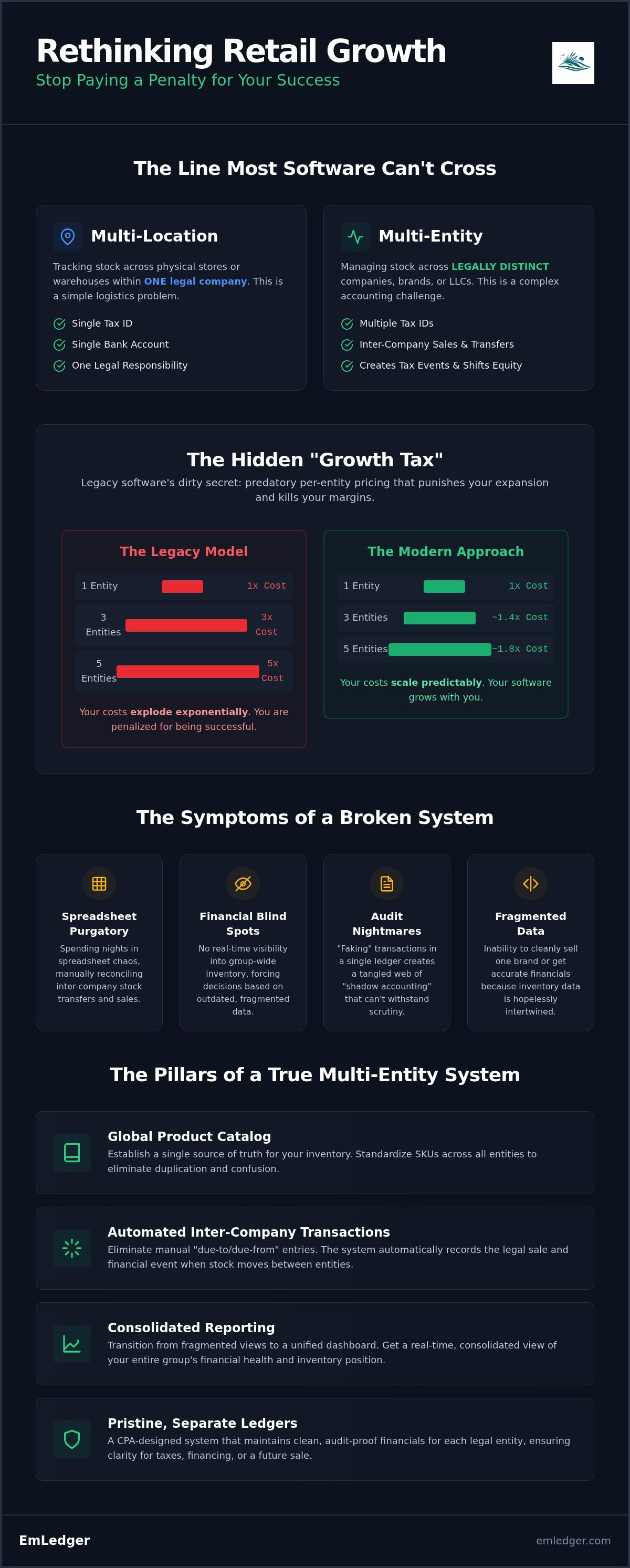
Most retail software treats growth as a logistical hurdle. It focuses on bins, warehouses, and shelf space. But for the ambitious operator, growth eventually hits a wall that logistics cannot scale. This is the distinction between multi-location and multi-entity operations. Multi-location inventory is simple. It is tracking stock across physical bins within a single company. One tax ID. One bank account. One legal responsibility.
True multi-entity inventory management for retail is an accounting challenge disguised as a warehouse problem. It involves managing stock across legally distinct LLCs or brands. When you move a product from Company A to Company B, you aren't just moving a box. You are executing a legal sale. You are creating a tax event. You are shifting equity. Most Inventory management software is built for the single-entity world. It lacks the logical architecture to handle inter-company transfers, leaving you to "fake it" with manual workarounds.
When Multi-Store Becomes Multi-Entity
The shift usually happens at a specific trigger point. Perhaps you launched a second brand to capture a different market segment. Maybe you created a holding company for liability protection. Or you expanded into a territory with unique legal requirements. At this moment, your single-entity POS breaks. It cannot reconcile the fact that Store 1 and Store 2 are owned by different legal persons. Faking these transactions in a single ledger is an audit nightmare. Clean financial exits require separate, pristine ledgers from day one. You cannot sell a brand if its inventory is tangled in a web of "shadow accounting" and shared spreadsheets.
The Data Model of a True Retail ERP
A functional system finds the "golden balance" between shared catalogs and separate ledgers. You need a global product catalog so you aren't duplicating SKUs across ten different entities. However, you also need native multi-entity inventory management that treats each company as its own financial universe. Real-time visibility is non-negotiable for cash flow. You cannot wait for a month-end reconciliation to know your total group stock. You need to distinguish between an inventory "pool" (what you can sell) and an inventory "ledger" (who owns the asset). Without this clarity, your growth is built on a foundation of spreadsheet errors and financial blind spots.
The Hidden Growth Tax: Why Per-Entity Pricing Kills Retail Margins
Software vendors have a dirty secret. They want you to believe that every new LLC you open is a brand-new business requiring a brand-new bill. It isn't. It's just a legal wrapper for your expansion. Yet, they charge you a "Growth Tax," a predatory per-entity fee that punishes your success. If you manage five stores under five separate entities, legacy systems often demand five separate subscriptions. This isn't just expensive. It's a logical fallacy that ignores how modern retail actually operates.
Legacy software giants prefer complexity over transparency. They build walls between your data sets so they can charge you to bridge them. When you are forced to pay for multiple subscriptions just to see your total group stock, you aren't paying for features. You are paying a penalty for being successful. True multi-entity inventory management for retail should simplify your life, not drain your bank account through compounding monthly fees. You built your business to create value, not to fund a software vendor's bloated bottom line.
The Scalability Math for Retailers
The math behind per-entity pricing is designed to trap you. As you scale from two entities to ten, your software costs shouldn't grow exponentially. Research into Retail Inventory Control Strategies emphasizes the importance of inventory pooling and consolidation to maintain margins. However, when your software costs fragment your budget, those margin gains disappear. Hidden costs in "Scale" plans often erode the very profits your expansion was supposed to generate. We believe pricing should match your growth stage, which is why our plans are built for the reality of your trajectory, not the count of your tax IDs.
Busting the Enterprise Software Myth
You've been told that multi-entity support requires a $50,000 implementation fee and a year of consulting. This is the Enterprise Software Myth. "Enterprise" is often just corporate-speak for "Stuffy and Overpriced." You don't need a massive, rigid ERP to manage three or four LLCs. You need a disruptive middle ground that offers the power of a global catalog without the legacy price tag. There is a logical exit from spreadsheet chaos that doesn't involve a six-figure contract. You can see how a fair pricing model changes the math for your business.
By moving away from per-entity fees, you reclaim your margins. You stop paying for the privilege of growing your brand. It is time to treat your software as a tool for efficiency, not a tax on your ambition. Real-time visibility and consolidated reporting should be standard features, not expensive add-ons that punish you for opening your next location.
Core Pillars of Multi-Entity Retail Systems
Inventory management is often sold as a logistics problem. It's actually an accounting problem. To execute multi-entity inventory management for retail effectively, you need a system built on financial logic, not just bin locations. You need native multi-entity ledgers that keep each company's books pristine from the start. No more tagging transactions and praying your accountant can untangle them at year-end.
Clean books start with automated inter-company transactions. When Entity A ships stock to Entity B, the system should handle the "due-to" and "due-from" entries automatically. This eliminates the manual journal entries that lead to human error and reconciliation nightmares. If your stock levels aren't syncing directly with your P&L, you don't have a system; you have a liability. You shouldn't have to endure a Sunday night spreadsheet marathon just to balance your books.
The integration of inventory and accounting is the final pillar. In a multi-entity environment, stock is equity. If your inventory system doesn't talk to your general ledger in real-time, your balance sheet is a work of fiction. You need to know the exact value of assets held by each LLC at any given moment. This isn't just for tax compliance. It is for operational survival. Knowing your true landed cost across multiple entities allows you to price for profit, not just for volume.
Automating the Inter-Company Flow
Moving stock between entities shouldn't feel like a legal deposition. It should be a single workflow. Modern inter-company transaction software automates the creation of purchase orders and sales invoices between your own entities. It manages inter-company loans and settlements in real-time. This is the only way to scale a retail group without drowning in administrative debt. You focus on selling. The system focuses on the legal transfer of value.
Consolidated Reporting for Retail Groups
Retailers often operate in a "Black Box" until the end of the month. You see store-level performance, but the total group health is a mystery until the spreadsheets are finished. Real-time consolidated reporting ends this cycle. It allows you to see a unified P&L across all brands instantly. Crucially, it handles eliminations automatically. You won't double-count internal sales as revenue. This level of clarity is what distinguishes a professional operation from a chaotic one. Using consolidated financial reporting software ensures your decisions are based on the "Big Picture," not fragmented data points.
From Spreadsheet Chaos to Automation: A 4-Step Migration
Shadow accounting is the silent killer of retail margins. If you are using spreadsheets to "fix" what your software cannot do, you are practicing shadow accounting. These files are a map of your system's failures. Moving to a professional system for multi-entity inventory management for retail requires a clean break from these manual workarounds. You built your business to scale, not to spend your life managing by exception. The transition from chaos to clarity follows a logical, four-step path.
First, audit your spreadsheets. Identify every manual calculation you perform to reconcile stock across your LLCs. Second, define your Global Product Catalog. You must standardize SKUs across all entities to ensure a single version of the truth. Third, map your inter-company relationships. Define exactly who sells to whom and how those internal debts are settled. Finally, execute the "Clean Cut." This involves moving your active data into a unified system without losing the historical context required for year-over-year analysis. Clean books are the only way to scale. Spreadsheets are where growth goes to die.
Standardizing Your Master Data
SKU mismatches are an operational liability. If Store A calls a product "Blue Widget" and Store B calls it "Widget-B," your group visibility is zero. Standardizing your master data is the foundation of group buying power. You cannot leverage your scale with vendors if you cannot prove your total volume. This step also requires a unified chart of accounts. Every entity must speak the same financial language. Cleaning up your vendor list ensures that you are managing relationships, not just processing invoices. It turns your fragmented data into a strategic asset.
The Technical Handover
To further streamline these relationships, many retailers use 123 EDI to automate the flow of electronic documents between their entities and external vendors, ensuring data accuracy across the entire supply chain.
The technical handover is where the math meets the reality of your bank account. Connecting automated bank reconciliation features for each entity is non-negotiable. This ensures that every inventory movement is backed by a verified financial transaction. You must also set up granular user permissions. You need to control who sees which entity without creating new silos. Testing the consolidation is the final hurdle. You must verify the math before your first month-end close. When the reports balance automatically, you know the migration is a success. If you are tired of the spreadsheet trap, it is time to start your migration to a unified inventory system today.
EmLedger: The Logical Choice for Multi-Entity Retail
EmLedger wasn't built in a vacuum. It was built by a CPA who saw the spreadsheet carnage firsthand. Most software is designed for "users" who just click buttons. We design for business operators who need to understand their margins across every legal entity. It is the logical choice for multi-entity inventory management for retail because it respects your accounting integrity while supporting your logistical speed. We don't just track boxes. We track value. This is the ultimate alternative for groups that have outgrown basic bookkeeping tools but refuse to pay the "Enterprise" ransom. You can explore our entry-level accounting alternatives to see why specialized architecture matters.
We provide all the power of legacy ERP systems with none of the corporate ego. You won't find bloated implementation fees or rigid, outdated interfaces here. Instead, you get a system that prioritizes transparency and functional utility. Our platform is built on the belief that financial management should be a rational calculation, not an emotional struggle against your own tools. By choosing a system designed for multi-entity logic from day one, you are investing in a foundation that supports your ambition rather than taxing it.
The Growth Plan: Designed for Retail Scaling
The Growth Plan is the sweet spot for retailers expanding into their second or third entity. It removes the friction of scale by providing a clear path from one store to many. As your business expands, our inventory management scales with your SKU count without becoming sluggish. You get real-time visibility across your entire portfolio, whether you are a holding company or a serial entrepreneur. We dismantle the "Black Box" of month-end reporting. You see the truth of your group's health instantly. No delays. No manual consolidation. No excuses.
Join the Movement Against the Growth Tax
Transparency is our core competitive advantage. We don't hide behind complex contracts or predatory per-entity fees. Our implementation is fast and direct because we respect your time. You shouldn't have to hire a fleet of consultants just to add a new tax ID to your system. We offer a no-nonsense approach that values logic over marketing fluff. It is time to stop paying a tax on your success and start using a system that champions your growth. Ready to see a better way? View our features and see how we've engineered a system that works as hard as you do.
Reclaim Your Margins and Scale Without Limits
Growth shouldn't be a financial burden. You've seen how legacy software vendors use per-entity fees to tax your success. It is a predatory model built on artificial complexity. By implementing true multi-entity inventory management for retail, you move beyond the limitations of single-ledger systems and spreadsheet workarounds. You gain a single source of truth that respects the legal and financial boundaries of your LLCs. This isn't just about tracking stock; it is about protecting your equity.
EmLedger offers a logical exit from this complexity. Our CPA-built platform provides native inter-company automation and consolidated reporting without the predatory per-entity fees that stall your momentum. We provide a fair alternative to the status quo. No hidden fees. No manual reconciliation. No growth tax. It is time to treat your accounting as a strategic asset rather than an administrative hurdle. Stop letting software giants dictate your margins.
Your retail group deserves a foundation that scales at the speed of your ambition. Take control of your data and stop paying for the privilege of being successful. Stop the Spreadsheet Chaos. Switch to EmLedger Today. You've done the hard work of building a brand. Now, use the tools that help you keep it.
Frequently Asked Questions
What is the difference between multi-location and multi-entity inventory?
Multi-location inventory tracks stock across physical warehouses or bins within a single legal company. Multi-entity inventory involves managing stock across legally distinct LLCs or brands with separate tax IDs. Location is about where the item sits; entity is about who legally owns the asset. True multi-entity inventory management for retail requires separate financial ledgers for every legal owner to ensure accounting integrity and clean financial exits.
Can I manage different retail brands under one EmLedger account?
Yes. You can manage multiple brands and legal entities under a single login. Our architecture is designed for holding companies and serial entrepreneurs who need a global view without the friction of logging in and out of different accounts. Each brand maintains its own pristine ledger while sharing a global product catalog. It is the logical way to manage a diverse retail portfolio without administrative bloat.
How does inter-company stock transfer work for retail?
It works through automated native inter-company transaction support. When you move stock from Entity A to Entity B, the system automatically generates the necessary purchase orders, sales invoices, and "due-to/due-from" journal entries. You stop manually balancing the books on Sunday nights. The software handles the legal transfer of value while you focus on the physical movement of goods. This eliminates human error and keeps your group books balanced.
Do I need a separate subscription for each LLC in EmLedger?
No. We don't charge a "Growth Tax" per entity. Our Solo, Growth, and Scale plans are based on your total group's trajectory and scale, not a count of your tax IDs. You can add multiple LLCs to your account without the predatory per-entity fees that legacy software giants use to punish your success. We value logic over legacy pricing models that penalize expansion. You pay for value, not for tax IDs.
Does EmLedger support consolidated P&L and Balance Sheets?
Yes. Consolidated reporting is a core feature included in our plans. You can generate a unified P&L and Balance Sheet across all your retail brands instantly. The system automatically handles inter-company eliminations so you don't double-count internal sales as group revenue. You get a real-time "Big Picture" view of your total group health without the month-end spreadsheet marathon. Clarity becomes a standard feature, not an expensive add-on.
Is EmLedger a good alternative to NetSuite for mid-sized retail?
It is the logical alternative for retailers who want enterprise power without the corporate ego or massive implementation fees. NetSuite often forces you into a complex, rigid ecosystem that requires months of consulting. EmLedger provides the native multi-entity inventory management for retail that mid-sized groups require, but with a transparent pricing model and a faster setup. We offer a disruptive middle ground that respects your margins and your time.
Can my bookkeeper use EmLedger to manage all my entities?
Absolutely. You can set granular user permissions so your bookkeeper has access to all entities or just a specific subset. They can perform bank reconciliation and manage multi-entity accounting across the entire group from one central dashboard. It turns fragmented bookkeeping into a streamlined, professional operation. Your team spends less time on manual data entry and more time on high-level financial analysis that actually drives growth.
How long does it take to set up multi-entity inventory tracking?
A clean setup typically takes days, not months. Because we have removed the legacy enterprise bloat, you can map your inter-company relationships and upload your global product catalog quickly. We prioritize a no-nonsense implementation that respects your operational schedule. You can execute the "Clean Cut" from your old spreadsheets and start seeing real-time consolidated data almost immediately. We focus on functional utility, not long-winded consulting projects.


