

The "Gold Standard" ERP has become a growth tax. If you're managing multiple LLCs, you've likely realized that the software meant to streamline your business is actually holding it hostage. You're paying for fifty modules you'll never touch. You're waiting six months for an implementation that should take weeks. Most importantly, you're being penalized with per-entity fees every time you scale. Finding a viable Oracle NetSuite alternative isn't just about saving money. It's about reclaiming your operational speed and your sanity.
We know the frustration of manual spreadsheet consolidation because your "enterprise" software is too rigid to handle inter-company eliminations. You deserve a platform that reflects the reality of modern finance, not a legacy trap. This article will show you how to swap expensive bloat for a logical, multi-entity accounting system that actually scales. We'll examine the real costs of the status quo and introduce a streamlined path to real-time visibility across all your brands in days; not months.
Key Takeaways
- Stop paying for bloated CRM and HR modules you never use. Focus on the core accounting features your multi-entity business actually requires to function.
- Replace manual spreadsheet consolidations with automated inter-company eliminations. Real-time visibility across all LLCs is a requirement for growth, not a luxury.
- Discover why a logical Oracle NetSuite alternative can be implemented in days. You don't need a team of expensive consultants to get your books in order.
- Eliminate the "growth tax" associated with legacy ERPs. Scale your portfolio without facing massive per-entity fees or hidden licensing costs that penalize success.
- Leverage a platform built by CPAs specifically for multi-entity operators. Get enterprise-grade power without the unnecessary complexity of a legacy software ecosystem.
The Real Cost of Oracle NetSuite: Why the 'Gold Standard' is Losing Its Shine
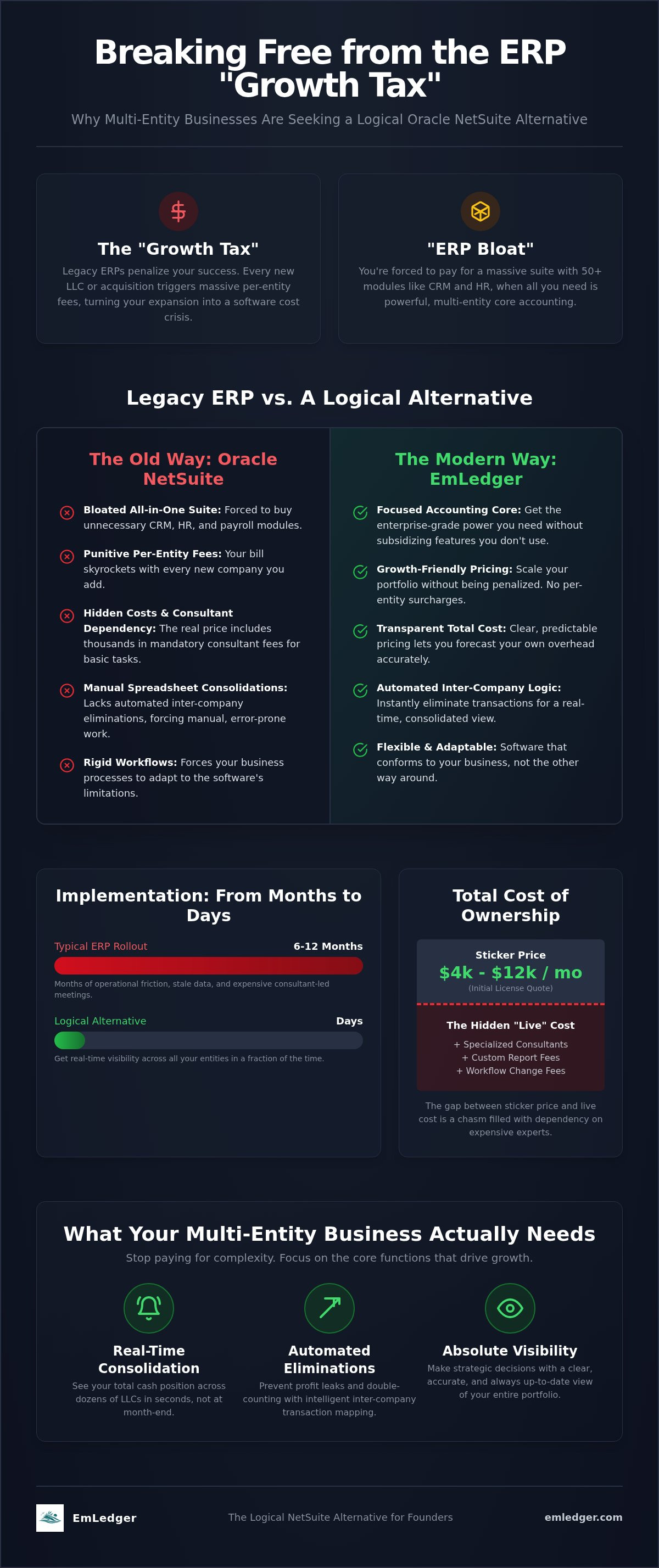
NetSuite positions itself as the inevitable destination for every ambitious company. They call it the gold standard. In reality, it's often a gilded cage. For many founders, searching for an Oracle NetSuite alternative isn't a matter of preference; it's a matter of survival. You start with a quote for core accounting. You end up with a bill for a bloated Enterprise resource planning (ERP) ecosystem that includes CRM, HR, and payroll modules you never requested and will never use. This is "ERP Bloat." It's the practice of forcing users to subsidize a massive software suite just to get basic financial consolidation. It's inefficient. It's expensive. It's illogical.
Then there's the "Growth Tax." Most legacy systems charge you more as you succeed. Every time you launch a new LLC or acquire a new entity, your bill spikes. You're being penalized for expanding your portfolio. A true Oracle NetSuite alternative should reward growth, not tax it. Instead of transparent pricing, you get complex tiers and per-entity surcharges that make forecasting your own overhead nearly impossible. You shouldn't have to choose between a new acquisition and a massive software price hike.
Understanding the Total Cost of Ownership (TCO)
Don't be fooled by the initial license quote. The gap between the sticker price and the "live" cost is a chasm. In 2026, mid-market firms often pay between $4,000 and $12,000 per month just for licensing. But the real drain is the dependency on specialized consultants. Want to change a workflow? Call a consultant. Need a custom report for a new entity? Pay for five hours of billable time. You're not just buying software; you're hiring a permanent shadow of expensive experts. This "all-in-one" approach often results in a system that is mediocre at everything. Your finance team ends up fighting the software rather than using it to drive strategy.
The Implementation Nightmare: Why 6 Months is Too Long
Time is your most valuable asset. A typical NetSuite rollout for a mid-market company takes between 6 and 12 months. That is half a year of operational friction. It's 180 days of stale data and manual workarounds while you wait for the "perfect" system to go live. Research shows that most businesses fail to utilize 70% of the features they pay for. You're paying for a massive engine but only using the headlights. Modern brands need high-velocity financial management. You shouldn't have to adapt your business to fit a rigid software workflow. The software should adapt to you.
This drive for efficiency should extend to every department. For sales teams, using a specialized platform like CloseStrong allows for precise strategy execution on every deal, avoiding the "one-size-fits-all" failure of bloated legacy systems.
ERP Bloat vs. Accounting Reality: What Your Multi-Entity Business Actually Needs
There's a persistent myth in corporate finance. It says that more features equal better control. It's wrong. Adding complexity doesn't increase clarity; it obscures the truth. Most multi-entity operators don't need a module for every possible business function. They need three things: Consolidation. Eliminations. Visibility. If you can't see your total cash position across ten LLCs in ten seconds, your software has failed. You don't need a digital Swiss Army knife with twenty blades you'll never open. You need a sharp, specialized tool that does the heavy lifting for your ledger.
Many founders find themselves stuck in the "Mid-Market Gap." QuickBooks was perfect for one entity. For five? It's a nightmare of manual log-ins and exported CSVs. But jumping to a legacy ERP is like buying a battleship to cross a pond. It's overkill. This is why the search for a logical Oracle NetSuite alternative usually starts when the manual work becomes a bottleneck. You need a system that respects your time and your data integrity. Transitioning shouldn't mean trading manual labor for software complexity. It should mean automating the chaos so you can focus on the next acquisition.
The Essential Multi-Entity Feature Set
Your finance team shouldn't spend their lives in Excel. To scale safely, you need a specific set of tools designed for multiple books. This isn't about fluff; it's about functional utility. The core requirements for any growing brand include:
- Real-time bank reconciliation across multiple jurisdictions to ensure cash accuracy without waiting for month-end.
- Automated inter-company transaction mapping to prevent profit leaks and eliminate the risk of double-counting.
- Inventory management that tracks stock across multiple locations without requiring a consultant to set up a simple warehouse.
Focusing on these essentials allows you to maintain robust entity management without the friction of a bloated, enterprise-grade interface.
Why 'Accounting-First' Beats 'ERP-Everything'
The ledger is the single source of truth. Legacy ERPs try to be everything to everyone. They offer HR tools, CRM modules, and marketing suites. This creates massive technical debt. You're paying for code that sits idle, slowing down your system and your team. An "Accounting-First" platform focuses on the numbers. It integrates with your existing tech stack instead of trying to replace it. You keep the specialized tools your team already loves—like FeedbackGraph for managing feature requests—while the accounting platform acts as the high-performance engine for your financial data. It's a cleaner, faster, and more logical way to run a multi-entity brand. Finding an Oracle NetSuite alternative that prioritizes the ledger over the "everything" ensures you stay lean as you grow.
Consolidated Reporting: Ending the Manual Spreadsheet Trap
Excel is where financial data goes to die. If you're managing a portfolio of brands, you know the drill. Every month, your team spends days exporting CSVs, mapping accounts, and praying that a broken formula doesn't tank the entire consolidation. By the time the report is ready, the data is two weeks old. You aren't making strategic decisions; you're performing an autopsy on a dead month. This manual spreadsheet trap is more than a nuisance. It's a massive operational risk that hides profit leaks and stalls your ability to pivot.
Legacy ERPs claim to solve this, but they often hide the solution behind an "enterprise" paywall. For example, NetSuite requires the OneWorld module for global consolidation. It's the ultimate growth tax. It adds significant technical complexity and a massive invoice to your bottom line. A logical Oracle NetSuite alternative treats multi-entity management as a standard feature, not an expensive luxury. You shouldn't have to pay a premium just to see your own cash position across multiple LLCs. Real-time visibility should be the baseline, not a tiered add-on.
Automating the Consolidated P&L and Balance Sheet
Accuracy is non-negotiable. When you're managing 10 or more LLCs, manual entry errors are inevitable. A single typo in a spreadsheet can lead to months of forensic accounting to find the discrepancy. Modern consolidated financial reporting software eliminates this human error by pulling data directly from the ledger. You get investor-ready reports with a single click. Your P&L and balance sheet update in real-time, allowing you to see the health of individual entities or the entire holding company instantly. It's clean. It's fast. It's logical.
Inter-Company Transactions and Eliminations
Manual inter-company reconciliation is a silent profit killer. Managing due-to and due-from entries across a portfolio is a logistical nightmare that often results in double-counting or missed liabilities. You need a system that handles these eliminations automatically. Instead of days of manual work, you get minutes of automation. By using automated inter-company reconciliation, you ensure that every transaction between your entities is perfectly mirrored and eliminated in the final consolidation. This isn't just about saving time. It's about ensuring your consolidated numbers actually reflect reality. If your current software can't handle this without a complex configuration, it's time to look for a better Oracle NetSuite alternative that prioritizes the needs of multi-entity founders.
Implementation & Scalability: Moving from Months to Days
The status quo is broken. Industry data suggests a typical ERP implementation takes over 150 days. That is five months of paying for software you can't use while specialized consultants bill you by the hour to "configure" your own data. It's a hostage situation, not a solution. A modern Oracle NetSuite alternative shouldn't require an army of experts. It should be designed for the operator who needs to move fast. You need a system that integrates with your workflow in days, allowing you to scale from one entity to one hundred without a total system overhaul.
Scaling should feel like a victory, not a logistical penalty. Most legacy platforms increase friction as you grow. They add layers of complexity that frustrate your bookkeepers and CPAs. By prioritizing a clean, logical interface, you reduce the learning curve. Your team spends less time fighting the interface and more time managing the assets. This is how you build a high-velocity finance department. You don't need more features; you need less friction.
The 3-Step Migration Strategy
Transitioning your books doesn't have to mean downtime. We recommend a logical, three-step approach to moving toward a better Oracle NetSuite alternative. First, audit your current ledger structure and entity map to strip away redundant accounts. Second, automate your bank feeds and reconciliation workflows to ensure data flows without manual intervention. Third, activate your consolidated reporting to gain instant visibility across your entire portfolio. This streamlined process turns a six-month nightmare into a weekend project.
Scaling Without the 'Growth Tax'
Per-user and per-entity pricing models are inherently anti-growth. They create a "success tax" that punishes you for every new hire or acquisition. It's an illogical way to price software. Instead, look for accounting software for growth stages that offers cost certainty. Tiered subscription plans like Solo, Growth, and Scale allow you to forecast your software spend with precision. You shouldn't have to guess what your bill will be next month. You deserve a platform that grows with you, providing enterprise-grade power without the predatory pricing models of legacy ERPs. Ready to see how logic beats bloat? Explore our multi-entity accounting features today.
EmLedger: The Logical NetSuite Alternative for Founders
Legacy ERPs are built for shareholders. EmLedger is built for operators. Most platforms want you to believe that "enterprise-ready" is synonymous with "expensive and slow." It's a lie designed to keep you paying for features you don't need. As a disruptive Oracle NetSuite alternative, EmLedger was built by a CPA who understands the granular headaches of multi-entity management. We didn't build a marketing suite or a bloated HR tool. We built a high-performance accounting engine for founders who value logic over marketing fluff. It is the last accounting platform you'll ever need to buy because it scales with your ambition, not your overhead.
We believe in a no-nonsense approach to finance. Your software should be a silent partner that automates the mundane, not a consultant-heavy burden that requires constant maintenance. By focusing on the ledger as the single source of truth, we've stripped away the "ERP Bloat" discussed earlier. You get the power of enterprise-grade consolidation without the enterprise ego. You get real-time visibility across your entire portfolio without the six-figure implementation bill. It is a clean, rational exit from the complexity of legacy systems.
From Solo to Scale: A Plan for Every Stage
Growth is a journey, not a single event. Your software should reflect that reality. Our Solo Plan is designed for high-impact founders who need real accounting power for a single entity without the "lite" limitations of entry-level apps. As your portfolio expands, our Growth Plan and Scale Plan introduce advanced inventory management and automated inter-company transactions. These tools are built to handle complex operations across 10, 50, or 100 entities with the same ease as one. You can view the full breakdown of our tiers on the EmLedger Pricing page to find the logical fit for your current stage.
The EmLedger Difference
The most significant difference is our refusal to participate in the "growth tax." We provide transparent multi-entity accounting without the predatory per-company fees that penalize your success. EmLedger is the preferred Oracle NetSuite alternative for franchises, property managers, and holding companies because we respect the operator's resources. We provide the automated inter-company eliminations and consolidated reporting you need to stay lean and agile. You've spent years building your business. Don't let a bloated software contract eat your margins. Stop paying the growth tax. Explore EmLedger Features.
Reclaim Your Financial Speed
Complexity isn't a sign of sophistication. It's a sign of inefficiency. You've seen the hidden costs of legacy systems: the months of implementation, the per-entity growth tax, and the endless modules you'll never use. Choosing a logical Oracle NetSuite alternative means prioritizing the ledger over the fluff. It means getting real-time consolidated reporting without the enterprise ego or the six-figure price tag. You don't need a massive software suite to manage a successful portfolio; you need a sharp, specialized tool that values your time.
EmLedger was built by a CPA who understands that multi-entity operators need clarity, not complexity. We provide enterprise-grade power with no per-entity pricing tiers. You get automated inter-company eliminations and bank reconciliation that works at the speed of your business. It's about having a single source of truth that actually keeps pace with your acquisitions and provides the visibility your investors demand.
Stop the ERP Bloat. See EmLedger Pricing.
Your accounting software should fuel your expansion, not fund a legacy vendor's marketing budget. It's time to move toward a faster, leaner, and more rational way to manage your books. You have the vision to grow. Now you have the tool to match it.
Frequently Asked Questions
What is the best alternative to Oracle NetSuite for a mid-sized business?
EmLedger is the most logical Oracle NetSuite alternative for mid-sized businesses that prioritize financial control over enterprise bloat. While legacy competitors offer massive suites, EmLedger focuses on high-velocity multi-entity accounting. It provides the consolidation power you need without the six-figure price tag or the need for a team of permanent consultants.
How much does a typical NetSuite implementation cost in 2026?
Implementation costs in 2026 typically range from $25,000 to over $500,000 for mid-market firms. This is a one-time fee separate from your monthly licensing. These rollouts often take 6 to 12 months to reach a live state. It's a massive investment of time and capital that many agile brands can no longer justify.
Can EmLedger handle inter-company eliminations like NetSuite?
Yes. EmLedger automates inter-company transactions and eliminations at the ledger level. You don't need an expensive add-on to mirror entries across your portfolio. The system handles due-to and due-from mapping instantly. This prevents double-counting and profit leaks without manual spreadsheet work.
Is there an accounting software that doesn't charge per entity?
EmLedger is specifically designed to end the growth tax of per-entity pricing. We offer tiered plans; Solo, Growth, and Scale; that allow you to manage multiple companies without a per-entity penalty. You can scale your portfolio without your software bill spiking every time you add a new LLC to your holding company.
How long does it take to switch from QuickBooks to EmLedger?
Moving from QuickBooks to EmLedger takes days, not months. Our migration strategy focuses on auditing your ledger and automating bank feeds quickly. You can achieve real-time visibility across all your entities in a fraction of the time required for a legacy Oracle NetSuite alternative rollout. We value your operational speed.
Does EmLedger support consolidated financial reporting for holding companies?
EmLedger provides real-time consolidated financial reporting designed specifically for holding companies and franchises. You can generate investor-ready P&L statements and balance sheets with a single click. It eliminates the manual spreadsheet trap. You get a unified view of your entire portfolio health whenever you need it.
Why is NetSuite so expensive compared to modern cloud alternatives?
NetSuite is expensive because you're paying for a bloated ecosystem. You're forced to subsidize CRM and HR modules you may never use. Additionally, the system relies on a network of specialized consultants for every minor configuration change. This creates a high total cost of ownership that modern, accounting-first platforms avoid.
Can I manage inventory across multiple companies in EmLedger?
Yes. EmLedger includes robust inventory management that scales across multiple locations and entities. You can track stock levels and movements without the complexity of a traditional manufacturing ERP. It is a streamlined solution for operators who need precise inventory data across their various brands and jurisdictions.


