

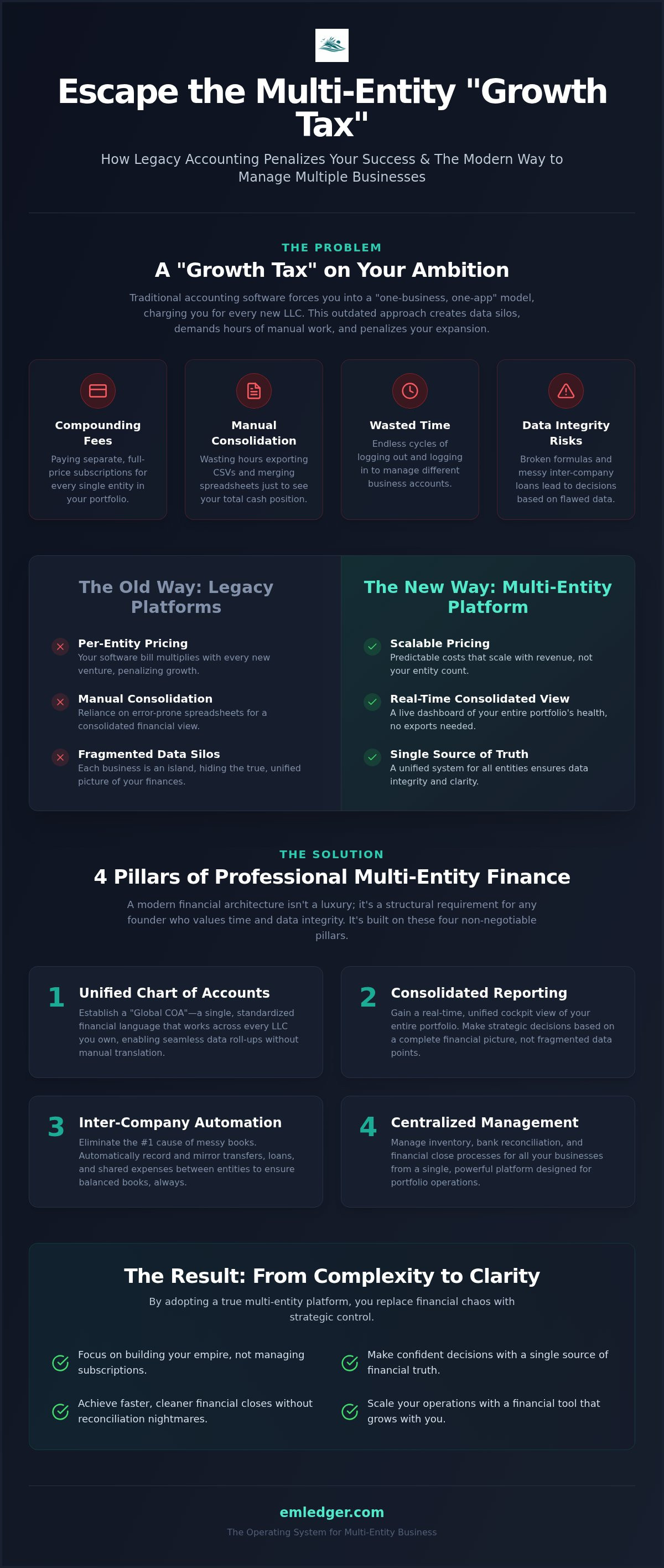
Success shouldn't come with a penalty. Yet, most accounting platforms treat every new LLC you launch as a fresh opportunity to pad their own bottom line. It's a "Growth Tax" disguised as a subscription fee. If you're tracking finances for multiple businesses, you're likely tired of the duplicate invoices and the manual CSV exports required to see a single, honest version of your financial truth.
We know the routine. You spend hours merging spreadsheets, manually reconciling inter-company loans, and praying your formulas didn't break during the last export. It's a nightmare that scales poorly and costs too much. You deserve a system that understands a multi-entity architecture shouldn't be an excuse for software companies to triple your bill. Logic dictates that your tools should support your expansion, not profit from its complexity.
This guide will show you how to end the manual consolidation trap for good. You'll learn how to achieve real-time consolidated visibility and automate inter-company eliminations. We'll explore a path toward predictable pricing that scales with your revenue, not your entity count, so you can focus on building your empire instead of managing your software subscriptions.
Key Takeaways
- Identify the "Growth Tax" and how legacy accounting software penalizes you for every new LLC you register.
- Discover how tracking finances for multiple businesses becomes seamless when you replace manual consolidation with a unified chart of accounts.
- Automate inter-company transactions to eliminate the primary cause of messy books and reconciliation errors.
- Learn to integrate inventory management directly with your ledger for real-time visibility across warehouse and retail entities.
- Compare the per-entity pricing model against scalable alternatives that support your expansion without tripling your bill.
The Hidden Cost of Multi-Business Finance: Why Separate Accounts Are a Trap
Legacy software companies love your ambition. Every time you register a new EIN or launch a fresh LLC, they see a payday. It's a "Growth Tax." You're being penalized for diversifying your portfolio. Most platforms force you into a one-business, one-app model. This isn't just expensive; it's a relic of 90s desktop accounting that has no place in a modern serial entrepreneur's toolkit. Software should adapt to your structure. If you have a holding company and three subsidiaries, your accounting should reflect that hierarchy naturally. Instead, legacy providers treat these entities as strangers. They ignore the reality of shared resources, inter-company transfers, and unified cash flow. Beyond software, establishing each entity's independent financial standing is just as crucial, and many founders use The CEO Creative to build business credit through net-30 accounts while securing custom branding essentials.
The friction is constant. You're trapped in a loop of logging out and logging in just to check a bank balance. You're manually exporting CSVs to see if you have enough cash for payroll across the group. This fragmented workflow creates data silos that hide the truth. When you're tracking finances for multiple businesses, you need a cockpit, not a dozen different dashboards. Managing your data like five different strangers isn't just inefficient. It's a deliberate choice by vendors to maximize their per-user revenue at the expense of your productivity.
The Scalability Wall: When Your Accounting Bill Outpaces Your Profits
The math is simple and brutal. If you run a portfolio of five LLCs, legacy platforms expect you to pay five separate subscription fees. These costs compound quickly. Before you've even made your first hire for a new venture, your software overhead has already doubled. Most "Basic" plans are intentionally crippled. They lack the native tools for consolidated reporting, forcing you into expensive enterprise tiers. Manual bookkeeping becomes a liability the moment your time is worth more than the hours spent fighting with a spreadsheet. You shouldn't have to choose between professional tools and a reasonable pricing structure.
Data Integrity Risks in Multi-Entity Management
Fragmented systems invite disaster. When your entities live in separate digital houses, maintaining a unified chart of accounts is nearly impossible. You end up with "ghost" transactions and messy inter-company loans that don't balance. Many founders try to bridge the gap with "hacked" spreadsheets. This is a dangerous shortcut. It complicates the financial close management process and creates an audit nightmare. One broken formula in a consolidation sheet can lead to strategic decisions based on fiction. Tracking finances for multiple businesses shouldn't feel like a high-stakes game of telephone. You need a single source of truth that respects the boundaries of every entity while providing the clarity of a unified view.
The 4 Pillars of Professional Multi-Entity Financial Tracking
Stop playing whack-a-mole with your data. Tracking finances for multiple businesses requires a deliberate architecture, not just a stack of separate apps. If you're still treating your entities like isolated islands, you're building on sand. Professional multi-entity management rests on four non-negotiable pillars. These aren't optional features. They're the structural requirements for any founder who values their time and their data integrity. You need a unified chart of accounts, consolidated reporting, inter-company automation, and centralized bank reconciliation. Without these, you don't have a portfolio. You just have a collection of headaches.
Standardization is the first step toward sanity. If Entity A classifies an expense as "Marketing" while Entity B calls it "Advertising," your consolidation will fail. You need a single, standardized language that speaks across every EIN you own. This uniformity allows you to roll up data without manual translation. Furthermore, you must address the movement of cash between these entities. Intercompany transaction regulations are complex for a reason. Messy "Due To/Due From" accounts aren't just an eyesore for your CPA. They're a liability. Automating these entries ensures that every transfer is mirrored perfectly on both ledgers, eliminating the #1 cause of reconciliation errors.
Standardizing Your Chart of Accounts (COA)
A "Global COA" is the foundation of professional tracking. It allows you to map entity-specific accounts to a parent-level reporting structure seamlessly. Logic dictates that you shouldn't reinvent the wheel for every new LLC. By implementing a standardized framework through multi-entity ledger management, you ensure that every transaction is categorized correctly from day one. This creates a plug-and-play environment for new ventures. You can launch, track, and scale without rebuilding your financial infrastructure every time.
Real-Time Visibility vs. Monthly Exports
Waiting 15 days for a bookkeeper to merge spreadsheets is a relic of a slower era. In a high-velocity business, that delay is a blind spot. There is a massive difference between "seeing" your data and truly "analyzing" your portfolio. You need to know your total cash position across all entities this morning, not next month. Leveraging consolidated financial reporting software allows for instant decision-making. It turns tracking finances for multiple businesses from a reactive chore into a proactive strategy. If you're ready to stop the manual entry cycle, it might be time to automate your Inter-Company Transactions and see the truth of your group's health in real-time.
Inter-Company Transactions: Eliminating the #1 Cause of Messy Books
Manual journal entries are where balance sheets go to die. In a multi-business ecosystem, "Due To/Due From" accounts act as the graveyard of financial accuracy. When you're tracking finances for multiple businesses, Entity A's ledger must mirror Entity B's perfectly. If it doesn't, your books are fiction. Most legacy software leaves you to handle this manually. You record a loan in one app. You log out. You log in to another app. You record the corresponding liability. One typo or missed entry creates a discrepancy that takes hours of forensic accounting to find. It's a waste of your time and a risk to your data.
This isn't just about sloppy bookkeeping. It's about data integrity. Without automated eliminations, your consolidated reports will lie to you. They'll double-count revenue and expenses that are actually just internal transfers. Elimination entries are the removal of internal transactions to show true external profit. Logic says your software should handle this by default. If it doesn't, you're paying for a tool that only does half the job. You need a system that recognizes the relationship between your entities and treats them as a single, cohesive group. Tracking finances for multiple businesses should clarify your position, not obscure it with internal noise.
Automating the Due-To/Due-From Ledger
A self-balancing inter-company entry ensures that every debit in one entity triggers a matching credit in the other automatically. You shouldn't have to think about it. By using inter-company transaction software, you link your entities at the ledger level. This creates a permanent, digital bond between transactions. It also makes tracking inter-company loans easier. The IRS expects these loans to carry fair-market interest rates. If you're just moving money without documentation or interest, you're begging for an audit. Automated systems track these details as they happen, keeping you compliant without the extra paperwork.
Settlements and Cash Flow Management
Managing cash flow across a portfolio often means using a "cash cow" to fuel a startup. This is a smart strategy. It's also dangerous without a clear audit trail. You need to maintain a bird's-eye view of every dollar moving between LLCs. This requires centralized bank reconciliation across all accounts simultaneously. You should be able to see the source and destination of every transfer in one place. This transparency protects you during an audit and gives you the confidence to move capital where it's needed most. Don't let your growth be throttled by messy settlements or fragmented bank feeds.
Scaling Your Operations: Inventory and Multi-Location Tracking
Physical assets don't care about your corporate structure. They move where they're needed. But your accounting software? It's usually stuck in a single-entity silo. Tracking finances for multiple businesses becomes exponentially more difficult the moment you add inventory to the mix. If you have a warehouse LLC supplying a retail LLC, you aren't just moving boxes. You're moving value, tax liabilities, and cost basis. Legacy apps treat these as external sales. This inflates your revenue and confuses your tax preparer. You need a ledger that understands that a transfer is not a sale. It's a movement of capital within your own ecosystem.
Managing multi-location overhead requires a clear view of entity-level profitability. You shouldn't have to guess which location is dragging down your group margins. Most systems force you to choose between a "big picture" view and granular detail. This is a false choice. Logic dictates that your inventory management systems must integrate directly with your primary ledger. If they don't, your Cost of Goods Sold (COGS) is just a guess. Precise tracking ensures that when a product moves between businesses, the cost basis follows it perfectly. This prevents the "ghost profits" that occur when you lose track of the original purchase price across your portfolio.
Multi-Entity Inventory Flows
Internal sales are a common trap for the unwary founder. When a parent company buys stock in bulk and distributes it to a subsidiary, the transaction must be eliminated at the consolidated level. If not, your balance sheet looks twice as healthy as it actually is. Robust inventory management ensures your asset values are accurate in real-time. It maintains the integrity of your stock levels without the nightmare of manual journal entries. Automation is the only way to avoid over-valuing stock through automated eliminations.
Operational Efficiency for Franchises and Property Managers
This complexity isn't limited to retail businesses. For franchises managing dozens of locations, the operational friction of tracking separate entities can kill your margins. Every store needs its own P&L. Yet, the group needs a unified view of total inventory investment. Similarly, property managers often treat individual buildings as separate legal entities to ring-fence liability. Tracking finances for multiple businesses in these sectors shouldn't require fifty software subscriptions. High-volume operators need a Scale Plan that centralizes these operations without a per-location penalty. If you're ready to stop the manual entry cycle, explore our Inventory Management solutions designed for multi-entity growth.
Choosing a Multi-Business Platform That Doesn’t Penalize Success
Legacy accounting platforms view your growing portfolio as a recurring revenue stream for their shareholders. They don't see a visionary founder; they see five separate subscriptions. This per-entity model is a tax on your success. Tracking finances for multiple businesses shouldn't require a negotiation with your software vendor every time you file a new LLC. You need a platform that aligns with your logic. EmLedger replaces the "Growth Tax" with a stage-based model that respects your resources. It's time to move beyond the patchwork of third-party consolidation apps. Native multi-entity accounting is the only way to ensure your holding company has a single source of truth.
Transitioning from "LLC Chaos" to a professional holding company structure requires a shift in mindset. You have to stop thinking about your businesses as isolated silos. Logic dictates that if you own the entities, you own the data. Your software should reflect that. By centralizing your ledgers, you eliminate the friction of multiple logins and the risk of fragmented reporting. You gain the ability to move capital, manage shared inventory, and reconcile bank feeds in a single, high-velocity environment. This isn't just about saving money on subscriptions. It's about reclaiming the time you currently waste on manual consolidation.
The EmLedger Solo, Growth, and Scale Framework
We designed our tiers to match your operational reality, not your legal structure. The Solo Plan is the logical choice for the foundational entrepreneur managing 2-3 businesses. It provides professional inter-company tools without the enterprise ego or price tag. The Growth Plan is built for businesses adding layers of complexity, such as inventory management and deeper reporting needs. For established operators, the Scale Plan manages complex holding company structures and high-volume transactions. It’s a rational calculation. You pay for the functionality you need, not the number of EINs you own.
Next Steps: Auditing Your Current Multi-Entity Workflow
Is your current software a tool or a bottleneck? Run this 3-point audit to find out. First, count your monthly subscriptions. If you're paying separate fees for every entity, you're being overcharged. Second, time your month-end close. If manual consolidation takes more than an hour, your workflow is broken. Third, check your inter-company balances. If they don't mirror each other perfectly, you're at risk. You can compare EmLedger against the giants of the industry to see a better way forward. Don't let legacy pricing models throttle your expansion. Stop paying the Growth Tax and start tracking logically with EmLedger.
Stop Paying the Growth Tax and Scale Logically
Manual consolidation is a choice, and it's a bad one. You've seen how legacy software uses your ambition as a revenue stream. It's time to reject the "Growth Tax" and the nightmare of fragmented spreadsheets. Professional tracking finances for multiple businesses requires a system built for the job, not a collection of separate accounts glued together with hope and manual labor. You need automated inter-company eliminations, unified bank feeds, and real-time visibility across your entire portfolio.
EmLedger was built by a CPA who understands the granular headaches of multi-entity management. We don't charge per-entity fees because we value logic over marketing fluff. Every plan includes consolidated reporting by default. You get professional tools without the enterprise ego or the hidden costs. It's a rational exit from complexity. You focus on building your empire. We'll handle the ledger.
View Pricing for Multi-Entity Accounting Plans
Your business structure should be an asset, not an administrative anchor. Take the first step toward a cleaner, more profitable future today. You've done the hard work of growing; now it's time to reap the rewards of a streamlined operation.
Frequently Asked Questions
Can I track both personal and business finances in one software?
You can track both, but you shouldn't mix them in the same ledger. Commingling personal and business data is a legal liability that risks your corporate veil. Logic dictates they should be separate entities under one roof. Our platform allows you to manage personal wealth and business operations in separate books while maintaining a single, unified login for total clarity. For those who want to apply this same level of organization to their family life, you can discover Haevn to centralize household management on a single, privacy-first platform.
What is the "Growth Tax" in accounting software pricing?
The "Growth Tax" is the industry practice of charging a separate subscription fee for every new LLC or EIN you register. It penalizes expansion. Legacy providers treat your ambition as a revenue stream. We don't. Tracking finances for multiple businesses should be about efficiency, not paying a penalty every time you launch a new venture or holding company.
How do inter-company transactions affect my tax filing?
Inter-company transactions must be perfectly mirrored to avoid tax discrepancies. If Entity A records a loan, Entity B must record a matching liability. Failure to track these correctly leads to inflated revenue or "ghost" profits, which can trigger IRS audits. Automated tracking ensures your books are audit-ready from day one by maintaining a clean, digital trail of every internal transfer.
Do I need a separate bank account for every business entity?
Yes, you absolutely need separate bank accounts for every entity. Commingling funds is the fastest way to lose your liability protection. Tracking finances for multiple businesses is only effective when the cash flows are legally and digitally distinct. Our system manages these separate feeds in one workspace, giving you the visibility of a single account without the legal risks.
How does consolidated reporting handle different fiscal years?
Consolidated reporting handles different fiscal years through standardized mapping and adjustment periods. Professional software aligns these disparate timelines into a single reporting window. This allows you to see a unified "group" view regardless of when each subsidiary closes its individual books. It turns a complex calendar problem into a simple, logical calculation for the parent company.
Is it possible to automate inter-company loan tracking?
Automation is the only way to ensure accuracy in loan tracking. When you move cash between entities, our system creates self-balancing "Due To/Due From" entries automatically. This keeps your ledgers in sync without manual journal entries. It also ensures you're tracking interest rates correctly to meet IRS expectations for fair-market loans, protecting you from reclassification risks.
Why shouldn’t I just use Excel for multi-entity consolidation?
Excel is a manual trap that lacks a verifiable audit trail. One broken formula in a consolidation sheet can hide a massive financial error for months. It's slow, prone to human error, and creates data silos. Professional multi-entity software provides real-time visibility and automated eliminations that a static spreadsheet simply cannot match. You need a ledger, not a calculator.
How many entities can I manage on the EmLedger Solo plan?
The Solo Plan is designed for founders managing up to 3 business entities. It provides the professional tools you need, like native inter-company transactions and consolidated reports, without the enterprise price tag. It's the logical starting point for entrepreneurs who have outgrown basic accounting but aren't yet managing a massive conglomerate with high-volume inventory needs.


