

Your success shouldn't be a line item for your software provider. Most legacy platforms treat every new entity you launch as a fresh opportunity to pick your pocket. It's a predatory model that punishes expansion and rewards complexity. You've likely felt the sting of the "growth tax" already. Every time you add a subsidiary, your monthly bill spikes, even though your core accounting needs haven't changed. It's a logical dead end that forces you back into manual Excel consolidations just to save a few dollars.
We agree that scaling is a math problem, not a marketing one. You shouldn't be penalized for building a multi-entity empire. Finding the right accounting software for scaling businesses means choosing a partner that values transparency over per-company price gouging. This article promises to show you how to exit the cycle of hidden fees. You'll learn how to secure a single source of truth for all your entities without the financial friction. We're diving into the mechanics of automated inter-company eliminations, the power of tiered pricing, and how to manage complex settlements without the manual mess.
Key Takeaways
- Learn why true accounting software for scaling businesses must prioritize data integrity over simple bookkeeping as your entity count grows.
- Expose the "Growth Tax" and stop paying more just because you're successful; it's time for a logical pricing structure.
- Automate your inter-company transactions and consolidated reporting to kill the "ghost" entries and manual Excel consolidations.
- Use our two-step audit to calculate your future "Entity Multiplier" costs and benchmark your month-end close efficiency.
- Discover why the Scale Plan is the logical exit for holding companies tired of legacy software limitations.
What is Accounting Software for Scaling Businesses?
Scaling isn't just about increasing your top-line revenue. It's a fundamental shift in your operational math. True accounting software for scaling businesses is an engine designed to maintain absolute data integrity while your entity count and transaction volume explode. It's the difference between a digital ledger that records what happened and a financial command center that manages what's happening now. Most founders realize too late that their entry-level software was never built to support a complex hierarchy. It was built for a single shop with a single bank account.
The "Growth Tax" starts here. Legacy software typically breaks when you hit your third or fourth LLC. You're forced into a fragmented reality where you have multiple logins, separate subscriptions, and zero visibility across your portfolio. You transition from simple bookkeeping to complex financial management, yet your tools remain stuck in the "small business" sandbox. A scale-ready platform treats your entire organization as a single ecosystem, regardless of how many subsidiaries you launch.
The Three Pillars of Scalable Accounting
Multi-entity architecture is the first requirement. This isn't just "adding another account" to your dashboard. It's a native structural design that allows for multi entity accounting without duplicating your effort. Second, you need real-time data synchronization. If you have to wait for a manual sync to see your cash position across five different units, you're flying blind. Finally, the software must facilitate a shift from reactive bookkeeping to proactive strategy. You need to see the consolidated truth immediately to make the next big move.
Why "Small Business" Software Hits a Ceiling
The manual spreadsheet trap is the clearest sign of failure. When your "simple" software can't handle consolidated reporting, you're forced to export data into Excel. This creates a massive security risk and a total loss of version control. Small business apps also suffer from API limitations. As your transaction volume grows, these platforms throttle your data flow, leading to lag and sync errors. They also lack native support for inter-company transactions. Without automation, your team spends dozens of hours every month manually reconciling "ghost" entries between your own entities. It's a waste of talent and a drain on your resources.
Core Features Required for Multi-Entity Growth
Scaling demands more than just more rows in a database. You need a system that handles the weight of multiple legal structures without buckling. True accounting software for scaling businesses provides a unified view of your entire operation while respecting the boundaries of each entity. It's about moving from "I think we're profitable" to "I know exactly where the leak is." You shouldn't have to log out and back in twenty times just to see your total cash position. The software should work for you; not the other way around.
The Power of Consolidated Reporting
If you're still manually merging CSV files at the end of the month, you're not scaling. You're just working harder for less. Consolidated financial reporting software automates the heavy lifting. It pulls the P&L and Balance Sheet from every subsidiary into a single dashboard instantly. This isn't just about speed. It's about accuracy. Seeing the big picture allows you to identify profit leaks that remain invisible at the individual LLC level. You need a single source of truth that reflects your entire group's health in real time.
Inter-Company Transactions and Eliminations
Ghost entries are the silent killer of financial clarity. When one entity buys from another, legacy systems often double-count that revenue. This creates a distorted, dangerous view of your group's health. High-performance inter-company transaction software solves this by automating eliminations. It ensures that internal transfers don't inflate your numbers. Clean trails reduce year-end audit friction and keep your settlements logical. You stop chasing "where did this $50k go?" and start focusing on the next acquisition. It's about precision, not guesswork.
Complexity scales faster than revenue. Managing twenty bank feeds shouldn't feel like a full-time job. Centralized bank reconciliation allows you to clear transactions across multiple entities from one screen. Pair this with integrated inventory management that tracks stock across different locations and entities. You gain a granular view of your assets without the manual mess. If your current stack makes you feel like an unpaid data entry clerk, it's time for a logical exit. Our consolidated reporting tools are built to handle this exact complexity without the enterprise bloat associated with legacy players.
The "Growth Tax": Per-Entity vs. Flat-Tier Pricing
Success shouldn't be a line item for your software provider. Legacy platforms lure you in with a low entry price for a single entity. Then you scale. You add a holding company. You launch a subsidiary. Suddenly, that "affordable" monthly fee triples. They call it a feature. We call it a "Growth Tax." It's a predatory pricing model that treats your ambition as a revenue stream for their shareholders. True accounting software for scaling businesses should empower your expansion, not tax it.
The Math of Scaling 10 Entities
Look at the logic of the numbers. If you manage 10 entities on a standard per-organization plan, you aren't just paying for software. You're paying for 10 separate subscriptions, 10 sets of login credentials, and 10 monthly invoices to reconcile. The math simply doesn't add up for serial entrepreneurs or high-growth firms. Choosing accounting software for growth stages requires a fundamental shift toward pricing transparency and predictable costs.
EmLedger's Growth Plan and Scale Plan offer a logical exit from this cycle. Instead of charging you a penalty for every new LLC, our tiered model supports your expansion. You get consolidated reporting and inter-company automation without the per-entity price gouging. Every hour your team spends toggling between accounts is an hour stolen from high-level financial strategy. We believe your software should be a force multiplier, not a recurring drain on your capital.
CPA-Built Logic: Why It Matters
Most accounting tools are built by marketers who prioritize "simplicity" over structural integrity. They're great for a solo freelancer, but they fail in the "messy middle" of business growth. EmLedger is different. It's a CPA-built platform designed specifically for the realities of multi entity accounting. We understand that your entities aren't isolated silos. They're interconnected parts of a larger financial ecosystem that requires a unified ledger approach.
Our logic focuses on high-velocity management and data accuracy. We built the Scale Plan to handle complex holding company structures with native inter-company ledger management. It's not about marketing fluff. It's about providing a rational, mathematical solution to a complex financial problem. You deserve an authoritative guide that protects your resources instead of draining them. You can see how we compare to the status quo on our pricing page, where logic finally beats legacy greed.
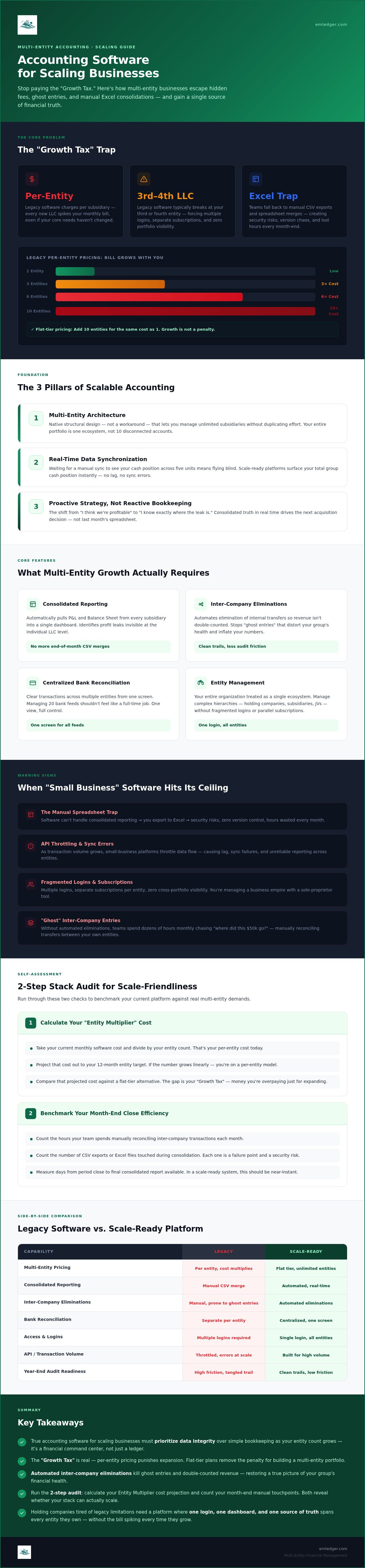
How to Audit Your Current Stack for Scale-Friendliness
Don't wait for your ledger to freeze before you admit there's a problem. Most founders ignore technical debt until it's a full-blown emergency. You need a proactive audit to determine if your current setup is actually accounting software for scaling businesses or just a glorified calculator. Start with the "Entity Multiplier." Project your growth for the next 24 months. If your software bill scales linearly with every new LLC, you're being robbed. A scalable platform should offer tiered logic that rewards your expansion, not a flat tax on every new venture.
Next, evaluate your inter-company loans. If your team is still recording these through manual journal entries across separate databases, you've already lost the battle. You need native automation that handles these settlements without human intervention. Finally, check your inventory visibility. If you can't see stock levels across every warehouse and every entity in one unified screen, your data is siloed and useless. Scaling requires a bird's eye view, not a magnifying glass for ten different spreadsheets.
The 3-Day Close Test
A slow month-end close is a symptom of a deeper rot. If your books aren't closed within 72 hours, your software is failing you. Manual bottlenecks like spreadsheet consolidations and broken bank feeds are the primary culprits. High-performance bank reconciliation software eliminates the need for manual matching. It turns a week-long ordeal into a streamlined, logical process. If you're still chasing pennies on day five, you're not managing a business; you're babysitting a database. Speed is a byproduct of better architecture.
Infrastructure Resilience
Your ledger shouldn't be an island. It must talk to your operations. Scalability dies when API limits throttle your data or when your inventory management systems can't sync with your financial records in real time. Test your export capabilities now. If getting your own data out of the system requires a developer, you're a hostage, not a customer. Ensure your tech stack is resilient enough to handle high transaction volumes without lag or sync errors. If your current audit reveals a bottleneck, it's time for a logical exit. Compare our multi-entity features to your current stack and stop the manual bleeding today.
EmLedger: The Logical Choice for Scaling Multi-Entity Businesses
EmLedger isn't another generic bookkeeping app designed for freelancers. It's a CPA-built platform designed specifically for the complexity of holding companies and serial entrepreneurs. Most accounting software for scaling businesses forces you to choose between manual spreadsheets or enterprise-level bloat. We offer a third way that values logic over marketing fluff. Our structural engine ensures that your software handles ten entities as easily as one. No hidden fees. No per-company penalties. Just a clean, rational command center for your financial operations.
Growth and Scale Tiers
Our Growth and Scale plans reflect the reality of your expansion. The Growth Plan provides the essential tools for businesses moving beyond the Solo stage, while the Scale Plan is our heavy hitter for complex holding company structures. This tier unlocks native consolidated reporting and multi-layered entity management without the predatory per-company price gouging common in legacy systems. You pay for the functional utility of the platform, not a penalty for every new LLC you launch. It's a fair, transparent model that keeps your overhead predictable.
The EmLedger Difference
Why do founders choose us over legacy platform alternatives? It comes down to implementation speed and accounting expertise. You don't need a six-month consulting project or a team of expensive specialists to get started. We built EmLedger to be intuitive for the business operator but robust enough for the most demanding CPA. Our users report cutting their consolidation time by 90%. That's dozens of hours every month reclaimed from the manual spreadsheet trap and redirected toward high-level strategy.
We remain fiercely committed to providing accounting software without per-entity pricing. This isn't just a marketing slogan; it's a fundamental belief in protecting your resources. You get direct support from professionals who understand the granular headaches of multi-entity accounting and inter-company settlements. Stop paying the "Growth Tax" on your hard-earned success. It's time to switch to a platform that actually respects your trajectory. Choose the plan that fits your vision today and start scaling without the financial friction.
Stop Funding Legacy Greed and Start Scaling
Scaling your business is a mathematical triumph, not a reason for your software provider to hike your rates. You've seen how the "Growth Tax" drains your resources and how manual consolidation kills your efficiency. Choosing the right accounting software for scaling businesses means demanding transparency, native inter-company automation, and a single source of truth that doesn't break when you add your tenth LLC. If your current tools force you back into spreadsheets, they're already obsolete.
EmLedger was built by a CPA who understands that multi-entity operators need logic, not marketing fluff. Our Scale Plan includes consolidated reporting out of the box and completely eliminates per-entity fees. You get the structural integrity of an enterprise system without the associated bloat or predatory pricing. It's time to audit your current stack and stop paying a penalty for your success. You deserve a platform that acts as a partner in your expansion rather than a recurring drain on your capital.
View EmLedger Pricing and Stop the Growth Tax
The path to a cleaner, faster close is right in front of you. Take the logical next step and build your empire on a foundation that actually supports it. We're ready to help you grow without the friction.
Frequently Asked Questions
What is the best accounting software for a business with multiple LLCs?
The best choice is a platform that uses a single-ledger architecture rather than siloed files. Legacy apps force you to open separate accounts for each LLC, creating a manual consolidation nightmare. EmLedger provides a logical exit from this mess by supporting native multi-entity management. You need a platform that handles complex hierarchies without charging a per-company penalty on your success.
How does consolidated reporting work in scaling accounting software?
It automates the aggregation of financial data from every subsidiary into a single group-level view. Instead of exporting CSVs and merging them in Excel, the software maps accounts across entities in real time. This ensures your financial statements are always accurate and ready for review. It eliminates the risk of version control errors and the exhaustion of manual data entry mistakes.
What are inter-company transactions and why do they matter for scaling?
These are financial exchanges between different entities under the same parent company. They matter because without automation, these transactions lead to double-counted revenue and entries that distort your group's health. Scaling businesses need software that performs automated eliminations. This keeps your group-level books clean and ensures your year-end audits don't become a forensic accounting project that drains your resources.
Is it better to have separate accounting files for each company?
No, separate files are a legacy bottleneck that prevents a unified view of your portfolio. Legal entities must remain distinct, but your data should live in a single environment for efficiency. Siloed files force you to log in and out constantly. They make bank reconciliation and inter-company settlements impossible to manage at scale. A unified ledger is the only logical path for expansion.
When should a scaling business move from entry-level software to an ERP?
You should move when the "Growth Tax" and manual workarounds exceed the cost of a better system. However, you don't always need a bloated ERP. Most businesses just need accounting software for scaling businesses that handles multi-entity complexity without the six-figure implementation fee. If your monthly close has become a week-long ordeal, you've already outgrown entry-level tools.
Does EmLedger handle inventory management for multiple locations?
Yes, EmLedger provides native inventory management designed for multi-location operations. You can track stock levels across different warehouses and entities from one dashboard. This visibility prevents overstocking and ensures your operational data matches your financial ledger. It's built to handle the logistical weight of a growing business without the need for expensive third-party plug-ins that frequently break. To further support this physical expansion, Executech Lease Group (ELG Leasing) offers flexible leasing for the POS systems and Clover devices required at each new location.
Can I manage bank reconciliations for 10 companies in one place?
Absolutely. Our platform centralizes bank reconciliation so you can clear transactions across all your entities from a single screen. You don't have to toggle between accounts or manage separate bank feeds for every subsidiary. This centralization is a core feature of accounting software for scaling businesses. It turns a multi-day reconciliation ordeal into a streamlined, high-velocity task that finally respects your time.
How does EmLedger’s pricing compare to per-entity software?
We use a tiered model instead of the predatory per-organization pricing used by legacy providers. Most platforms bill you for every new subsidiary you launch, which effectively taxes your growth. EmLedger’s Scale Plan supports complex holding structures with a flat, predictable fee. It's a rational calculation that keeps your overhead low as your entity count increases. We value transparency over the industry's hidden costs.


