

Success shouldn't feel like a penalty. For too long, legacy software providers have levied a "Growth Tax" every time you add a new entity to your portfolio. It's a broken system that rewards their bottom line while punishing your ambition. You spend your weekends wrestling with spreadsheet errors and manual inter-company eliminations just to see a basic financial picture. It's time to stop the chaos. Transitioning to cloud based consolidated reporting shouldn't be an enterprise luxury. It's a logical necessity for any business that values its time and data integrity.
You likely feel like you're drowning in browser tabs and broken Excel formulas. We agree that your accounting software should work as hard as you do. This guide promises to show you how to reclaim your schedule and eliminate the manual friction that stalls your decision-making. We'll preview the path to real-time visibility across all entities, explore automated inter-company transactions, and discuss a logical pricing model that supports your scale. It's time to move past the "Growth Tax" and embrace a streamlined financial future in 2026.
Key Takeaways
- Stop paying the "Growth Tax" by identifying the hidden costs and risks buried in your manual spreadsheet workflows.
- Transition to cloud based consolidated reporting to turn static financial snapshots into a single, real-time source of truth.
- Eliminate audit red flags with automated inter-company eliminations that remove the noise of internal transfers instantly.
- Learn the logical steps to standardize your chart of accounts and centralize bank feeds for multi-entity clarity.
- Discover why a CPA-built approach to accounting is the only rational exit from the complexity and high fees of legacy software.
Beyond the Spreadsheet: What Cloud-Based Consolidated Reporting Actually Means
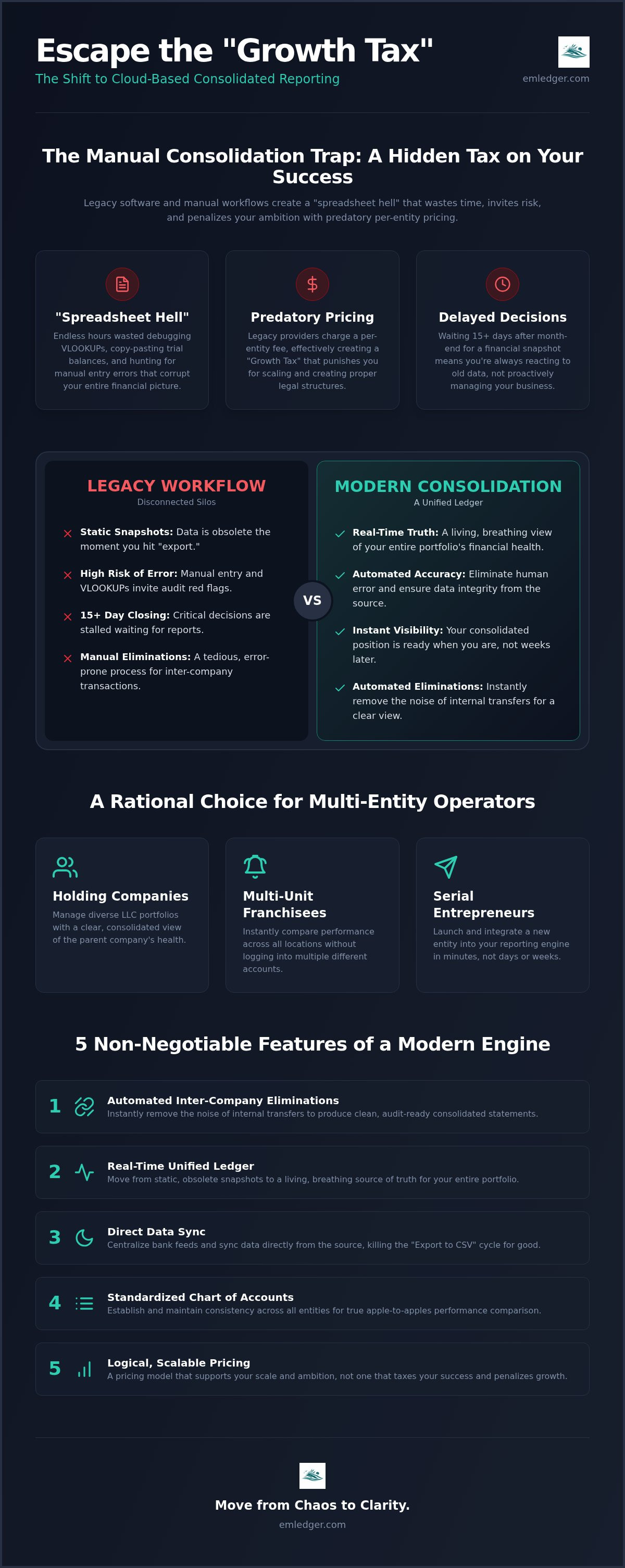
The traditional "Growth Tax" is a silent killer of momentum. Every time you launch a new LLC or acquire a new location, your accounting complexity doubles while your visibility halves. You've been told that manual spreadsheets are just "part of the process." That's a lie sold by legacy providers who benefit from your inefficiency. True cloud based consolidated reporting isn't just a digital version of your old Excel workbook. It's a fundamental shift from Disconnected Silos to a Unified Ledger. Instead of static snapshots that are obsolete the moment you hit "save," you get a living, breathing source of truth for your entire portfolio.
In 2026, the technology that once required a seven figure ERP budget is now accessible to the mid-market operator. We've moved past simple data aggregation. Modern systems create actual consolidated financial statements by syncing data directly from the source. No more manual entry. No more broken formulas. Just logic.
The Death of the Manual Monthly Close
Waiting 15 days after month-end to see your performance is a massive scaling liability. If you don't know your cash position until the middle of the next month, you aren't managing; you're reacting. There is a massive difference between aggregated data and consolidated intelligence. Aggregated data is just a pile of numbers. Consolidated intelligence is knowing exactly how your inter-company transfers and shared overhead impact your bottom line across all entities. Cloud based consolidated reporting kills the "Export to CSV" cycle. It replaces manual labor with automated accuracy, ensuring your data is ready when you are.
Who This is Actually For
This isn't just for the corporate giants. It's for the operators in the trenches who are tired of the friction. Specifically, this approach is the rational choice for:
- Holding Companies: Manage diverse LLC portfolios without losing sight of the parent company's health.
- Multi-Unit Franchisees: Compare performance across locations instantly without logging into ten different accounts.
- Serial Entrepreneurs: Launch a new entity every quarter and integrate it into your reporting engine in minutes, not days.
If you're managing more than two entities, the manual approach is already costing you more than you think. It's time to stop the leak. You can explore how a consolidated reporting engine works to see the difference for yourself.
The Manual Consolidation Trap: Why Your Current Workflow is a Scaling Liability
Excel is a phenomenal tool for scratchpads; it's a catastrophic database for a growing portfolio. The "Excel Tax" is the silent drain on your resources. It represents every hour your finance team spends debugging VLOOKUPs, copy-pasting trial balances, and hunting for that one cell that broke the entire workbook. This manual friction doesn't just waste time. It creates a "spreadsheet hell" where data-driven decisions go to die because the information is always too old to be useful. Scaling a multi-entity business requires cloud based consolidated reporting that doesn't break under the weight of its own complexity.
Manual inter-company eliminations are the primary source of audit red flags. When you're managing the growing complexity in financial reporting, a single human error in a shared overhead allocation can trigger a cascade of reconciliation nightmares. You aren't just risking an error; you're inviting a liability. If your current workflow relies on a human being to remember which entity owes which, you're operating on a house of cards.
The Hidden Cost of Per-Entity Pricing
Legacy software giants have turned multi-entity management into a profit center. They charge you per-company, which is a predatory practice designed to tax your success. This per-entity fee structure is a scam. It doesn't cost the software provider more to host your third LLC than it did your first. This pricing model actually discourages founders from creating the proper legal structures they need for asset protection. You can read more about finding accounting software without per-entity pricing to stop paying this unnecessary tax. Growth should be a milestone, not a line-item expense on your software bill.
The Risk of "Lagging Indicators"
Looking at last month's data to make today's investment decisions is a recipe for disaster. By the time you see a consolidated P&L in a manual system, the market has already moved. Invisible inter-company loans that aren't reconciled in real-time can mask a cash flow crisis until it's too late to pivot. Real-time visibility is the primary antidote to portfolio insolvency. Without it, you're flying blind. You can see how a logic-driven entity management system keeps your data current and your risk low.
5 Non-Negotiable Features of a Modern Consolidation Engine
Logic dictates that your software should simplify your life, not add another layer of management. If your platform doesn't have these five pillars, it's just a glorified ledger. Transitioning to cloud based consolidated reporting requires tools that handle the heavy lifting of multi-entity accounting automatically. You need a system that eliminates friction, not one that creates it. Don't settle for "good enough" when your data integrity is on the line.
- Automated Inter-Company Eliminations: Remove the noise of internal transfers instantly. You shouldn't have to manually zero out "loans" that are just moving money between your own pockets.
- Multi-Entity Bank Reconciliation: See all cash across all accounts in one view. Stop logging into ten different portals to check your liquidity.
- Real-Time Currency Conversion: Essential for brands operating across national borders. You need today's rates, not last month's averages.
- Drill-Down Capabilities: Move from a consolidated total to a single transaction in two clicks. Transparency shouldn't require a scavenger hunt.
- Unified Chart of Accounts (COA): Force logic onto chaotic multi-business bookkeeping. One structure to rule them all.
Inter-Company Transaction Automation
Manual journal entries for "Company A paying Company B" are a relic of the past. They invite error. They waste time. They belong in the era of paper ledgers and fax machines. Modern inter-company transaction software is non-negotiable because it ensures every transfer is mirrored perfectly across your entities. Automated entries maintain clean books for each individual LLC. This removes the "Inter-company nightmare" from your month-end close. It's a rational solution for a granular headache.
Consolidated Reporting Without the CPA Degree
You shouldn't need a master's degree to understand your own cash flow. One-click Balance Sheets and P&L statements are the industry standard. Research indicates that this level of automation improves reporting efficiency by 30-50%, allowing you to focus on strategy instead of math. Your reporting system must also integrate with your inventory management systems to provide a full picture of your physical assets alongside your cash. Whether you're presenting a high-level view to investors or checking granular daily operations, your views must be customizable and instant. It's about having the right data for the right decision at the right time.
Logical Migration: From Manual Chaos to Automated Clarity
Moving from manual spreadsheets to cloud based consolidated reporting doesn't require a six-month consulting project. Legacy providers want you to believe migration is a mountain. It's actually a staircase. You just need a logical path that prioritizes data integrity over marketing fluff. Stop the bleeding. Start the automation. This transition is about reclaiming your time and ensuring your portfolio-wide data is actually reliable.
Step 1: The Unified Chart of Accounts
Standardization is the bedrock of any rational accounting system. You can't consolidate "Marketing" in Company A with "Ad Spend" in Company B. It's a logic error that creates hours of manual re-mapping. Adopt a "Logic-First" approach by renaming categories for portfolio-wide clarity. It feels like a chore, but it's a one-time investment in your future sanity. This is where multi-entity accounting software proves its value by automating this mapping across every LLC you own, ensuring your "Advertising" line item means the same thing in every entity.
Step 2: Automating the Data Feed
Centralize your data source to kill the manual entry cycle. Connect your bank feeds and merchant accounts directly to a single platform. This is where the "Human Error" factor dies. Logic replaces memory. When you use automated bank reconciliation software, you're not just matching transactions; you're building a real-time pulse of your entire operation. Set up real-time alerts for inter-company imbalances. Catch the error before it becomes a journal entry nightmare that halts your month-end close.
Define your elimination rules early. Map exactly how internal loans and transfers should be treated so the system handles them without your intervention. Run parallel systems for a single month. Compare the cloud accuracy against your old manual reports to verify the logic. You'll likely find errors in your old spreadsheets you never knew existed. Finally, train your team to shift their focus from "data entry" to "data analysis." They should be looking for trends that drive profit, not typing in numbers that already exist in the cloud. If you're ready to exit the chaos, start by choosing a plan that supports your growth without taxing your success.
Consolidation Without the Ego: Why EmLedger is the Rational Choice for Multi-Entity Operators
Most accounting software tries to be a Swiss Army knife. They bundle payroll, tax filing, and HR services you didn't ask for. Then they charge you for the privilege. We don't play that game. EmLedger is built by a CPA who spent years in the trenches of multi-entity management. We understand the granular headaches of inter-company loans, broken spreadsheets, and predatory software fees. That's why we built a "No-Nonsense" platform. We provide the best accounting tech on the market, period. No bloat. No ego. Just cloud based consolidated reporting that works as hard as you do.
We've eliminated the "Growth Tax" by design. Scaling your business shouldn't lead to a predatory software bill. Our pricing is a rational calculation based on your needs, not a tax on your success. Moving from Solo to Growth to Scale plans is based on logic, not greed. Whether you're managing two LLCs or twenty, the logic remains the same. You need clarity. You need speed. You need a system that supports your ambition instead of penalizing it. We focus on the functional utility of your data so you can focus on the next acquisition.
Tiered Scaling for Every Stage
Growth isn't linear. Your software should reflect that reality. We offer tiered plans designed to meet you exactly where you are. The Solo Plan is the essential foundation for the focused founder managing their first few entities. It provides the core tools you need without the enterprise price tag. As you expand, our Growth and Scale plans introduce advanced inter-company and inventory tools for the heavy hitter. This makes EmLedger the best QuickBooks Online alternative for portfolio owners who have outgrown basic ledgers but refuse to be extorted by legacy ERPs. You get the power of an enterprise engine with the agility of a startup.
The EmLedger Features That Matter
We focus on the features that actually drive your bottom line. Our cloud based consolidated reporting engine provides real-time visibility across your entire structure. No more waiting for month-end. No more manual exports. We've also simplified entity management for complex holding structures, ensuring your legal protection doesn't become an administrative nightmare. It's a clean, logical exit from complexity. Stop the manual friction. See how EmLedger ends the manual reporting trap and start making decisions based on data, not guesses.
Stop the Leak and Scale with Logic
The "Growth Tax" is a choice you no longer have to make. You've seen how manual spreadsheets invite audit risks and how legacy pricing models punish your success. It's time to stop the copy-paste cycle and reclaim your weekends. Transitioning to cloud based consolidated reporting isn't just about better software; it's about better logic. You deserve a system that recognizes your ambition as an asset, not a line-item to be exploited. Legacy giants have had their turn; now it's time for a solution that prioritizes the operator.
EmLedger provides a CPA-designed path out of the financial chaos. We offer automated inter-company eliminations and flat-tier pricing that respects your scale. Don't let your accounting tech be the bottleneck that stalls your next acquisition. Choose a system built for professionals who value transparency, speed, and rational decision-making. Your portfolio is ready for a professional upgrade that leaves the spreadsheet nightmares in the past where they belong.
It's your data. It's your time. Take control of your financial future today. Stop paying the "Growth Tax" and start consolidating with EmLedger. You've done the hard work of building your business; let us do the hard work of making the numbers make sense.
Frequently Asked Questions
What is the difference between financial consolidation and a simple "roll-up" report?
A roll-up report is just a basic addition of numbers across entities. It's often inaccurate because it ignores the relationship between those entities. Consolidation is a logical process that adjusts for inter-company transactions and minority interests to show the true economic reality of the group. A roll-up treats an internal transfer as external revenue; consolidation fixes that error. It's the difference between a pile of raw data and a verified financial statement.
Is cloud-based consolidated reporting secure for multiple legal entities?
Modern cloud based consolidated reporting uses bank-level encryption and siloed data structures to protect your portfolio. You control access at the granular entity level. This ensures a manager at Entity A doesn't see the books for Entity B unless you grant specific permission. It's significantly safer than emailing unencrypted Excel files to your team. Centralized, encrypted data is the only rational choice for protecting your sensitive financial resources.
Can I consolidate entities that use different currencies or fiscal years?
Sophisticated platforms handle these variations automatically without manual intervention. The system converts local currencies using daily spot rates to provide a unified reporting currency of your choice. It also maps different fiscal calendars to a single master reporting period. You don't need to manually re-calculate exchange rates or shift columns in a spreadsheet. The software applies the math so you can focus on the performance results.
How much does cloud-based consolidated reporting software typically cost?
Software costs vary based on the number of entities and the complexity of your feature requirements. Legacy providers often use predatory per-entity pricing that scales your bill faster than your profit margins. You should look for tiered plans that offer predictable costs as you grow. Avoid hidden fees for basic features like bank reconciliation. A logical pricing model should support your expansion rather than taxing your success at every milestone.
Do I need a CPA to set up my consolidated reporting platform?
You don't need a CPA to run the software, but the platform should be built on CPA-designed logic. EmLedger is intuitive enough for a founder to navigate while maintaining the professional standards an auditor requires. The setup involves mapping your chart of accounts and connecting your bank feeds. Once this foundation is established, the automation takes over the daily heavy lifting. It's designed to empower the business operator, not gatekeep the data.
What are inter-company eliminations and why do they matter for reporting?
Eliminations remove internal "noise" like loans or sales between your own companies. Without them, your consolidated revenue and expenses are artificially inflated. If Company A pays Company B for rent, that shouldn't show up as external group profit. Eliminations zero out these entries automatically. This ensures your cloud based consolidated reporting reflects actual transactions with the outside world. It's the only way to see the true health of your total portfolio.
Can EmLedger consolidate data if my different companies are in different industries?
Logic remains constant regardless of your industry. Whether you own a SaaS company, a retail shop, or a real estate holding, the fundamental debits and credits don't change. The key is a unified chart of accounts. You map different operational categories to a single reporting structure. This allows you to see your total cash position and debt load across diverse sectors. It turns a fragmented portfolio into a cohesive business engine.
How long does it take to implement EmLedger for 10+ entities?
Implementation usually takes a matter of days, not months. Legacy ERPs drag out the process to justify high consulting fees; we don't. A modern platform connects to your existing bank feeds and pulls in data instantly. The bulk of the time is spent standardizing your chart of accounts for long-term clarity. Once that logic is applied, adding the tenth entity is as simple as adding the first. It's a streamlined exit from manual chaos.


