

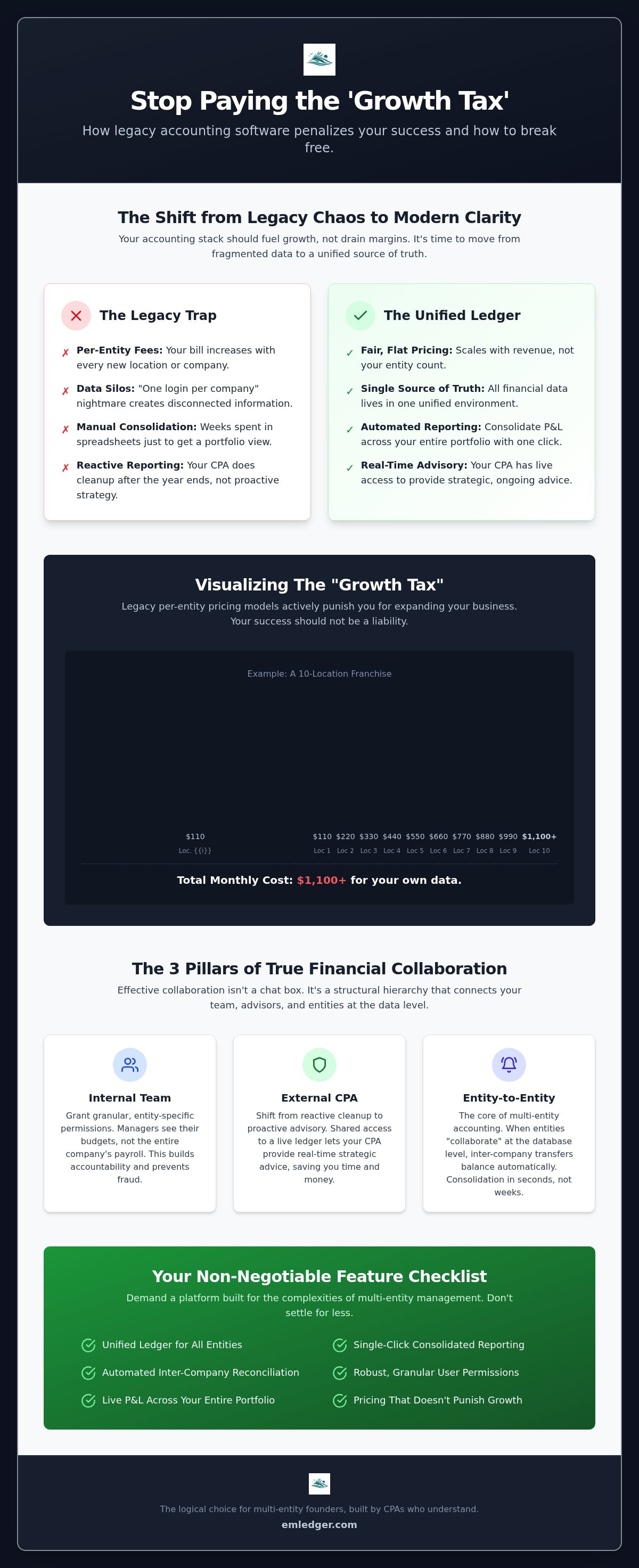
Why are you still paying a "growth tax" for the privilege of expanding your business? If you manage a 10-location franchise, legacy software providers expect you to pay over $1,100 every single month just to access your own financial data. It isn't a service; it's a penalty for success. You've spent years battling manual spreadsheet consolidation and searching for collaborative accounting software that handles multi-entity complexity without the predatory pricing. It's inefficient, it's expensive, and it's time to stop the bleed.
We agree that your accounting stack should fuel your growth, not drain your margins. This guide shows you how to eliminate per-entity fees and kill the manual reporting grind for good. You'll discover the logical exit from spreadsheet chaos and the path to true financial clarity. We'll preview the shift toward real-time visibility across all business entities, automated inter-company reconciliations, and a fair, flat pricing model that scales with your revenue, not your entity count. Stop paying for the status quo and start scaling for 2026.
Key Takeaways
- Shift from legacy silos to a unified ledger where financial data flows in real time between your team and your various entities.
- Stop paying a "growth tax" with per-entity pricing models that punish your expansion and drain your monthly margins.
- Learn how the right collaborative accounting software eliminates the manual spreadsheet trap by automating inter-company reconciliations.
- Demand non-negotiable features like consolidated reporting that provides a live P&L across your entire portfolio with a single click.
- Transition to a platform built by CPAs who understand the granular headaches of multi-layered management and multi-entity accounting.
What is Collaborative Accounting Software in 2026?
Collaborative accounting software isn't just a fancy way to say your bookkeeper has a login. It's a technology-enabled ecosystem where data lives in a unified ledger, not a series of disconnected silos. For too long, legacy providers have forced multi-company operators into a "one login per company" nightmare. This isn't just an inconvenience. It's a structural failure that forces you to act as a human bridge between your own businesses. Modern systems eliminate this friction by allowing entities to share a single environment while maintaining perfect financial separation.
When you implement collaborative accounting software that actually works, you move from reactive data entry to proactive financial management. You stop chasing receipts and start analyzing margins. The goal is simple: create a single source of truth where every stakeholder has the exact level of access they need to drive the business forward.
The Three Pillars of Modern Financial Collaboration
Internal Team Collaboration: Stop the bottleneck. Managers and department heads need real-time visibility into their budgets without having the keys to the entire kingdom. Granular permissions allow your team to own their numbers. This shifts the administrative burden away from the founder and onto the people actually spending the money.
External CPA Collaboration: The "document request" email loop is a relic of the past. When your CPA has shared access to the live ledger, they can provide proactive advice instead of reactive clean-up. You stop paying for data entry and start paying for strategy. It turns your tax professional into a real-time advisor.
Entity Collaboration: This is the core of multi-entity accounting. It's about business units sharing a single chart of accounts. When entities "collaborate" at the database level, inter-company transfers balance automatically. Consolidation happens in seconds, not weeks. It's the only logical way to manage a portfolio.
Why Portals and Email Threads are Not Collaboration
Most software companies sell "portals" as a collaboration tool. Don't fall for it. A portal is just a digital filing cabinet where PDFs go to die. It doesn't clean your trial balance or reconcile your accounts. It's just another place to lose a password. Email threads are even worse. They create information silos that disappear into inboxes, leaving no audit trail and zero context for future decisions.
True collaboration happens at the ledger level. If every stakeholder can't see the same live data point at the same time, you aren't collaborating; you're just talking about why the books are late. You need a system where the conversation and the calculation happen in the same space. That is the only way to scale without losing control of your numbers.
The Layers of Collaboration: Internal, External, and Entity
Most software providers treat "collaboration" as a shallow feature. They think a comment box next to a transaction or a basic chat window is enough. It isn't. For a scaling multi-company operator, collaboration is a structural hierarchy. It's about how data moves between people and business units without compromising security or accuracy. True collaborative accounting software must solve for three distinct layers: your team, your advisors, and your entities. If any of these layers are disconnected, your financial data remains a liability rather than an asset.
Internal: Multi-User Permissions and Accountability
Scaling requires delegation, but delegation without control is a recipe for disaster. You need to assign entity-specific roles within a single environment. Your warehouse manager should see inventory levels for Entity A, but they have no business looking at the payroll of Entity B. Legacy systems fail here by forcing you into "all or nothing" access. A modern system uses granular permissions and robust audit trails. Every entry and edit is tracked. This creates a culture of accountability where mistakes are caught early and fraud is prevented before it starts. It's about giving your team the tools to work without giving them the keys to the entire kingdom.
External: Making Your CPA Your Most Valuable Asset
If you only talk to your CPA during tax season, you're paying for reactive clean-up instead of strategic advice. The "year-end panic" is a direct result of disconnected data silos. By providing your CPA with shared access to a live ledger, you shift the relationship to real-time advisory. They see the numbers as they happen. They can spot tax-saving opportunities in July, not January. This transparency also reduces billable hours. When you provide clean, consolidated data upfront, your CPA spends less time hunting for documents and more time protecting your wealth. You can learn more about our use cases for bookkeepers to see how this shared workflow functions in practice.
Entity-Level: The Holy Grail of Multi-Company Accounting
This is the layer most software ignores. Your business units shouldn't live in isolation. For franchises and holding companies, the logic of a shared chart of accounts is undeniable. When your entities "collaborate" on a single platform, inter-company loans and transfers balance automatically. You stop building manual consolidation bridges in Excel. Instead, you get a bird's-eye view of your entire portfolio with one click. It's the only way to manage a complex structure without hiring a small army of accountants. You can explore entity management features to understand how a unified ledger simplifies your life. If you're tired of the manual grind, it's time to look at a consolidated reporting framework that actually scales with your ambition.
The "Growth Tax": Why Per-Entity Pricing is a Scam
Per-entity pricing is a scam. It's a tax on your ambition. Legacy providers like QuickBooks treat every new LLC you open as a fresh revenue stream for their own shareholders. They don't care if your new entity is a holding company with three transactions a month or a high-volume retail location. They want their cut. This "growth tax" creates a massive financial barrier for multi-company operators who are trying to scale. When your software costs grow faster than your headcount, your technology is no longer an asset; it's a liability.
The problem isn't just the subscription fee. It's the structural inefficiency. Because these legacy systems are siloed, you're forced into the "Manual Spreadsheet Trap." You spend hours every month exporting data into Excel just to see a consolidated view of your portfolio. You're paying premium prices for collaborative accounting software that doesn't actually collaborate across your entities. It's a broken model that rewards complexity and punishes efficiency.
Calculating the Real Cost of Legacy Software
The sticker price is just the beginning. To get a clear picture of the damage, you have to look at the total cost of ownership. For a 10-location franchise, using QuickBooks Online Plus costs approximately $1,150 per month. That's nearly $14,000 a year just for the right to log in. Add in the cost of third-party consolidation apps and the manual labor hours your team spends reconciling inter-company transfers, and the number skyrockets. You can read more about Accounting Software Without Per-Entity Pricing: Stop Paying the Growth Tax to see the full breakdown of these hidden drains.
The mental overhead is equally expensive. Managing 20 different logins, 20 different bank feeds, and 20 different sets of permissions is a recipe for error. It's a high-friction environment that prevents you from making fast, data-driven decisions. You're too busy managing the software to actually manage the business.
The Logical Exit: Flat-Tiered Pricing Models
Software should support your growth, not tax it. The logical solution is a flat-tiered pricing model where you pay for features and capacity, not the number of tax IDs you own. This is why we built tiered plans that respect your margins. Whether you're on a Solo, Growth, or Scale plan, your costs remain predictable. For example, a 15-location franchise can save over $18,000 per year by moving to a platform that doesn't charge per entity. You can view EmLedger Pricing Plans to see how a rational cost structure actually looks.
True collaborative accounting software should empower you to open that next location without checking your software budget first. "Scale" should mean more power, more automation, and more insight. It should never mean an endless list of subscription line items on your credit card statement. It's time to stop paying the growth tax and start keeping your profits.
Evaluating Collaborative Features for Your Multi-Entity Stack
Selecting collaborative accounting software is not about checking a "multi-user" box on a feature list. It is about building a structural framework where data flows between entities without manual intervention. For a scaling operator, the non-negotiables are clear. You need consolidated reporting that updates in real time, inter-company transactions that balance themselves, and bank reconciliation that doesn't require 20 different logins. If your software requires you to act as a data entry clerk to move information between your own companies, it isn't collaborative. It is just a digital ledger with extra steps.
Consolidated Reporting Without the Spreadsheets
Most legacy platforms treat consolidation as an afterthought. They offer an "Export to Excel" button and call it a day. That is not a feature; it is an admission of failure. True consolidation means your P&L and Balance Sheets are live across all entities at any given moment. You should be able to spot a margin squeeze in Entity C while looking at the group view. Watch out for "reporting bolt-ons" that sit on top of your accounting software. These often lag behind the live ledger, leading to decisions based on stale data. You can automate your consolidated reporting to ensure you always have a single source of truth without the spreadsheet gymnastics.
Inter-Company Transactions and Eliminations
Manual inter-company entries are the primary cause of audit failures and balancing nightmares. If Entity A pays a vendor bill for Entity B, the "Due To/Due From" accounts must update instantly on both sides. A collaborative system automates this logic. It also handles the elimination of internal revenue and expenses automatically. Without automated eliminations, your group-level revenue is artificially inflated, which distorts your actual performance. You need to master inter-company transactions at the database level to maintain a clean, audit-ready group view.
Inventory Management for Collaborative Growth
Scaling a multi-entity business often involves moving physical goods across different locations and tax IDs. If your inventory management is siloed, you will constantly battle stockouts or overstocking. The logical move is to integrate inventory directly with the accounting ledger. This allows you to track stock levels across multiple entities in real time. When a sale happens in one location, the cost of goods sold and inventory valuation update globally. You can explore integrated inventory management to see how a unified view of your assets prevents capital from being trapped in the wrong warehouse. If your current stack requires a manual bridge between entities, it is time to switch to a platform built for operators who value efficiency over busywork.
EmLedger: The Logical Choice for Multi-Entity Founders
EmLedger didn't start in a boardroom. It started in the trenches. Our founder, a CPA, saw firsthand how legacy software punishes success with per-entity fees and fragmented data. This platform is the logical exit from the manual spreadsheet trap. It's built specifically for the multi-company operator who is tired of acting as a human bridge between siloed accounts. We've stripped away the unnecessary complexity to focus on the functional utility that founders actually need to scale.
Transitioning to a unified system isn't just about saving money. It's about reclaiming your time. Most founders spend the first week of every month chasing reconciliations and fixing broken bank feeds. When you implement collaborative accounting software that works at the database level, that work happens automatically. You move from a reactive state of "fixing the books" to a proactive state of "leading the business." It is a fundamental shift in how you view your financial operations.
Built by Operators, for Operators
Professional accounting tools don't need to be stuffy or corporate. We value functional utility over marketing fluff. Our "No-Nonsense" philosophy means we build features that actually solve granular headaches. Whether you are managing a portfolio of franchises, a complex holding company, or a growing ecommerce brand, the logic remains the same. You need a platform that understands inter-company debt and consolidated visibility without charging you a premium for every new tax ID.
Our Solo, Growth, and Scale plans provide a clear roadmap for your business evolution. We support the diverse needs of modern operators, including:
- Holding companies needing automated "Due To/Due From" balancing.
- Franchise owners requiring real-time P&L comparisons across locations.
- Property managers seeking integrated inventory and multi-entity bank recs.
- Ecommerce brands scaling across multiple entities and warehouses.
Ready to Stop Paying the Growth Tax?
The first step is a simple calculation. Look at your current software spend and the labor hours wasted on manual consolidation. If you have 10 or more entities, you are likely overpaying by thousands of dollars every year. Moving your entities into a single, collaborative environment shouldn't be a months-long project. We designed the transition to be efficient and direct. You can move from fragmented silos to a unified ledger in about 30 minutes. It's a small investment of time for a massive return in clarity and capital.
Stop accepting the industry status quo as a necessary evil. You don't have to tolerate per-entity price gouging or manual spreadsheet grinds. You can start your logic-driven accounting journey today and keep your growth capital where it belongs: in your business. Scale your portfolio with the confidence that your financial stack is built to support your ambition, not tax it.
Time to Reclaim Your Growth Capital
You've spent too long battling a system designed to exploit your success. The "growth tax" of per-entity pricing is a relic of legacy software that doesn't understand your business structure. By moving toward a unified ledger, you eliminate the manual spreadsheet grind and replace it with real-time financial clarity across your entire portfolio. Implementing the right collaborative accounting software is the final step in professionalizing your financial stack. It is the logical exit from operational chaos and the entrance to true scalability.
EmLedger was CPA-founded to solve the exact multi-entity logic problems you face every day. We provide built-in consolidated reporting and flat-rate plans that scale with your revenue, not your entity count. You deserve a technology partner that rewards expansion instead of taxing it. It's time to stop the manual grind and start leading with actionable data. Stop Paying the Growth Tax; Get Started with EmLedger. You've built the business; now use the tools that help you keep it.
Frequently Asked Questions
What is the difference between collaborative accounting and a client portal?
A client portal is a passive digital filing cabinet for old PDFs. It doesn't clean your trial balance or reconcile your accounts. In contrast; collaborative accounting software is a live; shared ecosystem where you and your team work inside the same ledger. It's about active data flow versus static storage. You move from looking at historical snapshots to managing real-time financial truth.
Do I need a separate subscription for each LLC in my holding company?
No. Legacy providers often charge you for every single tax ID; a practice we call a "growth tax." EmLedger utilizes a tiered model where you can manage multiple entities under a single Growth or Scale plan. This structure respects your margins. You pay for the capacity and features you actually use; not a penalty fee for the simple act of expanding your business portfolio.
Can my CPA access EmLedger without me paying for an extra user?
Yes. Your CPA can access the platform without you incurring any additional costs. All EmLedger plans include unlimited users. We believe that your software should encourage collaboration with your advisors; not penalize it with per-user surcharges. Your tax professional can jump into the live ledger to provide real-time strategic advice whenever you need it; keeping your books audit-ready year-round.
Does collaborative accounting software support inter-company eliminations?
Yes. True collaborative accounting software must automate eliminations to provide an accurate group-level view. EmLedger removes internal revenue and expenses automatically during the consolidation process. This ensures your consolidated P&L reflects actual market performance instead of inflated numbers from internal transfers. It's a critical requirement for any founder managing a portfolio of companies or a complex holding structure.
How does EmLedger handle bank reconciliation for multiple entities at once?
EmLedger centralizes bank reconciliation so you can clear transactions for all your business units within a single interface. You don't have to log out and log back in dozens of times just to check bank feeds. This unified view allows you to reconcile accounts across different entities with much higher efficiency. It reduces administrative friction and eliminates the manual errors that occur when switching between siloed systems.
Is it difficult to migrate from legacy accounting platforms to a collaborative environment?
Migration is direct and typically completed in under 30 minutes. You aren't forced to rebuild your financial history manually. Instead; you transition your entities into a more logical; unified structure. Because the platform was CPA-founded; the migration logic ensures perfect data integrity. You can exit the fragmented silo model and start scaling without the technical debt of your previous software.
What industries benefit most from collaborative accounting software?
Any operator managing multiple tax IDs sees immediate benefits. This specifically includes franchises; holding companies; property managers; and ecommerce brands with multiple warehouses. These industries frequently struggle with inter-company loans and the need for consolidated reporting. If your current business structure requires you to bridge data between different companies in Excel; you are the primary candidate for a unified; collaborative ledger.
Can I manage inventory across different business units in one place?
Yes. You can track and manage stock levels across multiple entities and locations from a single dashboard. The inventory management system integrates directly with your accounting ledger. This means your inventory valuation and cost of goods sold update in real time as products move between your various business units. It prevents your capital from being trapped in siloed systems and ensures your balance sheet is always accurate.


