

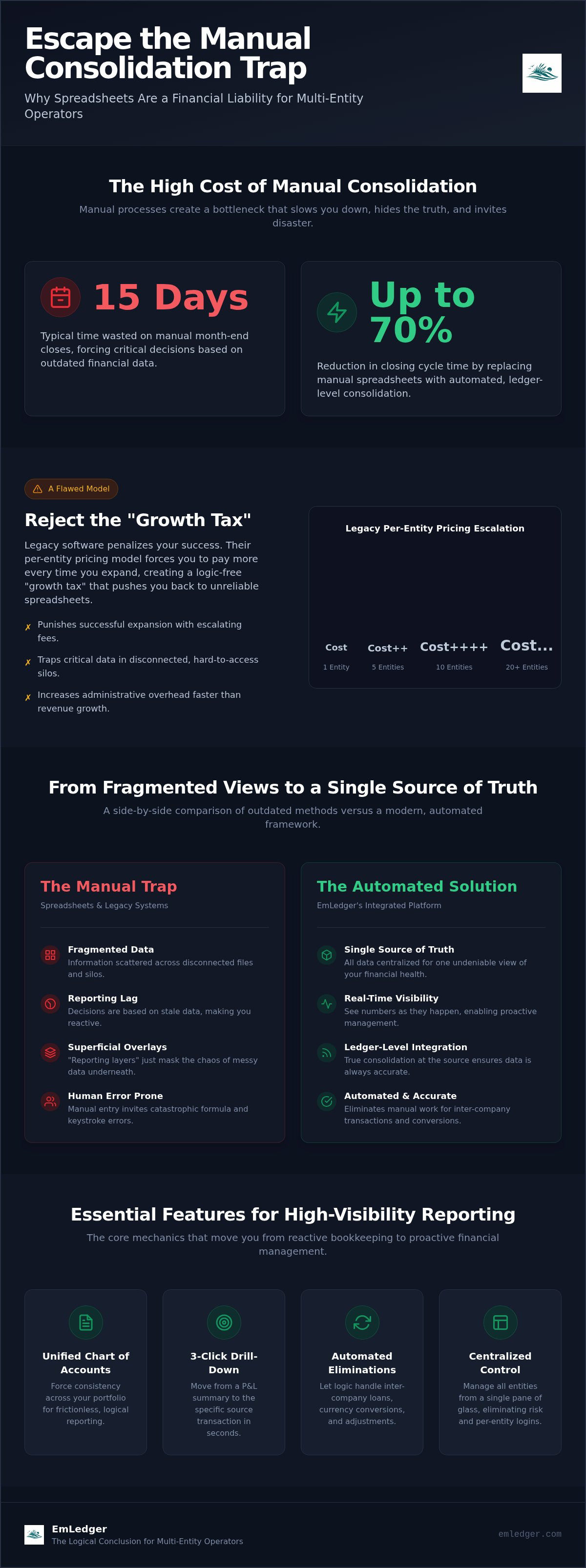
Your success shouldn't feel like a penalty. Most legacy software providers charge a "growth tax," hiking your fees every time you add a new entity to your portfolio. It's a logic-free model that pushes ambitious operators back into the nightmare of manual spreadsheets. You're left staring at fragmented data, hunting for formula errors, and wasting fifteen days on a month-end close. We're tired of seeing professionals trapped in this cycle, which is why choosing the right consolidated P&L reporting software is now a logical baseline for growth.
You already know that manual data entry is a liability, not a task. In 2026, relying on static files means your financial data is lagging before the ink even dries. This article will show you how to eliminate fragmented views and reclaim your accuracy. We'll outline a framework to automate inter-company eliminations and move to a single source of truth. You'll learn how to slash your closing cycle by up to 70% and gain clear visibility into your holding company's performance without the per-entity price gouging.
Key Takeaways
- Stop wasting fifteen days on month-end closes. Manual spreadsheets are financial liabilities that hide errors and lag behind your actual business performance.
- Shift your focus from reporting overlays to ledger-level integration. Automated consolidated P&L reporting software ensures your data is accurate at the source, not just cleaned up for a slide deck.
- Reject the "Growth Tax" imposed by legacy providers. Stop paying per-entity fees that punish your expansion and keep your data trapped in disconnected silos.
- Demand real-time visibility across your entire portfolio. Implement a unified Chart of Accounts to group entities by region or brand without hitting a manual refresh button.
- Choose a scalable framework built by experts. EmLedger’s Solo, Growth, and Scale plans provide a logical exit from complexity for multi-entity operators.
The Manual Consolidation Trap: Why Your Spreadsheets are Financial Liabilities
Spreadsheets aren't tools; they're liabilities. If you're managing five or fifty entities, manual entry is a ticking time bomb. A consolidated P&L reporting software isn't a luxury. It's a centralized system that pulls data from every ledger automatically. It creates a single, undeniable view of your financial health. Most operators treat spreadsheets as a safety net, but they're actually a bottleneck. They slow you down. They hide the truth. They invite disaster.
Your business moves fast. Spreadsheets don't. They're static documents trying to capture a dynamic reality. Every manual keystroke is a chance for a catastrophic error. When you're building a Consolidated financial statement, one misplaced decimal in an inter-company transfer can ghost-write a profit that doesn't exist. That isn't accounting. It's blind gambling. You're betting your company's future on a formula that might have been broken three months ago by an intern.
The Human Error Factor in Multi-Entity Reporting
Broken formulas. Hidden rows. Hard-coded numbers that nobody remembers. These are the silent killers of holding company accuracy. In high-growth accounting, "manual" is just another word for "unreliable." You can't scale on a foundation of "maybe." The Consolidation Trap is the point where administrative overhead outpaces revenue growth. When your team spends more hours reconciling data than analyzing it, you've stopped growing and started treading water. You need precision, not a best-guess estimate from a tired bookkeeper at 2:00 AM.
Real-Time Visibility vs. Reporting Lag
Most operators live in the past. If your consolidation takes two weeks, you're making decisions based on ancient history. By the time you see the P&L, the cash flow crisis in Subsidiary B has already metastasized. True consolidated P&L reporting software gives you the day-one advantage. You see the numbers as they happen, not as they were. This visibility is the difference between strategic scaling and a slow-motion wreck. You move from reactive bookkeeping to proactive financial management. You gain the power to:
- Identify underperforming units in hours, not months.
- Redirect capital to high-growth entities instantly.
- Spot cash flow leaks before they drain your reserves.
- Diversify your portfolio’s income and explore Display Advertising Revenue to uncover hidden profit centers in your digital assets.
Financial visibility isn't just about pretty charts. It's about survival. If you don't have a real-time view of your total profit and loss, you aren't leading. You're just following a trail of breadcrumbs that might lead off a cliff.
The Mechanics of Automated Consolidated P&L Software
True consolidation isn't a visual trick. It doesn't happen in a dashboard overlay that sits on top of messy data. It happens at the ledger level. Most legacy providers sell you a "reporting layer" that just masks the chaos underneath. Real consolidated P&L reporting software integrates directly with the source. It forces a unified Chart of Accounts (COA) across your entire portfolio. Without a shared COA, your mapping is just a series of guesses. With it, every transaction has a logical home. One source. One truth. Zero friction.
Multi-Entity Ledger Management: The Foundation of Clean Data
Managing 10 LLCs should feel like managing one. Centralized control is the only way to avoid decentralized chaos. Per-entity logins are a relic of the past. They were designed by companies that profit from your inefficiency. You need a single pane of glass for multi-entity ledger management. It's about security, speed, and sanity. When you control everything from one login, you eliminate the risk of fragmented data and forgotten entries.
Automated Inter-Company Eliminations and Adjustments
Inter-company transactions are the primary source of "phantom" revenue. If Entity A sells to Entity B, that income must be wiped from the consolidated view. It isn't new money. It's just moving pockets. Automated balancing ensures that if one entity owes another, the software reconciles it instantly. This isn't just about clean books; it's about survival. Messy inter-company loans are a red flag for regulators. Automated inter-company transactions turn a complex audit risk into a background process. It's the logical way to keep your holding company clean and compliant without adding headcount.
Add-ons vs. Built-in Consolidation: Avoiding the "Growth Tax" Scam
Industry giants have built a business model on your success. They don't celebrate your growth; they tax it. Every new entity you add to your portfolio becomes another monthly fee. It's a "Growth Tax" that punishes ambition and rewards inefficiency. These providers force you to buy third-party add-ons just to see your total profit. It's a fragmented approach that serves their shareholders, not your business. Logic dictates that consolidation should be a native function of your accounting platform, not a premium "extra" you have to bolt on later.
Add-ons create "Data Silos." This happens when your reporting software and your ledger don't speak the same language. You're left with the "Sync Failure" nightmare. You spend hours troubleshooting why Entity C didn't import correctly or why the inter-company eliminations didn't trigger. You hit the refresh button and pray the data is accurate. That isn't a financial strategy. It's a waste of your most valuable resource: time. Choosing a unified consolidated P&L reporting software ensures your data remains integrated from the first entry to the final report.
The Integration Headache: Why Add-ons Often Fail
API connections are fragile. They are the weak links in your financial chain. One update on the ledger side can break the bridge to your reporting tool without warning. You're left with a "Consolidated P&L" that is missing critical data from two subsidiaries. "All-in-One" isn't just a marketing slogan; it's a technical advantage. When the ledger and the reporting are the same tool, there is no sync. There is just data. You need accounting software without per-entity pricing to ensure your infrastructure stays stable as you scale. This eliminates the bridge entirely and keeps your records clean.
Calculating the Total Cost of Ownership (TCO)
Do the math. Compare the cost of maintaining five separate QuickBooks licenses plus a Fathom subscription against a single Scale plan. You aren't just paying for software. You're paying the "Admin Tax." This is the hidden cost of the hours your team spends managing eleven different logins and reconciling disparate data sets. Per-entity pricing is a logical fallacy for serial entrepreneurs who need to scale without friction. You shouldn't be penalized for opening a new location or launching a new brand. A flat-fee model respects your margins. It allows you to focus on performance instead of managing a growing pile of software bills. You've earned your growth; don't let a legacy software provider take a cut of it.
Essential Features for High-Visibility Consolidated Reporting
High-visibility reporting isn't about pretty colors or complex charts. It's about data integrity. Most consolidated P&L reporting software forces you to hit a "refresh" button and wait for a sync that might fail. That isn't automation; it's a chore. You need real-time synchronization that updates as transactions hit the ledger. You also need customizable reporting hierarchies. You must be able to group entities by region, brand, or business unit. If you can't slice your data to see how your Northeast franchises are performing against the West Coast in one click, your software is failing you.
Efficiency is a calculation, not a goal. Logging into twenty different bank portals to reconcile twenty different entities is a waste of your life. You need automated bank reconciliation across all entities simultaneously. Security is just as critical. Permission-based access ensures that entity managers see only what they need, while you maintain the high-level view. Every number must have an audit-ready trail. If a figure on your consolidated P&L looks off, you must be able to trace it back to the specific source document without opening a single spreadsheet.
Dynamic Drilling: From Consolidated P&L to Individual Transactions
Validation shouldn't be a scavenger hunt. When you're looking at a $1M consolidated expense, you need to know where it came from right now. Dynamic drilling allows you to move from the top-level P&L down to individual transactions in seconds. This transparency is your best defense against internal fraud and mismanagement. It keeps your team honest and your data clean. Explore our consolidated reporting features to see how we turn transparency into a strategic advantage. It's the logical way to manage a growing portfolio without losing control of the details.
Inter-Company Transaction Automation
Profit bleeding usually starts with messy inter-company loans and settlements. Manual journal entries for these transactions are an invitation for errors. You need automation that handles these entries at the source. If Entity A pays a bill for Entity B, the software should record the debt and the credit across both ledgers instantly. This is why inter-company transaction software is non-negotiable for multi-entity operators in 2026. It stops the bleeding and keeps your consolidated view accurate without the human overhead. Stop guessing and start knowing. See how EmLedger simplifies multi-entity accounting today.
EmLedger: The Logical Conclusion for Multi-Entity Operators
EmLedger wasn't built in a marketing boardroom. It was built by a CPA who spent years in the trenches of multi-entity accounting. We saw the industry giants overcharging for basic functionality. We saw the "Growth Tax" strangling ambitious businesses. We decided to build a better way. Our consolidated P&L reporting software isn't an expensive add-on or a hidden upcharge. It's a core feature. It's the logical baseline for any business with more than one entity. We've stripped away the complexity and the hidden costs. You're left with a clean, functional platform that respects your resources.
The transition to automated reporting is simple. We've replaced the manual "refresh" buttons and broken API bridges with a unified ledger. Our workflows are designed for the modern entrepreneur who values logic over legacy fluff. You don't need a six-month implementation period. You don't need a team of consultants. You just need a system that works as hard as you do. We've built that system. It's time to stop fighting your software and start using it to drive your business forward.
Scaling Without the Growth Tax
Success shouldn't come with a higher software bill. Most providers punish your expansion by charging per entity. We've rejected that model. Our Solo Plan supports early-stage founders while preparing them for the multi-entity expansion they're planning. It's about building a foundation that stays unified as you grow. When you're ready for complex holding company structures, the Scale Plan provides enterprise-level power without the enterprise ego. You get the tools you need to manage multiple entities without the six-figure price tag. View the EmLedger pricing to see how we've eliminated the growth tax for good.
From Consolidation to Strategic Execution
Clean data is the prerequisite for strategic execution. Your consolidated P&L should be more than a month-end report. It's a map for capital allocation. It identifies exactly which entities are printing cash and which are burning it. This visibility is essential for a successful exit or acquisition. Potential buyers don't want to see a pile of messy spreadsheets and broken formulas. They want to see a unified ledger they can trust instantly. Move from reactive bookkeeping to proactive financial management. Stop paying the growth tax and start consolidating with logic.
Reclaim Your Margins and Your Sanity
Spreadsheets are liabilities. Per-entity fees are a tax. Fragmented data is a risk. You've seen the cost of the status quo, and it's too high for any ambitious operator. Moving to a dedicated consolidated P&L reporting software is the only logical way to regain control. You need ledger-level integration, automated inter-company eliminations, and a single source of truth that updates in real time. This isn't just about accounting; it's about strategic survival.
EmLedger was built by a CPA who was tired of the industry overcharging for basic visibility. We include consolidated reporting in all our multi-entity plans because logic dictates it should be a baseline feature. There are no hidden per-LLC fees here. We value your scalability, not your software budget. It's time to exit the spreadsheet chaos and focus on the performance of your portfolio. Your success should be celebrated, not taxed.
View Pricing and Stop the Growth Tax
Frequently Asked Questions
What is the difference between financial consolidation and financial close?
Financial consolidation is the process of aggregating data from multiple entities into a single report. It focuses on structure and mapping. The financial close is the period-end workflow where you finalize entries and lock the books. Consolidation is a component of the close process. You can't have an accurate close without a logical consolidation of your subsidiaries.
Does consolidated P&L software handle inter-company eliminations automatically?
True consolidated P&L reporting software identifies and wipes out phantom revenue at the source. If Entity A sells to Entity B, the software recognizes the internal movement and removes it from the consolidated view. This prevents you from double-counting the same dollar. It turns a manual reconciliation nightmare into a background process that runs without human intervention.
Can I consolidate entities that use different currencies or fiscal years?
Yes. Logical software handles currency conversion and fiscal mapping at the ledger level. You shouldn't be manually calculating exchange rates in a spreadsheet. The system applies the correct historical or average rates to ensure your reporting is accurate. It aligns disparate periods into a unified view so you can compare performance across your entire global portfolio without friction.
Why is per-entity pricing considered a "growth tax" in accounting software?
Per-entity pricing is a penalty for your success. Legacy providers charge you a new monthly fee every time you launch a brand or open a location. It's a model designed to benefit their shareholders, not your margins. We call it a "growth tax" because it creates a financial barrier to expansion. Your software costs should scale with your needs, not your entity count.
How long does it typically take to implement consolidated reporting software?
Implementation depends on your data cleanliness, but automated systems are built for speed. Unlike legacy enterprise platforms that take months of consulting, a unified ledger system can be live in days. You map your Chart of Accounts once and let the software handle the rest. It's a logical exit from the months of setup required by clunky enterprise competitors.
Do I still need a CPA if I use automated consolidation software?
Yes. Software handles the mechanics, but a CPA handles the strategy. Automated consolidation frees your CPA from the low-value task of manual data entry. Instead of hunting for spreadsheet errors, they can focus on high-level capital allocation and tax planning. You're paying them for their expertise, not for their ability to copy and paste numbers into a file.
Can I drill down into individual transactions from a consolidated report?
You must be able to. If you see an anomaly on your consolidated P&L, you should reach the source transaction in three clicks. High-quality software maintains a direct link between the aggregate total and the individual ledger entry. This transparency is your best defense against mismanagement. If your current system doesn't allow for dynamic drilling, it's a liability, not a tool.
Is EmLedger compatible with businesses that have 10 or more LLCs?
EmLedger is built specifically for complex multi-entity structures. Our Scale Plan supports holding companies with dozens of LLCs without the "growth tax" of per-entity fees. We handle the inter-company transactions and bank reconciliations across your entire portfolio from a single login. Whether you have five entities or fifty, the logic of the platform remains the same: simplicity, transparency, and scalability.


