

Your software provider is taxing your success. Every time you scale and add a new entity, your accounting bill shouldn't triple. That isn't a service fee. It's a growth tax designed to penalize your expansion. If you're still managing inter-company billing software through a mess of spreadsheets and manual journal entries, you're losing hours to a problem that's already been solved.
We know the drill. You spend days on inter-company eliminations only to find duplicate data errors that reset the clock. It's frustrating, inefficient, and entirely unnecessary. You deserve a system where adding a new company doesn't break the bank or the bookkeeper. You're looking for logic, not another expensive subscription tier that eats your margins.
In this guide, you'll discover how to eliminate manual entries and stop overpaying for multi-entity accounting with a logical, unified approach. We'll explore how to achieve one-click settlements and real-time consolidated visibility. It's time to move toward predictable pricing that scales with your profit, not your entity count.
Key Takeaways
- Understand why per-entity pricing models act as a "growth tax" that penalizes your success by forcing you into expensive, disconnected database silos.
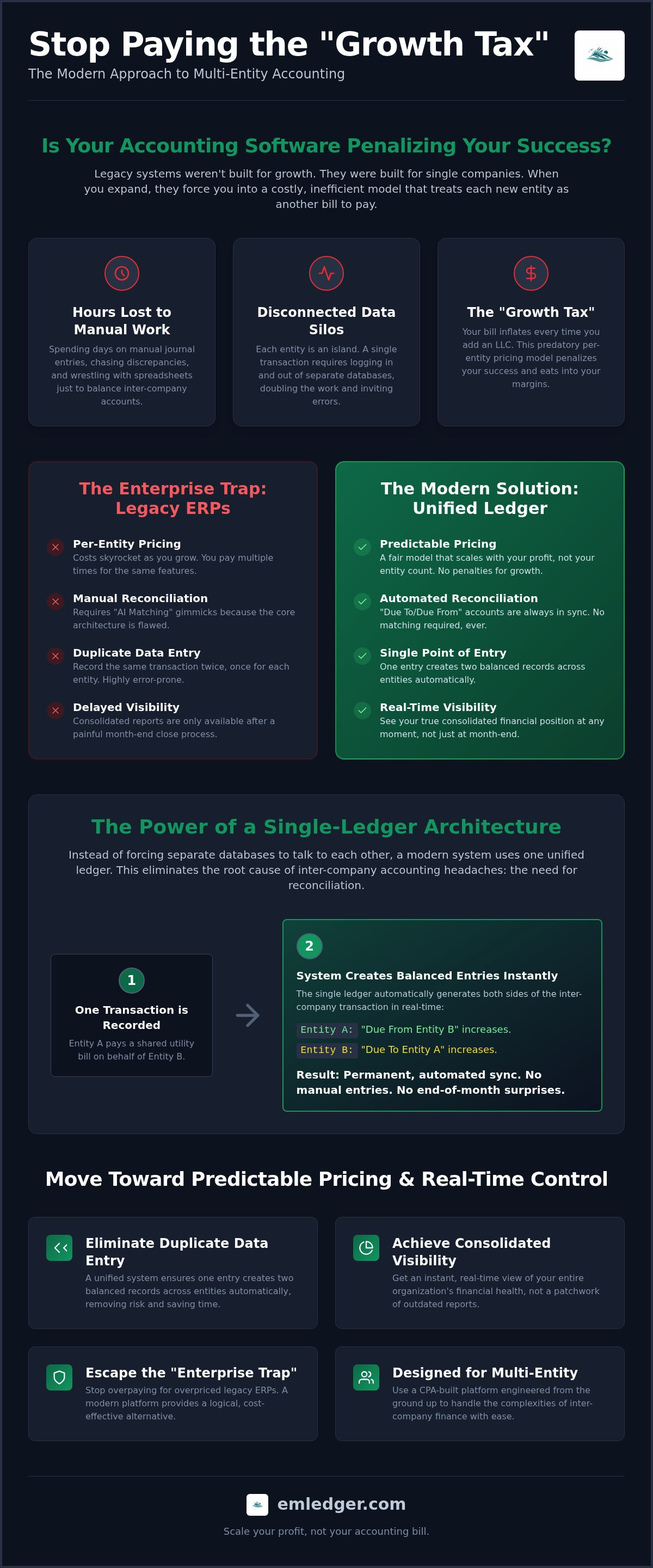
- Learn how a single-ledger architecture eliminates manual journal entries by keeping "Due To/Due From" accounts in permanent, automated sync.
- Identify the "Enterprise Trap" and why modern inter-company billing software provides a logical, cost-effective alternative to overpriced legacy ERPs.
- Discover the practical steps for standardizing your chart of accounts to streamline inter-company loan tracking and automated interest calculations.
- Explore how a CPA-built platform replaces spreadsheet chaos with real-time consolidated visibility and predictable pricing that scales with your profit.
Why Your Current Inter-Company Billing is a "Growth Tax"
Growth should be your goal. It shouldn't be a liability. Most software providers see your ambition as an opportunity to inflate their own bottom line. Every time you launch a new LLC or acquire a competitor, they raise your bill. This is the "Growth Tax." It is a predatory pricing model that treats each new entity as a fresh excuse to charge you for features you already own. If your inter-company billing software forces you to pay more just because your org chart got more complex, you are being penalized for succeeding.
To understand the scope of the problem, we must first define the basics. What is Inter-Company Billing? It is the process of charging shared expenses or services between related legal entities. In a logical world, this would be a simple data transfer. In the world of legacy accounting, it is a manual nightmare. Legacy software wasn't built for you. It was built for single companies. When you grow, these systems struggle to keep up. They force you into a fragmented architecture that creates manual labor where automation should exist.
The emotional toll on your team is real. Controllers spend their weekends chasing five-cent discrepancies. Founders lose sleep over "blind spots" in their cash flow. This isn't just an accounting headache. It's a drain on your company's culture and its capacity to scale. You didn't start a business to manage a tech stack that works against you.
The Hidden Cost of Separate Databases
Legacy ERPs rely on "Database Silos." This means Entity A is completely blind to Entity B. When you move money or share a service, you have to log out of one database and log into another to record the same transaction twice. This is where the errors live. Unbalanced inter-company accounts are the inevitable result of this design flaw. A growth tax is a financial penalty on business diversification. It forces you to choose between clean books and affordable software. You shouldn't have to choose.
Signs Your Billing Process is Broken
Your process is broken if it relies on human memory instead of system logic. If you identify with these symptoms, your current inter-company billing software is failing you:
- You spend more than four hours every month manually typing journal entries to balance your books.
- Your inter-company loans are tracked in a "master" spreadsheet because your software can't handle the math.
- Month-end consolidation feels like a rescue mission instead of a routine report.
If you are tired of the complexity, it is time to look at a fair pricing model that values your growth. You need a system that treats your entities as part of a whole, not as separate bank accounts to be drained by a software vendor.
The Mechanics of Automated Inter-Company Reconciliation
Most software companies want to sell you "AI matching." It's a marketing gimmick designed to hide a fundamental architectural flaw. If your accounting system forces you to "reconcile" two different records for the same internal event, the system is broken. Modern inter-company billing software should eliminate the need for matching entirely. It does this through a single-ledger architecture. When you record a transaction in one entity, the corresponding entry in the other entity should be a mathematical certainty, not a manual hope.
The logic relies on "Due To" and "Due From" accounts. These aren't just line items; they're the connective tissue of your multi-entity balance sheet. In a properly designed system, these accounts stay in permanent sync. If Entity A owes money to Entity B, both balance sheets update instantly. There is no delay. There is no "matching" process at the end of the month. You get real-time visibility into your consolidated position because the math is handled at the point of entry.
Eliminating the Duplicate Data Entry Loop
Duplicate data entry is a relic of the 90s. When you use a unified system, one entry creates two balanced records across different entities automatically. This removes the risk of "wash" transactions getting lost in the shuffle. By automating your settlements, you ensure that inter-company debt is cleared without a flurry of manual checks. For a deeper look at why this logic is superior to manual work, read more about inter-company transaction software and its role in modern finance.
Centralized Purchasing and Shared Payroll
Complexity often peaks when one entity pays a bill for another. In legacy systems, you'd record the bill in Entity A, then manually create an invoice for Entity B. It's a waste of time. A logical approach allows you to bill Entity B for a vendor invoice paid by Entity A with a single click. This is especially critical for shared payroll allocations. You need an audit trail that links the original vendor invoice directly to the inter-company charge. Following Best Practices for Inter-Company Loan Tracking ensures your records stay clean for future audits or exits.
Stop chasing ghosts in your spreadsheets. If you're ready to see how logic beats "black box" AI, explore our approach to inter-company transactions today.
Legacy ERPs vs. Modern Multi-Entity Billing Platforms
Most businesses start with QuickBooks or Xero. It's fine for one company. It's a disaster for ten. You're forced to manage ten separate logins. You're forced to pay ten separate subscriptions. This is where the friction starts. You aren't just managing books; you're managing a fragmented mess of data silos. The manual workload doesn't just double; it compounds. Every new entity adds a layer of complexity that your existing tools weren't designed to handle. You end up hiring more bookkeepers just to manage the software, which is the opposite of why you bought software in the first place.
When the pain gets too high, the big players tell you to move to NetSuite or Sage Intacct. This is the "Enterprise Trap." It's an overkill solution that requires a six-figure implementation fee and a dedicated team just to keep it running. You don't need a spaceship to drive across town. You need a logical, CPA-built platform that understands multi-entity life. These legacy giants charge you for the privilege of growth. They profit when you add complexity. It's a fundamental misalignment of interests between the vendor and the operator.
The difference between a marketing-built tool and a CPA-built tool is simple. One focuses on flashy dashboards and "AI" buzzwords. The other focuses on the integrity of the ledger. Investing in the right revenue infrastructure is about more than just features. It's about ensuring your inter-company billing software doesn't become a bottleneck as you scale. You need a system that facilitates growth instead of taxing it. Logic dictates that your costs should scale with your success, not your legal structure.
The Problem with "Accounting Overlays"
Some vendors sell "overlays" to fix your legacy software. It's a losing strategy. You're paying for a third-party sync tool to bridge the gap between two broken databases. It's like putting a band-aid on a broken leg. You still have to pay for the underlying software plus the cost of the overlay. The only logical choice is accounting software without per-entity pricing that handles multi-entity logic natively. Don't build your house on sand. If the foundation is fragmented, no amount of "syncing" will make it stable.
Scalability Checklist: Solo to Scale
Before you sign another predatory contract, run your current inter-company billing software through this checklist. If you can't check every box, you're already behind the curve:
- Does the software support consolidated reporting out of the box without manual Excel exports?
- Are inter-company eliminations automated or do you still have to manually "match" them every month?
- Can you add a new LLC to your system in under 60 seconds without calling a sales representative?
- Is the pricing predictable, or does your bill triple every time you expand your footprint?
Best Practices for Inter-Company Loan Tracking and Settlements
Chaos is expensive. If your entities don't share a standardized chart of accounts, you aren't running a business. You're running a collection of disconnected hobbies. Standardizing your accounts is the first step toward real automation. It ensures that every transaction is categorized identically across your entire portfolio. Without this, your inter-company billing software is just a glorified calculator that requires constant manual intervention. You need a single source of truth that translates across every LLC you own.
Interest isn't a suggestion. It's a compliance requirement. For August 2026, the IRS set the short-term Applicable Federal Rate (AFR) at 4.10% and the mid-term rate at 4.35%. If you aren't applying these rates to your inter-company loans, you're inviting an audit. Automated interest calculations remove the guesswork. They keep your transfer pricing documentation clean and your tax compliance bulletproof. Logic dictates that your software should handle this math for you.
The "Monthly Settlement" habit is non-negotiable. Don't let Due To and Due From balances bloat your balance sheet for months on end. Clear them out. Keep your books lean. This practice provides a clear picture of your actual cash position. It prevents "zombie debt" from masking the true performance of individual entities. Clean books lead to better decisions.
Step-by-Step: Managing an Inter-Company Loan
Tracking a loan shouldn't require a PhD in accounting. Follow this logical workflow to maintain total control:
- Create the agreement: Define the principal and set the interest rate based on current AFRs.
- Map the accounts: Use your inter-company transaction software to link the lending and borrowing entities.
- Automate accruals: Set the system to generate monthly interest entries automatically.
- Verify eliminations: Use consolidated reports to ensure the loan zeros out at the group level.
Automating the Settlement Process
Physical bank transfers are slow and costly. You can reduce transaction fees by "netting" inter-company balances before moving any cash. If Entity A owes Entity B $1,000, but Entity B owes Entity A $800, only $200 needs to move. Use bank reconciliation software to match these net transfers instantly. This minimizes the number of physical transactions and keeps your banking fees low. It's a rational approach to cash management that respects your bottom line.
Ready to stop the spreadsheet manual labor? Automate your inter-company transactions and regain your time today.
Scaling Without the Headache: The EmLedger Approach
The accounting software industry is built on a lie. It tells you that as your business grows, your software must become more complex and exponentially more expensive. This is the foundation of the "Growth Tax." We built EmLedger because we were tired of watching multi-entity operators get penalized for their own success. Our platform was designed by a CPA who spent years in the trenches, fighting the very same spreadsheet chaos you're dealing with today. We didn't build a marketing tool; we built a logical solution for the financial reality of running multiple companies.
Logic dictates that your inter-company billing software should be a facilitator, not a gatekeeper. Our EmLedger Pricing model reflects this philosophy. We offer Solo, Growth, and Scale plans that respect your margins. Unlike legacy competitors, we don't believe in charging you a premium just because you added an eleventh or twelfth LLC to your portfolio. You get the tools you need to manage your empire without the predatory per-entity fees that eat your profit. It is a fair, transparent alternative to the industry status quo.
The Scale plan is where the "Enterprise Trap" ends. It provides enterprise-grade consolidation and automated settlements without the enterprise ego. You don't need a six-month implementation period or a team of consultants. You need real-time visibility across every ledger. For the serial entrepreneur, this clarity is the ultimate competitive advantage. It allows you to move capital, allocate resources, and make decisions based on facts, not three-week-old manual reports.
Designed for the Multi-Entity Operator
EmLedger is more than just a place to record transactions. It is a unified command center for your entire business structure. We've integrated consolidated reporting and entity management directly into the core architecture. This means you can manage inventory and accounting in one unified system. Whether you are running a holding company, managing a franchise network, or overseeing a portfolio of properties, the logic remains the same. One ledger. One source of truth. Zero duplicate data entry.
Your Logical Next Step
You have a choice. You can continue fighting your software, or you can start leveraging your data. The manual work, the spreadsheet errors, and the "Growth Tax" are optional. Join the community of founders who have escaped the legacy software trap and moved toward a more rational way of managing their finances. We invite you to explore our use cases to see exactly how we solve the granular headaches of your specific industry. It is time to stop paying for the privilege of growth and start using inter-company billing software that actually works for you.
Stop Punishing Your Own Success
Growth is the objective; complexity is the byproduct. You shouldn't be forced to choose between scaling your business and keeping your sanity. Legacy systems thrive on the "Growth Tax" by trapping you in fragmented databases and predatory per-entity pricing. It's an outdated model that prioritizes software profits over your operational efficiency. By shifting to a single-ledger architecture, you eliminate the need for manual matching and reclaim hours of lost time every month.
Modern inter-company billing software should be a tool for expansion, not a financial bottleneck. You need a CPA-built platform that offers real-time consolidated reporting without the hidden fees. EmLedger provides a logical exit from spreadsheet chaos with pricing that scales with your results, not your entity count. It's time to demand transparency and efficiency from your financial stack.
Take the next logical step for your business. View the EmLedger Pricing: Stop Paying the Per-Entity Growth Tax and see how a unified ledger can transform your multi-entity management. You've built an empire; it's time to start running it like one.
Frequently Asked Questions
What is inter-company billing software and why do I need it?
It's a platform that automates the charging of shared expenses or services between related legal entities. You need it because manual entries are a financial liability that leads to errors and burnout. Legacy systems treat every LLC as a silo. This software bridges the gap; it ensures your books balance across the entire organization without duplicate data entry or fragmented logins.
How does automated inter-company reconciliation actually save time?
It eliminates the matching loop by using a single-ledger architecture. When you record a transaction in Entity A, the system creates the corresponding entry in Entity B automatically. This removes the need for manual journal entries at month-end. You stop chasing five-cent discrepancies and start reviewing reports that are already balanced. It turns a multi-day reconciliation process into a routine check.
Can I use inter-company billing software with multiple LLCs?
Yes, it's specifically designed for multi-entity operators who manage several legal structures. Whether you have two LLCs or twenty, the software handles the cross-entity traffic. It stops the fragmented cycle where you log out of one company to log into another. You manage everything from a unified command center. This is the only logical way to scale without adding administrative bloat.
What is the difference between inter-company billing and consolidation?
Inter-company billing is the operational recording of transactions between entities, while consolidation is the reporting process that combines all financial statements into one. Billing happens daily to keep the ledgers in sync. Consolidation happens at month-end to eliminate those internal transactions for an accurate group-level view. Both are essential, but billing is the foundation that makes consolidation possible and accurate.
Does inter-company software help with tax compliance and audits?
It provides a clear, digital audit trail that links every inter-company charge to its source. This is critical for defending transfer pricing policies and loan interest rates during an audit. The software can automate interest accruals based on current IRS Applicable Federal Rates. You move from best guesses in a spreadsheet to verifiable data that satisfies regulators and auditors without the stress.
Is inter-company billing software expensive for small businesses?
It's often cheaper than the "Growth Tax" hidden in legacy per-entity pricing models. Many providers charge you extra for every new LLC you add. A logical platform offers tiered pricing that supports multiple entities without penalizing your expansion. It's an investment that pays for itself by reducing the need for additional bookkeeping staff as you scale your business portfolio.
How do I track inter-company loans without using spreadsheets?
You use built-in loan tracking features that map lending and borrowing accounts across your entities. The software calculates interest and generates monthly accrual entries automatically. This keeps your Due To and Due From balances accurate in real-time. You stop relying on a master spreadsheet that is prone to version control issues and human error. The system becomes your permanent source of truth.
Will this software integrate with my existing bank accounts?
Yes, modern inter-company billing software connects directly to your bank feeds to streamline reconciliation. It allows you to match physical cash transfers with the internal records you've already created. This ensures that your bank balance and your inter-company ledger are always in agreement. Integration reduces manual data entry and provides immediate visibility into your actual cash position across all entities.


