

Every time you open a new warehouse or launch a new LLC, your software provider sends you a bill. It's a "growth tax" designed to punish your success. With 34% of small businesses still tracking inventory manually, the risk of financial error is staggering. You need inventory accounting software that treats your multi-entity structure as an asset, not a profit center for a legacy tech giant. Your software should work for you. Not the other way around.
We agree that managing stock across multiple locations shouldn't feel like a constant battle against your own ledger. You deserve a system that scales as fast as you do. This article explains why integrated inventory accounting is the only way to maintain financial integrity without overpaying for growth. We'll show you how to achieve real-time visibility, automate your sync, and finally adopt a pricing model that doesn't penalize your ambition.
Key Takeaways
- Eliminate the "Integration Tax" by using inventory accounting software that natively connects stock movements to your general ledger.
- Stop guessing your margins. Learn why treating inventory with the same rigor as a bank account is the only way to maintain true financial integrity.
- Protect your profits from legacy pricing models that charge per entity or per warehouse. Growth should be rewarded, not taxed.
- Discover the non-negotiable features required for real-time visibility across multiple LLCs and complex supply chains.
- Build a roadmap for multi-entity expansion using a system designed by professionals who understand the granular headaches of scaling.
What is Inventory Accounting Software and Why Integration Fails
Most software vendors sell you "stock control" and pretend they've solved your problems. They haven't. There is a massive difference between knowing where a box sits and knowing how that box impacts your bottom line. True inventory accounting software is the system that connects physical stock movements directly to your financial ledger in real time. It ensures that every item received, sold, or lost is immediately reflected in your financial statements without manual intervention.
If your warehouse team scans a barcode but your accountant has to wait for a weekly CSV export to update the books, you don't have a system. You have a mess. Logistics is about the movement of goods; inventory accounting is about the movement of value. When these two worlds are separated, your financial integrity disappears. Relying on spreadsheets is a ticking time bomb. Research shows 24% of small businesses still use manual sheets, where one broken cell can turn your inventory valuation methods into a work of fiction. You cannot scale a multi-entity business on a foundation of broken formulas.
The Reality of Data Drift
The "Integration Tax" is the hidden cost of trying to force two different platforms to talk to each other. When you sync separate inventory and accounting tools, data drift is inevitable. Orders get stuck in the API. Returns aren't processed on the ledger. Suddenly, you have "phantom inventory" on your balance sheet that doesn't exist in the warehouse. This isn't just a technical glitch; it's a financial liability.
Managing these liabilities requires more than just better accounting; as your data footprint expands, EmberHound provides specialized software to help you identify sensitive information and ensure your business remains compliant with GDPR and PCI standards.
Reconciling these discrepancies at year-end is an expensive, manual nightmare that drains your team's time. You end up paying for software and then paying again for the labor to fix the software's mistakes. Inventory accounting is the bridge between the warehouse and the P&L. Without a direct, native connection, that bridge is always broken. You lose visibility, you lose accuracy, and ultimately, you lose money.
Why 'Best-of-Breed' is a Growth Trap
The industry loves to push "best-of-breed" solutions. They want you to buy a specialized tool for every tiny task. For a growing business, this is a trap. Every new "simple" inventory add-on creates another API connection to manage, another subscription to pay for, and another point of failure for your data. It's a recipe for complexity that punishes your success. As you add more entities or warehouses, the cost and the chaos grow exponentially.
Your CPA likely hates your third-party inventory plugin. It forces them to play detective instead of acting as a financial advisor. They spend hours hunting down why the sub-ledger doesn't match the bank statement. A single source of truth isn't just a marketing buzzword; it's a logical necessity for any operator serious about Inventory Management. You need one system that handles the count and the cost simultaneously. Stop paying the integration tax and start building on a platform that respects your growth.
Financial Integrity: Why Inventory is a Ledger Problem
Boxes aren't just plastic and cardboard. They are cash. If you don't track your inventory with the same rigor as your bank account, you're leaking capital. Most "stock control" tools focus on the warehouse floor. They ignore the general ledger. This is a fatal mistake for any multi-entity operator. When your inventory numbers are disconnected from your accounting, your financial statements become a work of fiction.
Proper inventory accounting software treats every SKU as a financial asset. If your valuation is off, your entire financial statement is a lie. Modern challenges in inventory management, like inflation and supply chain volatility, mean you can't afford "close enough" numbers. Your valuation methods, whether FIFO or LIFO, must be locked to your accounting to ensure your margins are real and your taxes are accurate.
Perpetual vs. Periodic Inventory
Periodic inventory is a relic of the pre-digital era. Waiting until month-end to count boxes is a recipe for disaster. It leaves you blind for 29 days out of the month. You can't make strategic decisions on data that is four weeks old. Perpetual tracking provides real-time accuracy and ensures your consolidated balance sheet reflects reality every single minute. You stop guessing. You start knowing. This is the only way to scale without losing control of your cash flow.
The COGS Accuracy Gap
Bad data creates bad tax filings. If your Cost of Goods Sold (COGS) is calculated on a spreadsheet, you're likely overpaying or underpaying the IRS. Neither is a good outcome. You have to track more than just the purchase price. True inventory integrity requires tracking landed costs, including shipping, duties, and insurance, as part of the "real" cost of stock. Automated COGS entries eliminate human error in margin reporting by ensuring every sale triggers an immediate, accurate expense recognition on your ledger.
Investing in modern inventory accounting software isn't about counting boxes; it's about protecting your cash flow and maintaining total financial integrity. You shouldn't need a math degree to understand your margins. If you're tired of manual reconciliations, it's time to look at Inventory Management that actually connects to your ledger.
The Growth Tax: Why Your Software Bill Triples as You Scale
Legacy software vendors love your ambition. They monetize it. Every new LLC you launch is another line item on their revenue report. It is a tax on your success. It is a punishment for scaling. Most inventory accounting software providers operate on a per-entity pricing model that makes sense when you have one warehouse, but becomes predatory the moment you expand. They aren't charging you for more features or better support. They are charging you for the privilege of growing your own business.
The math of scaling on traditional platforms is a rational disaster. If you are a serial entrepreneur or a holding company manager, your software costs shouldn't grow faster than your margins. You need a system that values logic over legacy. A flat-rate model respects your resources. It allows you to add entities, test new markets, and launch sub-brands without checking your software budget first. Multi-entity inventory management should be a tool for expansion, not a recurring financial penalty.
The Multi-Entity Pricing Scam
Break down the cost of managing 10 LLCs on a "Standard" cloud accounting platform. You aren't just paying for ten subscriptions. You are paying for ten separate silos of data. You are paying for the time it takes to log in and out of ten different accounts. You are paying a 900% premium for the exact same functionality you had with your first company. It is an inefficient use of capital that serves the vendor, not the operator.
This is why a disruptive approach to entity management is necessary. You should pay for the power of the platform, not for the number of tax IDs you own. Logic dictates that your accounting system should handle one entity or fifty with the same level of efficiency. When you remove the per-entity friction, you free your team to focus on operations rather than subscription management.
Consolidating Inventory Across Brands
Multi-brand ecommerce is a logistical puzzle. If you own three different brands that share a warehouse, legacy systems force you into a nightmare of manual consolidation. You end up with three different inventory lists that don't talk to each other. Stock transfers between entities become a mess of manual journal entries and "phantom" stock levels. It is a recipe for human error and financial drift.
To keep your multi-brand operations secure, you must also monitor your external sales channels; Hawk Margin provides a platform for continuously tracking your product listings and advertising accounts across various stores.
Integrated Inter-Company Transactions solve this by automating the movement of value between your entities. When Entity A sells stock to Entity B, the ledger should update instantly. No spreadsheets. No manual syncs. For a deeper dive into why the industry's current pricing model is broken, read The Multi-Entity Tax: Why Per-Company Pricing is a Scam. Stop letting your software provider dictate the pace of your growth.
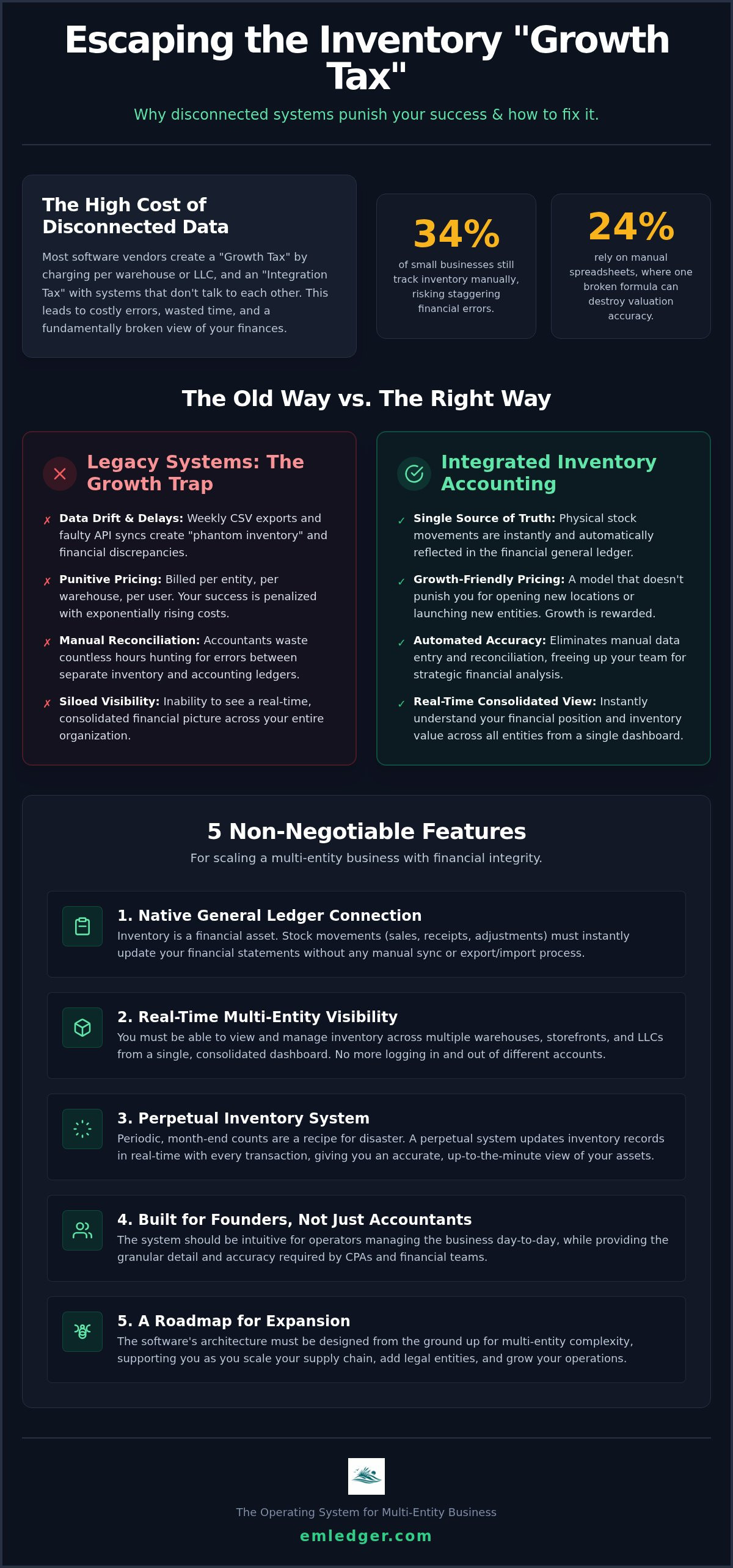
5 Non-Negotiable Features for Multi-Entity Inventory Management
Legacy software giants build for the average. You aren't average. You are scaling a complex operation with multiple moving parts, and you cannot afford a "good enough" solution. If your inventory accounting software doesn't handle these five pillars natively, you're playing a dangerous game with your financial integrity. Manual workarounds are a choice. Usually, they're a bad one.
- Real-time ledger sync: Every stock movement must trigger a ledger entry. No batching. No waiting. No "syncing" buttons.
- Multi-location tracking: Warehouses are operational hubs, not billing opportunities for your vendor. You need visibility without per-location surcharges.
- Automated inter-company logic: Stock moves. Value follows. The system must handle the transfer and the elimination automatically.
- Deep bank reconciliation: Cash is the ultimate validator of inventory data. If your bank statement doesn't match your stock purchases, your ledger is lying to you.
- Granular reporting: You need to pivot by entity, location, or product category in seconds. If you have to export to Excel to see your margins, your software has failed.
Automated Inter-Company Eliminations
Manual eliminations are a leading cause of audit failures. When you "sell" stock from a parent company to a subsidiary, you aren't generating external revenue. You are moving assets. If your software doesn't recognize this, your consolidated reports will be artificially inflated. You need a system that understands the nuance of internal transfers and wipes out the internal gains automatically. It's the only way to keep your books clean and your auditors happy. Read more about fixing these leaks in Inventory Management Systems: Stop the Bleeding.
Multi-Location Visibility
In 2026, your stock is everywhere. It's in FBA centers, 3PLs, and your own warehouses. You need a single pane of glass to see it all. High-performance inventory accounting software uses the logic of "Virtual Warehouses" to group these physical locations into logical entities. This allows holding companies to track global stock levels while maintaining strict entity-level accounting. Your Inventory Management must scale as you add physical footprints, not become more fragmented.
Stop settling for half-baked solutions that punish your growth. Check out our Scale Plan features to see how we handle multi-entity complexity without the integration tax.
The EmLedger Advantage: Inventory Built for Founders
Most software companies are built by developers who have never balanced a ledger. It shows. They focus on flashy interfaces while the underlying financial logic remains an afterthought. EmLedger is different. We are the only logical choice for multi-entity scaling because we were built by a CPA who has been in the trenches. Financial integrity is our baseline, not a premium feature. When you choose our inventory accounting software, you are choosing a system designed to protect your capital and your time.
Logic dictates that your software should be a catalyst for growth, not a recurring obstacle. We've eliminated the spreadsheet chaos that plagues most mid-market operators. No more manual reconciliations. No more "phantom stock" on your balance sheet. Just clean, real-time data that allows you to make decisions with confidence. You reclaim your visibility. You reclaim your sanity.
Disrupting the Status Quo
Legacy giants rely on "Software Bill Shock" to pad their margins. They wait for you to succeed, then they raise your rates. We find that offensive. Our "Solo to Scale" roadmap is designed to respect your journey from a single entity to a complex holding company. We provide a no-nonsense approach to accounting for growth stages that doesn't penalize you for adding new tax IDs or warehouses.
Serial entrepreneurs are switching from the giants because they are tired of being treated like a profit center. They want a partner that understands the granular headaches of Inventory Management across multiple brands. We provide the sophisticated tools you need, without the corporate-speak or the hidden fees. It is a rational solution for an irrational industry.
Ready to Scale Without the Tax?
EmLedger is the only inventory accounting software that provides enterprise-grade multi-entity logic with a pricing model that actually rewards your ambition. Whether you are starting with our Solo Plan or scaling rapidly into our Scale Plan, your financial integrity remains uncompromised. You get consolidated reporting, automated inter-company logic, and real-time ledger sync in one unified platform.
Stop paying the growth tax to providers who don't understand your business. Visit our pricing page to see how we compare to the legacy alternatives. If you are ready to see the platform in action, you can explore EmLedger features today. Build your empire on a foundation of logic, not legacy complexity.
Reclaim Your Margins and Your Growth
Your business deserves more than a patchwork of disconnected tools. You've seen how legacy systems use the "Integration Tax" to drain your resources. They punish your success with per-entity surcharges and manual data drift. It's time for a logical exit from that complexity. Choosing the right inventory accounting software means securing your financial integrity from the warehouse floor to the final consolidated report. You can't scale a multi-layered empire on a foundation of "close enough" numbers and broken API connections.
EmLedger was built by a CPA who understands that growth shouldn't be an expense category. We provide consolidated reporting and native inter-company logic as standard features. You get total visibility without the hidden fees or the spreadsheet chaos. We offer zero per-entity surcharges because we value your expansion. It's time to stop letting software vendors dictate your margins. You have the map to scale without the penalty. Take the next step toward a cleaner, faster, and fairer financial future. Stop paying the 'Growth Tax' and switch to EmLedger today. Your ledger will finally reflect the reality of your success.
Frequently Asked Questions
Does inventory accounting software replace my current accounting system?
It depends on the platform you choose. Legacy "add-on" tools just sync with your existing ledger and create data drift. Integrated inventory accounting software like EmLedger replaces the need for separate silos by housing your inventory and financial ledger in one system. You stop managing two platforms. You start managing one business. This eliminates the "Integration Tax" and ensures your data remains consistent across every entity you own.
How does multi-entity inventory management handle stock transfers between companies?
It uses automated inter-company logic to move value along with physical goods. When Entity A moves stock to Entity B, the system creates reciprocal journal entries instantly. It tracks the transfer price and automates the elimination of internal gains on your consolidated reports. You don't need manual workarounds. You don't need spreadsheets. The value flows as smoothly as the boxes, keeping your inter-company accounts perfectly balanced at all times.
What is the difference between perpetual and periodic inventory accounting?
Periodic accounting relies on manual counts at set intervals. It's an outdated method that leaves you blind between counts. Perpetual accounting updates your ledger every time an item is received, moved, or sold. It provides real-time accuracy for your balance sheet. In 2026, perpetual tracking is the only logical choice for high-velocity operations that value data integrity over guesswork. You stop guessing your stock levels and start knowing them.
Can I track inventory across multiple warehouses without paying extra?
With legacy vendors, probably not. They often charge per warehouse or per location as a way to tax your expansion. EmLedger disrupts this model. We believe warehouses are operational hubs, not billing opportunities. Our Scale Plan allows for multi-location tracking without the predatory surcharges common in the industry. You pay for the platform's power, not for the number of physical footprints you need to run your business.
How does inventory software improve my Cost of Goods Sold (COGS) accuracy?
It automates the calculation based on your chosen valuation method. Whether you use FIFO or LIFO, the software ensures that landed costs, like shipping and duties, are included in the unit cost. This eliminates the human error inherent in manual calculations. Your margins become real. Your tax filings become accurate. You stop leaking cash through bad data and start seeing the true profitability of every SKU in your catalog.
Is EmLedger a good alternative to legacy platforms for multi-entity inventory?
It is the superior choice for operators who refuse to pay a growth tax. Most legacy platforms require expensive third-party plugins and per-entity subscriptions that punish expansion. EmLedger provides consolidated reporting and integrated inventory accounting software natively. You get more power, better logic, and a system that respects your ambition. It is a rational choice for a complex business structure that legacy systems simply weren't built to handle.
Do I need a CPA to set up my inventory accounting software?
You don't need one, but the software should be built with their rigor in mind. EmLedger is designed to be intuitive for the operator while maintaining the precision an accountant requires. Our platform follows CPA-level logic for inter-company eliminations and ledger sync. You get a professional-grade setup without the complexity of legacy enterprise systems. It's built for founders who value financial integrity but don't want to play full-time accountant.


