

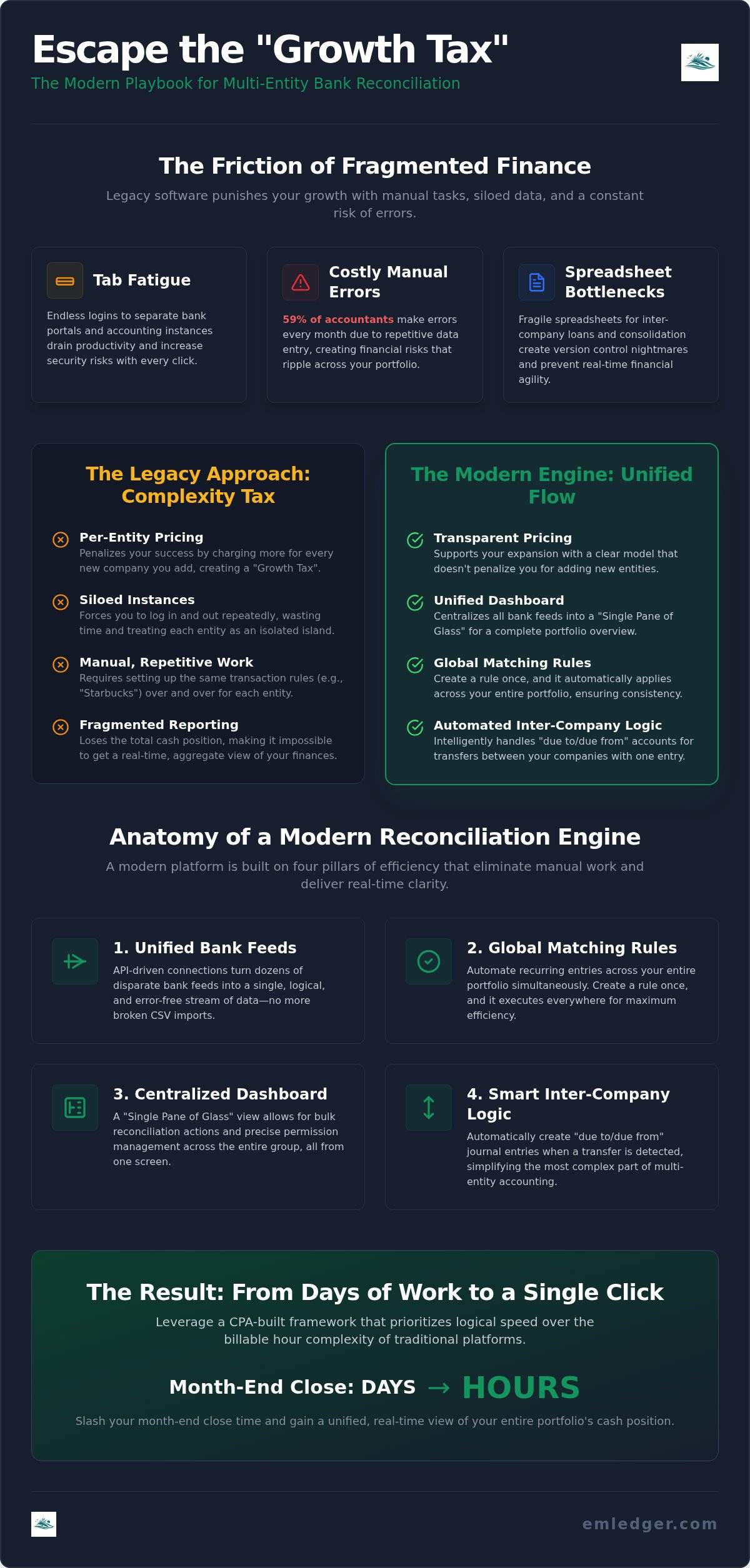
Scaling your business shouldn't feel like a financial punishment. Yet, most legacy accounting platforms charge you a "Growth Tax" the moment you add a second, fifth, or twentieth entity. It's a broken system that rewards complexity and penalizes your success. You're likely exhausted by the manual friction of multi-company bank reconciliation. Logging in and out of different software accounts is a drain on your focus. Tracking inter-company loans on fragile spreadsheets is a disaster waiting to happen. You aren't alone in your frustration. A Gartner survey found that 59% of accountants make several errors every month due to the repetitive nature of manual data entry.
We agree that the status quo is unacceptable. You deserve a financial stack that works as hard as you do. This article promises to help you master the logic of multi-entity books and eliminate the manual hurdles that slow your month-end close. We'll show you how to gain a unified view of all bank feeds and implement automated matching across every entity you own. You'll learn how to transition to a transparent pricing model that supports your expansion instead of draining your margins. It's time to stop fighting your software and start driving your growth.
Key Takeaways
- Stop paying the "Growth Tax" by ditching legacy software models that penalize your success every time you add a new entity.
- Centralize every account into one dashboard to streamline multi-company bank reconciliation and kill the productivity drain of tab fatigue.
- Apply global matching rules across your entire portfolio to automate recurring entries and eliminate manual data entry errors.
- Simplify inter-company loan tracking with a unified workflow designed to slash your month-end close time by days.
- Leverage a CPA-built framework that prioritizes logical speed over the billable hour complexity of traditional platforms.
The Friction of Manual Multi-Company Bank Reconciliation
Legacy software treats your business like a collection of isolated islands. It forces you to perform the bank reconciliation process over and over, once for every LLC you own. This is multi-company bank reconciliation in its most primitive, manual form: the act of aligning cash books across separate legal entities using brute force and repetitive logins. It is a waste of your talent and a drain on your resources. In 2026, the market moves too fast for traditional end-of-month batching. You need real-time visibility, not a history lesson 30 days after the fact.
The "Tab Fatigue" problem is real. Logging into 10 different bank portals and 10 different accounting instances is a security nightmare. Every redundant login increases your surface area for a breach. Beyond security, it's a productivity sinkhole. Your team spends hours toggling between screens instead of analyzing data. The invisible cost of manual entry is even more dangerous. According to Gartner, 18% of accountants make financial errors daily. In a multi-layered business, a single typo in one entity ripples through your entire portfolio, creating a mess that takes days to untangle.
The Problem with Fragmented General Ledgers
Siloed data is the enemy of clarity. When your ledgers don't talk to each other, you lose your total cash position. You might have $1M in aggregate, but if it's spread across 20 entities with different reconciliation schedules, you're flying blind. This fragmentation creates massive risks with inter-company transfers. If Entity A records a payment to Entity B, but Entity B hasn't reconciled its feed yet, that money effectively vanishes from your reporting. These gaps lead to audit-trail failures that make holding companies look like a liability rather than an asset.
Why Spreadsheets Are Not a Scalable Solution
Many operators try to fix this with "Excel-based" consolidation. It doesn't work. Spreadsheets are where financial logic goes to die. You face impossible version control issues the moment more than one person touches the file. One broken formula can invalidate your entire month-end close. The spreadsheet trap acts as a structural bottleneck that prevents real-time financial agility. If you're still copying and pasting bank balances into a master sheet, you aren't managing a business; you're babysitting a document. Professional multi-company bank reconciliation requires a unified engine, not a manual workaround.
The Anatomy of a Modern Multi-Entity Reconciliation Engine
Stop playing whack-a-mole with your bank statements. A modern engine doesn't just "connect" to banks; it unifies them. It turns twenty disparate bank feeds into a single, logical stream of data. This is the core of effective multi-company bank reconciliation. By leveraging API-driven connections, you ensure data integrity that old-school CSV imports can't touch. No more broken columns. No more missing rows. Just clean, real-time financial data flowing directly into your ledger.
Global matching rules are the real game-changer. Why set up a rule for "Starbucks" or "AWS" ten separate times? A sophisticated engine lets you apply logic across your entire portfolio simultaneously. You create the rule once. It executes everywhere. This isn't just a convenience; it's a key internal control that ensures consistency across every LLC you manage. If you're dealing with international structures, the engine handles multi-currency conversions on the fly, stripping away the manual math that leads to errors.
Centralized Dashboard vs. Siloed Instances
Legacy software keeps you trapped in siloed instances. You log in. You reconcile. You log out. You repeat. A centralized dashboard offers a "Single Pane of Glass" view that shatters this cycle. It allows you to manage permissions with precision. You decide who sees which bank feeds across the group without compromising security. Bulk reconciliation actions become your new standard. You can match hundreds of transactions across multiple entities with a single click. It’s about high-velocity management for high-volume operators.
Reconciling Inter-Company Bank Transfers
Inter-company transfers are where most multi-entity books fall apart. When Company A sends cash to Company B, you shouldn't have to record it twice. Modern multi-company bank reconciliation software masters the logic of "due to/due from" accounts. When the engine detects a transfer, it automatically suggests the secondary entry for the receiving entity. This eliminates the most common source of book imbalances. It turns a manual headache into a synchronized, automated event. You don't just save time; you gain a level of accuracy that manual tracking can't provide.
Why Per-Entity Pricing Destroys Reconciliation Efficiency
Legacy software models are built on a fundamental lie. They claim to support small businesses, yet they levy a "Growth Tax" the moment you succeed. If you're a real estate operator with 20 properties held in 20 LLCs, that $50 per month "starter" plan isn't $50 anymore. It's $1,000. This pricing structure isn't just expensive; it’s a direct assault on your efficiency. It forces a choice between clean books and a manageable software bill. Most founders choose the latter, and their data suffers for it.
This economic friction creates "orphan accounts." These are the smaller entities or holding companies that never get added to the official software because the per-entity fee feels like a waste. Instead, they sit in spreadsheets. They get ignored. They become the primary source of errors in your multi-company bank reconciliation process. Fair pricing isn't a luxury. It is a prerequisite for financial integrity. You can't have a unified view of your business if half of your entities are locked behind a paywall.
The Hidden Cost of "Lite" Multi-Company Features
Don't fall for the "Lite" trap. Many platforms gate essential multi-entity tools behind their most expensive enterprise tiers. You want consolidated reporting? Pay up. You want unified bank feeds? Upgrade. Founders often settle for manual work to avoid this bill bloat, but the cost in human hours is far higher. You can find Accounting Software Without Per-Entity Pricing that treats your growth as a milestone, not a revenue stream for their shareholders. Stop settling for gated features that stall your momentum.
Economic Logic: Software Should Scale with Users, Not LLCs
An LLC is just a folder. It's a logical container for transactions, not a reason to double your subscription price. When software scales with users or volume instead of legal entities, the behavior of your accounting team changes. They stop hesitating to add new accounts. They start reconciling everything. This shift moves you from reactive fire-fighting to proactive management. Mastering multi-company bank reconciliation shouldn't require a venture capital round just to cover software licenses. The mic drop: software that rewards your expansion instead of taxing your ambition.
Implementing a Unified Reconciliation Workflow
Stop building your workflow around software limitations. Build it around your growth. Traditional processes fail because they treat each company as a separate project. A unified workflow treats them as a single, logical operation. It moves the needle from manual effort to strategic oversight. Follow these five steps to master multi-company bank reconciliation without the usual friction.
- Step 1: Consolidate your bank feeds. Bring every account from every LLC into a single dashboard. If you're still logging into individual bank portals, you're losing money.
- Step 2: Establish global matching rules. Create logic for recurring vendor payments that applies to the entire group. One rule for one vendor, regardless of which entity pays.
- Step 3: Define inter-company settlement logic. Automate the "Due To/Due From" entries. When cash moves between entities, the software should record both sides of the transaction instantly.
- Step 4: Execute bulk reconciliation. Stop matching line by line. Use bulk actions to clear hundreds of transactions across all active accounts in seconds.
- Step 5: Review exceptions. Focus your talent on the 10% of entries that require human judgment. Generate a consolidated cash report to see your true position.
Setting Up Global Rules That Actually Work
Logic should be shared, not duplicated. Use "if-this-then-that" rules for shared services across your entities. If multiple LLCs pay for the same insurance or software, the matching logic should be universal. However, avoid the over-automation trap. Keep a human in the loop for high-value or irregular transfers. Intelligent Multi-Entity Ledger Management requires a balance between speed and control. You want a system that works for you, not one that makes mistakes faster.
The Role of Real-Time Consolidated Reporting
Reconciliation isn't just a compliance task. It is the fuel for accurate Consolidated Reporting Features. Without reconciled bank data, your P&Ls are just guesses. In 2026, real-time data is the only way to drive property management or franchise performance reviews. You can't make decisions on last month's numbers. Reconcile daily. Review weekly. Scale always.
Ready to exit the manual nightmare? Streamline your multi-company bank reconciliation today.
The EmLedger Approach: Scaling Without the Complexity
EmLedger exists because the status quo is a scam. We didn't build this to be another bloated enterprise tool. We built it because our founder, a CPA, lived the manual reconciliation nightmare every single month. Most software companies want you to stay slow. They want you to pay for more billable hours of setup and more per-entity fees. We disagree. Our Bank Reconciliation feature is engineered for pure speed. It handles multi-company bank reconciliation with a logic that legacy platforms simply can't match. Reconcile once. Scale forever.
The Scale Plan is our direct answer to the "Growth Tax." While competitors charge you for every new LLC you register, we remove that financial friction. We believe you should be rewarded for expansion, not penalized for it. An LLC is a logical container for your assets, not a revenue stream for a software vendor. By eliminating per-entity pricing, we allow your accounting team to focus on accuracy instead of subscription costs. It’s a rational calculation for a serious business operator.
Built for the Serial Entrepreneur
We focus on the operators in the trenches. Whether you are managing a portfolio of short-term rentals, a nationwide franchise network, or a complex family office, we understand your granular headaches. Our "No-Nonsense" promise is simple. No hidden fees. No per-entity penalties. No corporate fluff. We provide a clean, logical exit from the complexity often found in Use Cases for Holding Companies. We don't just sell software; we champion your right to grow without administrative bloat.
Your Next Step Toward Financial Sanity
You have two choices. You can stay trapped in legacy complexity, paying more for less efficiency every year. Or you can choose EmLedger simplicity. It’s the difference between fighting your tools and using them to win. This is the logical end of manual data entry and the beginning of real-time financial clarity. We invite you to see the difference for yourself. Start a free trial of our Solo Plan or book a demo of our multi-entity engine. Stop the manual madness and see EmLedger in action.
Exit the Complexity and Scale Your Portfolio
Legacy software is a trap. Manual work is a choice. You need a system that scales with your ambition, not your entity count. You've now seen how unified dashboards and global matching rules transform multi-company bank reconciliation from a monthly nightmare into a background process. The logic is simple: stop fighting your tools and start using them to win. Complexity shouldn't be the cost of doing business.
EmLedger was built by a CPA who knows the trenches. We've eliminated per-entity fees on Scale plans and included consolidated reporting as a standard feature. It's a rational calculation for operators who value precision over billable hours. No hidden costs. No marketing fluff. Just a logical, high-velocity engine that respects your resources. It's time to treat your LLCs as folders, not as reasons for a software vendor to tax your success.
Stop paying the Growth Tax today. View Pricing and Stop the Growth Tax. Your business deserves financial clarity, and your growth deserves a platform that actually supports expansion. Scalability is a logic problem; we've already solved it for you.
Frequently Asked Questions
Can I reconcile bank accounts for multiple LLCs in one dashboard?
Yes, you can. A unified dashboard pulls bank feeds from every legal entity into a single view. This eliminates the security risk of logging in and out of different accounts. It allows you to execute bulk reconciliation actions across your entire group simultaneously. You gain a real-time perspective on your total cash position without the manual friction of siloed software instances.
How does multi-company bank reconciliation handle inter-company loans?
Modern software uses "due to/due from" logic to synchronize these transfers. When you reconcile a payment from Company A to Company B, the system automatically suggests the matching entry on the secondary ledger. This automation eliminates the most common source of multi-entity book imbalances. It ensures your inter-company transactions are always in balance, reducing the time spent on manual adjustments during month-end close.
Is it possible to automate bank feeds for 20+ different entities?
Yes, API-driven connections handle high-volume bank feeds with ease. Unlike manual CSV imports, direct bank connections ensure data integrity across dozens of entities. You can establish global matching rules that apply to every account in your portfolio. This setup allows you to manage 20 or 200 entities with the same level of effort, making multi-company bank reconciliation a scalable process rather than a labor-intensive chore.
What is the "Growth Tax" in accounting software pricing?
The "Growth Tax" is a predatory pricing model used by legacy software providers. They charge you a separate fee for every new legal entity you add to your portfolio. This punishes successful operators for expanding. It forces you to pay for the same features repeatedly just because your assets are held in different LLCs. We believe software should scale with users and volume, not with your number of folders.
Do I need a separate subscription for each company I manage?
Not if you choose a platform designed for multi-entity operators. Legacy tools often require a separate billing account for every LLC. This creates massive administrative bloat and high monthly costs. EmLedger offers plans that allow you to manage multiple entities under a single subscription. It’s a logical approach that treats your business as a unified group rather than a collection of disconnected bills.
Can EmLedger handle multi-currency bank reconciliation for international entities?
Yes, the engine handles multi-currency conversions automatically. It pulls real-time exchange rates to ensure your multi-company bank reconciliation is accurate across different regions. This feature is essential for international structures or ecommerce businesses dealing with global payments. It strips away the manual math that leads to errors, providing a clear and reconciled view of your international cash flow without the spreadsheet gymnastics.
How does automated reconciliation improve audit readiness for holding companies?
Automation creates a permanent, digital audit trail for every transaction. It ensures that every bank entry has a corresponding ledger entry, leaving no room for "missing" transfers. By using standardized matching rules, you demonstrate strong internal controls to auditors. This consistency reduces the risk of manual data entry errors, which Gartner reports affect 59% of accountants monthly. Clean books mean faster, cheaper, and less stressful audits.
What happens if a transaction matches multiple rules across different companies?
The system flags these as exceptions for human review. While AI-powered matching can resolve over 90% of entries, logic dictates that complex cases require an expert's eye. You can prioritize which rules take precedence or manually assign the transaction to the correct entity. This exception management ensures that automation never overrides accuracy. You keep total control over the nuances of your books while the software handles the repetitive heavy lifting.


