

Your accounting software shouldn't penalize you for being successful. Most CFOs still spend month-end buried in a spreadsheet scramble, struggling with multi-entity financial consolidation while legacy vendors wait to triple the bill for every new LLC added. It's a predatory model that treats your growth as a profit center for their shareholders. You've worked too hard to build a multi-layered business to be held hostage by manual data entry and "per-entity" pricing traps.
Consolidation is a logic problem, not a manual labor problem. With new IFRS 10 and IAS 7 amendments taking effect in 2026, the margin for error has disappeared. You need a system that offers real-time visibility across all subsidiaries without the "growth tax" associated with outdated platforms. This guide will show you how to master the logic of consolidating multiple entities, ensuring your reports are audit-ready in one click. We'll explore a path to predictable software costs that support your expansion instead of draining your resources. It's time to stop paying for the privilege of growing your business.
Key Takeaways
- Stop the manual spreadsheet scramble and gain immediate visibility into the true financial health of your holding company or franchise.
- Learn to align disparate charts of accounts and automate inter-company eliminations to build an audit-ready financial foundation.
- Avoid the "Growth Tax" of legacy software by choosing a logic-based approach to multi-entity financial consolidation that doesn't penalize your success.
- Streamline your month-end close by connecting real-time bank feeds and establishing a unified Global Chart of Accounts.
- Transition from expensive manual workarounds to a CPA-built system where consolidated reporting is a core philosophy, not a predatory add-on.
What is Multi-Entity Financial Consolidation?
Financial consolidation isn't just a fancy term for adding up bank balances. It's the technical process of aggregating data from various subsidiaries to create one clear, unified set of financial statements. If you're a holding company owner or a multi-unit franchise operator, understanding What is Multi-Entity Financial Consolidation? is critical. It is the only way to see the "true" health of your entire portfolio. Without it, you're flying blind, relying on fragmented data that doesn't account for the big picture.
This process goes far beyond simple addition. It requires mapping disparate charts of accounts into a single, unified view. If Entity A records "Rent" and Entity B records "Lease," a standard spreadsheet won't recognize they're the same expense category. True multi-entity financial consolidation creates a single source of truth for the parent company. It eliminates the exhausting need to log into ten different ledgers just to find one number. You get a birds-eye view of your cash flow, liabilities, and equity across the board.
The Difference Between Reporting and Consolidation
Reporting is looking at a single entity. Consolidation is looking at the entire ecosystem. Many operators confuse "rolling up" numbers in a spreadsheet with actual consolidation. It isn't the same thing. Spreadsheets don't handle inter-company eliminations or currency translations with any degree of reliability. The parent company's role is to provide unified financial management. This ensures every subsidiary speaks the same financial language, making consolidated reporting a strategic asset rather than a monthly chore.
Why 2026 is the Year to Kill the Spreadsheet
Manual data entry is a liability, not a process. In 2026, the global financial consolidation software market is valued at approximately $3.8 billion. There's a reason for this massive investment. The cost of human error in multi-entity reporting can easily reach six figures in lost tax opportunities or inflated audit fees. Multi-entity financial consolidation is the logical aggregation of distinct financial entities into a single economic unit. Relying on fragile Excel formulas to manage millions in revenue is no longer a viable business strategy. It's a risk your balance sheet can't afford to take.
The Three Pillars of a Clean Consolidation Process
Effective multi-entity financial consolidation isn't a dark art. It's a three-legged stool built on mapping, eliminations, and translation. If one leg is weak, your entire financial report collapses under the weight of an audit. You don't need "AI orchestration" to solve this. You need clear logic and a system that respects your time. The data doesn't lie, but it can be obscured by poor processes.
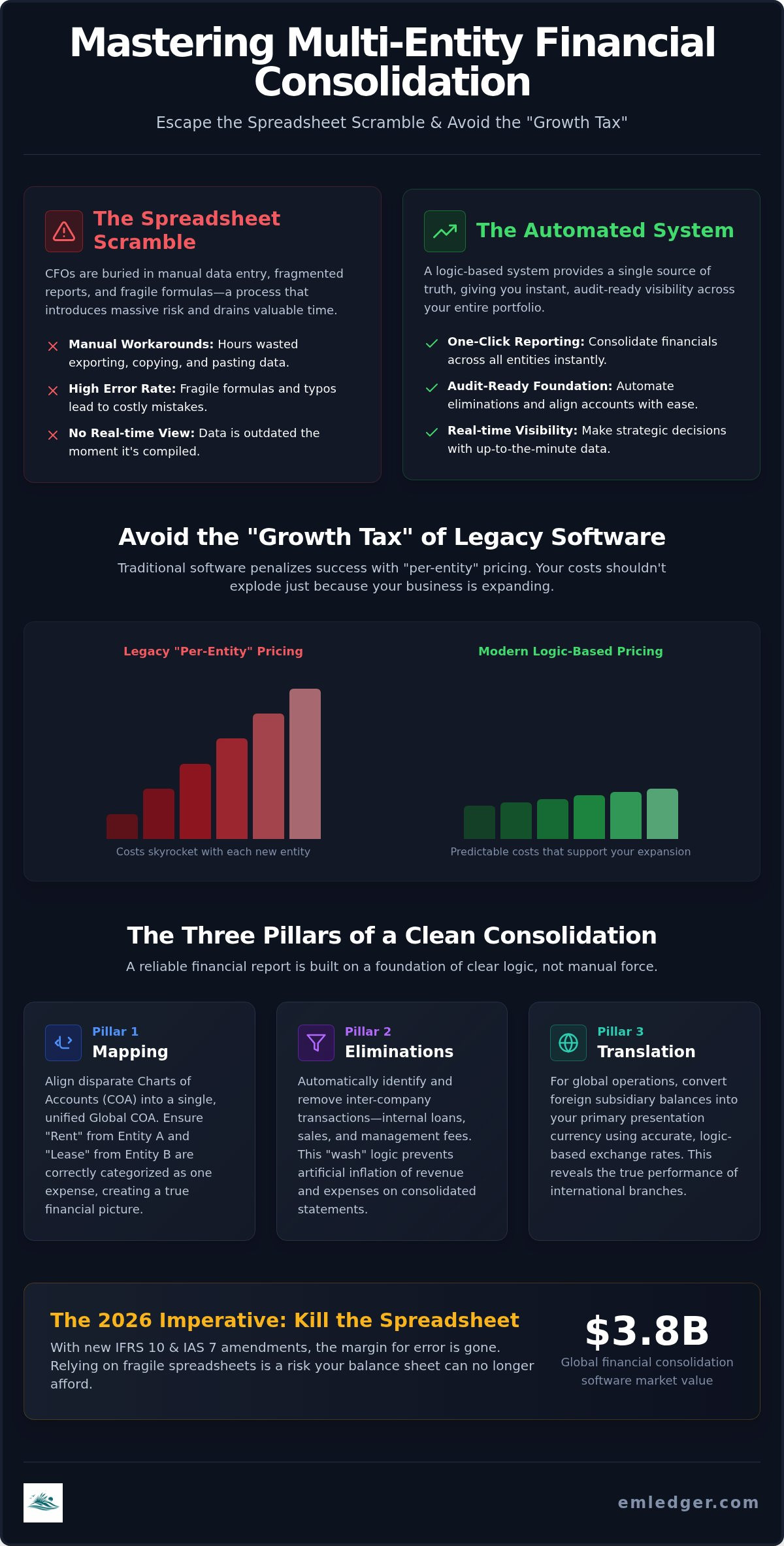
Mapping is the process of aligning different Charts of Accounts (COA). If Entity A calls an expense "Rent" while Entity B labels it "Lease," your consolidated view will be a mess. A clean process forces these disparate data points into a single, unified bucket. This ensures that your totals actually reflect the reality of your spending across every location.
Eliminations remove the internal noise. They ensure your P&L reflects only your interactions with the outside world. Without this pillar, your revenue figures are essentially fake news. You're counting money that you moved from one pocket to another as if it were a new profit.
Inter-Company Eliminations: The "Wash" Logic
Inter-company transactions are often just "wash" entries. They shouldn't appear on your consolidated statements because they don't represent actual economic growth. If your holding company charges a management fee to a subsidiary, that's a revenue for one and an expense for the other. It's a zero-sum game. Failing to eliminate these entries artificially inflates your top line. It makes your business look bigger than it is. This is a dangerous game to play during an audit. You need robust inter-company transaction software to identify and scrub internal loans, sales, and fees automatically.
Standardizing the Chart of Accounts
Managing disparate COAs is a recurring nightmare for multi-unit operators. You shouldn't have to re-code every entity manually every month. The solution is a "set it and forget it" mapping approach. By defining global rules, you ensure that every transaction flows into the right category without human intervention. This maintains consistency across your multi-entity ledger management. It turns a week-long spreadsheet scramble into a momentary background process. Consistency is the enemy of audit risk. If you're tired of manual workarounds, it's time to explore a more logical way to handle consolidated reporting.
The "Growth Tax": Why Legacy Consolidation Software Fails You
Legacy software vendors love your growth. Not because they care about your success, but because every new LLC you form is a fresh line item on their invoice. This is the "Growth Tax." It is a predatory pricing model that punishes entrepreneurs for expanding their footprint. Most legacy platforms treat multi-entity financial consolidation as a premium add-on rather than a fundamental requirement for modern business management.
If you manage 10 LLCs, most entry-level accounting platforms expect you to pay 10 separate subscription fees. You're paying for the same core features over and over again. It's illogical. It's inefficient. It's expensive. At the other end of the spectrum, enterprise solutions like NetSuite offer the features you need, but at a cost that eats your profit margins. They treat basic ledger aggregation like a luxury service for global conglomerates. Software should scale with your revenue, not your entity count.
The Per-Entity Pricing Scam
Let's break down the math. A seemingly harmless monthly habit for one entity turns into a massive annual drain when you hit 10 or 20 subsidiaries. This cost doesn't even account for the time wasted logging in and out of different accounts to pull data. This pricing model creates a dangerous trend known as "shadow accounting." Operators keep smaller entities off-system to save money. They use messy spreadsheets instead of professional tools. This leads to the exact errors multi-entity financial consolidation is supposed to prevent. You shouldn't have to choose between financial accuracy and your bottom line. You can find a better path by looking at Accounting Software Without Per-Entity Pricing.
Complexity vs. Power: Choosing the Right Tool
You don't need a bloated enterprise ERP to get clean reports. Most operators don't want corporate bureaucracy; they want results. There is a straight-shooting alternative to the legacy trap. Tiered plans built for real-world operators provide the power you need without the "enterprise ego." When you compare the EmLedger Scale Plan to legacy enterprise competitors, the difference is clear. You get audit-ready reports without the predatory per-entity fees. It's a logical exit from complexity. It's a fair deal for growing businesses that value transparency over marketing fluff.
How to Automate Your Consolidation Workflow
Automation isn't about magic. It's about logic. If your current workflow involves downloading ten CSV files and manually aligning columns, you don't have a process; you have a liability. Transitioning to automated multi-entity financial consolidation requires a structured approach that replaces manual effort with system-driven rules. Cloud-based solutions are currently the fastest-growing segment in this market, growing at a CAGR of 12.6%, because they solve the data fragmentation problem at the source. Here is how you build a high-velocity workflow:
- Step 1: Connect your bank feeds across all entities for real-time data flow. Eliminate the friction of manual uploads.
- Step 2: Define your Global Chart of Accounts. Create a single financial language that every subsidiary must speak.
- Step 3: Automate inter-company transaction tags. Flag eliminations the moment they occur, not weeks later.
- Step 4: Set up automated bank reconciliation to ensure data integrity. Trust your numbers without second-guessing.
- Step 5: Generate real-time consolidated P&L and Balance Sheets with a single click.
Real-Time Visibility vs. Month-End Scrambles
Waiting until the 15th of the following month to see your performance is a recipe for failure. In a volatile market, yesterday's data is already stale. You need a "Continuous Close" mindset. This means your books are audit-ready every single day, not just once a month. When you implement automated inter-company reconciliation, you remove the primary bottleneck that slows down most finance teams. You move from reacting to the past to directing the future.
Managing Inventory Across Multiple Entities
Tracking stock that moves between subsidiaries adds another layer of complexity. You need centralized inventory management systems that integrate directly with your accounting ledger. Logic dictates that your consolidated view must remain clean. Inventory valuation must be eliminated if stock is sold between entities at a markup to prevent unrealized profit from artificially inflating your consolidated balance sheet. Stop the month-end madness and automate your consolidated reporting with a system that understands multi-entity logic. Efficiency is the only sustainable competitive advantage.
EmLedger: Consolidation Without the Enterprise Ego
EmLedger wasn't built in a boardroom by "tech bros" chasing the next SaaS trend. It was built by a CPA who was tired of the industry's obsession with the "Growth Tax" and manual workarounds. Most software companies treat multi-entity financial consolidation as a high-priced luxury. They bury it behind enterprise sales teams and opaque pricing structures. We don't. Our Consolidated Reporting feature isn't an expensive add-on. It is a core philosophy. We believe that if you manage more than one entity, you deserve a unified view without being penalized for your success.
Whether you're managing a few units or a massive portfolio, you need a system that adapts to your reality. From our Solo Plan to our Scale Plan, we offer a logical exit from complexity. You choose the plan that matches your current operational complexity, not a future entity count that hasn't happened yet. This makes EmLedger the logical choice for holding companies, franchises, and property managers. These operators deal with high-volume transactions and tight margins. They don't need "AI agents" to tell them how to do their jobs; they need a clean ledger that works as hard as they do.
Scale Without Friction
Adding a new LLC to your portfolio shouldn't feel like a punishment. It shouldn't require a new subscription, a credit card update, or a call to a sales rep who wants to "upsell" your growth. EmLedger's entity management is built to handle growth natively. You add the entity, map the accounts, and move on. The "No-Nonsense" promise is simple. No hidden fees. No per-entity taxes. Just real accounting for real business operators who don't have time for legacy games. We focus on the math so you can focus on the management.
Your Next Logical Step
It's time to audit your current software spend. Are you paying for entities or are you paying for value? If your month-end still feels like a scramble, your current system has already failed you. Multi-entity financial consolidation should be a background process, not a manual labor project. You can request a demo of our Growth or Scale plans today to see the difference for yourself. Don't let legacy software hold your margins hostage in 2026. Transitioning to a system that respects your growth is the final step in achieving the "Continuous Close" mindset. Stop the spreadsheet scramble and switch to EmLedger to reclaim your time and your data integrity.
Take Control of Your Financial Future in 2026
Legacy software companies want you to believe that complexity equals cost. It's a lie. Your growth shouldn't be a line item on their balance sheet. You've seen how the right technical pillars turn a week-long scramble into a background process. You know the "Growth Tax" is a scam designed to punish scaling operators. Now it's time to act on that logic. Your business deserves a system that rewards efficiency instead of taxing it, and advisors like 41 Legacy can ensure you are also protecting the enterprise value of your company as it grows.
Choosing a system built by a CPA means choosing accuracy over manual workarounds. You get real-time multi-entity financial consolidation as a standard feature, not an enterprise-priced luxury. There are no per-entity pricing scams here. There is no shadow accounting. You get a single source of truth that stays audit-ready every single day. It's the logical exit from the month-end madness that has held your finance team back for years.
Stop letting outdated platforms dictate your margins. It's time to scale without the friction of predatory billing or spreadsheet errors. Your business deserves a financial foundation that actually supports expansion. Master Your Multi-Entity Accounting with EmLedger. You've built something great; now give it the tools it needs to thrive.
Frequently Asked Questions
What is the most common mistake in multi-entity financial consolidation?
The most common mistake is failing to eliminate inter-company transactions, which leads to double-counting revenue and expenses. When you sell services from one LLC to another, it is a zero-sum game for the parent company. If you don't scrub these entries, your P&L will show artificial growth. This error creates a false sense of security and often leads to painful adjustments during an audit.
Can I consolidate entities that use different currencies?
Yes, you can consolidate entities using different currencies through a process called currency translation. Automated tools apply the correct spot or average exchange rates to convert foreign subsidiary balances into your presentation currency. This ensures your global performance is measured accurately without the manual math that plagues traditional spreadsheets. It's the only way to maintain a reliable consolidated balance sheet in a global market.
How does inter-company elimination work in automated software?
Automated software works by flagging transactions between related entities and scrubbing them from the final report. The system identifies a debit in one entity that matches a credit in another using specific inter-company tags. This "wash" logic ensures that only external economic activity appears on your statements. It removes the manual labor of hunting down matching entries at month-end.
Is multi-entity financial consolidation required for small businesses?
While not always legally mandated for every small business, multi-entity financial consolidation is operationally essential for anyone managing more than one legal entity. You can't make informed decisions if your data is trapped in separate silos. Consolidation provides the visibility needed to manage cash flow and tax liabilities across your entire portfolio. It turns fragmented data into actionable intelligence.
What is the difference between a consolidated and a combined financial statement?
Consolidated statements aggregate the financial results of a parent company and its subsidiaries as a single economic unit. Combined statements simply add together the financials of entities under common control without the formal parent-subsidiary relationship. Both require eliminations to be accurate. The choice depends on your legal structure, but the technical requirement for data integrity remains the same in both scenarios.
How long does it take to set up automated consolidated reporting?
Setting up automated consolidated reporting usually takes a few days rather than the months required for enterprise ERP implementations. The process involves connecting your bank feeds, mapping your accounts, and defining your elimination rules. Once the initial logic is set, the system runs automatically. You don't need a massive IT team to exit the spreadsheet scramble; you just need a logical framework.
Can I manage multiple charts of accounts within one consolidation tool?
You can manage multiple charts of accounts by using a mapping layer that rolls disparate codes into a single Global Chart of Accounts. This allows Subsidiary A to keep its specific local codes while the parent company sees a unified view. It is a "set it and forget it" approach that respects local operational needs without sacrificing the clarity of your multi-entity financial consolidation process.
Why is per-entity pricing considered a "Growth Tax"?
Per-entity pricing is a "Growth Tax" because it forces you to pay more simply for expanding your legal footprint. Legacy software vendors charge you for every new LLC, regardless of transaction volume. This model treats your success as their profit center. It is a predatory practice that often leads operators to keep entities off-system to save costs, which compromises financial accuracy and increases audit risk.


