

Most legacy accounting platforms treat your business growth like a crime they need to tax. You spin up a new LLC. They slap another $50 monthly fee on your bill for the privilege of a new login. It's a predatory model that punishes ambition. You're likely tired of logging in and out of ten different accounts just to record a single inter-company transfer. You know manual spreadsheets are a ticking time bomb. Yet the enterprise alternatives feel like paying for a private jet when you just need a functional engine. Effective multi-entity ledger management should be a basic logical requirement, not a luxury upsell.
We agree that your software costs should scale with your revenue, not your entity count. You deserve a system that works as hard as you do. This guide will show you how to master the architecture of multi-company accounting without the manual data entry or the growth tax. You'll learn how to establish a single source of truth for all your entities and generate real-time consolidated reports in minutes. We're going to break down the logic of automated inter-company transactions and show you a path to scaling that actually makes sense.
Key Takeaways
- Stop toggling between dozens of logins and move your financial data into a centralized architecture designed for rapid scale.
- Automate inter-company transactions to eliminate the manual reconciliation errors that act as an invisible profit killer in multi-layered structures.
- Learn to identify and bypass the "Growth Tax" by rejecting predatory software models that charge you extra for every new LLC you form.
- Standardize your Chart of Accounts to ensure your multi-entity ledger management produces clean, apples-to-apples financial comparisons across all subsidiaries.
- Transition to real-time consolidated reporting to gain instant visibility into your entire portfolio's health without waiting days for manual spreadsheet merges.
What is Multi-Entity Ledger Management? (And Why You're Doing It Wrong)
Multi-entity ledger management is the centralized control of financial data across multiple legal entities. It's not a luxury reserved for the Fortune 500. It's a survival requirement for holding companies, property managers, and serial entrepreneurs. If you're managing more than five LLCs, you've likely hit the "Spreadsheet Trap." This is the point where separate Excel files stop being helpful and start becoming a source of data corruption. One broken formula in a consolidation sheet can hide a five-figure deficit for months. You aren't just managing accounts; you're managing risk.
The transition from single-entity bookkeeping to multi-entity management isn't just about adding more rows to a table. It's a fundamental shift in architecture. You're moving from a flat view of a single business to a multi-dimensional view of an entire ecosystem. This requires a system that understands the relationship between entities, not just the balances within them. If your current process involves manual data entry across different logins, you're doing it wrong. You're wasting the one resource you can't buy back: time.
The Core Building Blocks of a Unified Ledger
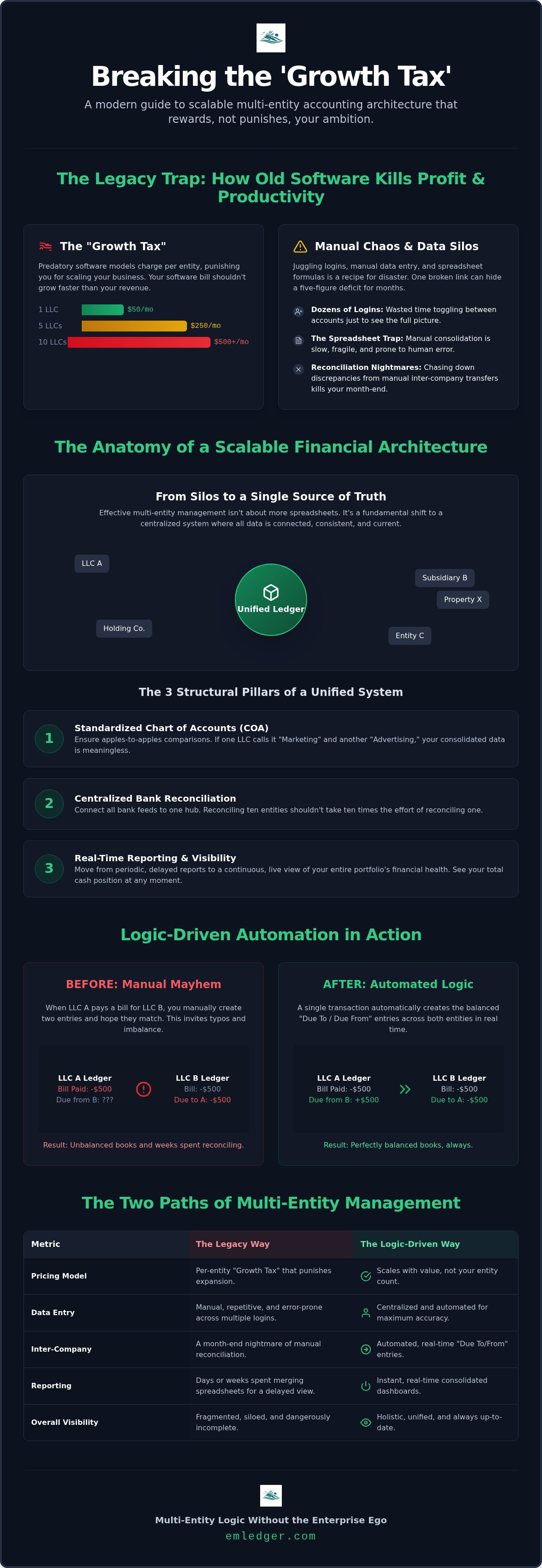
To move from chaos to logic, you need three structural pillars. First, you must have a standardized Chart of Accounts (COA) across all entities. If Entity A calls an expense "Marketing" and Entity B calls it "Advertising," your data is useless for comparison. Second, you need centralized bank reconciliation. Reconciling ten entities shouldn't take ten times longer than one. Finally, you need real-time visibility. Traditional accounting is periodic; logic-driven accounting is continuous. You should see your total cash position at any moment, not just the third week of the following month.
Why Legacy Software Fails Multi-Entity Operators
Legacy software companies want you to believe that multi-entity ledger management is an "Enterprise" feature that justifies a massive price hike. They use this as an excuse for the "Growth Tax." The Growth Tax is the cost of software that scales by entity count rather than the value provided. It's an irrational penalty for expanding your portfolio. Beyond the cost, there's the friction. Logging in and out of ten different accounts is a productivity killer. It creates data silos that prevent you from seeing a holistic view of your business health. You shouldn't have to pay a premium just to see all your numbers in one place.
The Anatomy of Effective Multi-Entity Financial Architecture
Architecture is the skeleton of your business. Without a clear hierarchy, your financial data is just a pile of receipts. You must define the logical relationship between your parent company, subsidiaries, and sister entities. This isn't just for legal compliance. It's for operational clarity. If your software doesn't allow you to visualize these connections, you're flying blind. Learn how EmLedger handles entity management to map this hierarchy without the usual enterprise friction.
Mastering Inter-Company Transactions
Inter-company transactions are the invisible profit killer. When Entity A pays a bill for Entity B, you create a "Due To/Due From" entry. If you do this manually, you're inviting human error. One missing entry and your reconciliation is dead. Logic-driven multi-entity ledger management automates these entries in real time. It ensures that every dollar moving between entities is accounted for on both sides of the ledger. This eliminates the month-end nightmare of hunting for missing transfers.
When you scale, the volume of inter-company transfers grows exponentially. Manual entries don't just take time; they create liability. A single typo in an inter-company loan record can trigger a reconciliation nightmare that lasts weeks. You also need to understand inter-company eliminations. Internal noise should never clutter your external reports. Tracking inter-company loans shouldn't require a master's degree in spreadsheet forensics; it should be a standard function of your financial engine.
Consolidated Reporting: The Founder's Dashboard
Consolidated reporting is your primary source of truth. It's the only way to see your true net worth without spending three days in Excel. Individual P&Ls tell a story about a specific unit. A consolidated P&L tells the whole truth about your empire. It lets you see the big picture across all revenue streams simultaneously. You stop guessing. You start knowing. If you're looking for a cleaner way to manage your portfolio, automating your inter-company transactions is the first step toward true visibility.
Similarly, a consolidated balance sheet gives you a clear view of your total liability and equity. You can't make strategic decisions if your data is fragmented across ten different logins. If you're tired of piecing together a puzzle every month, it's time to explore our consolidated reporting features. We turn fragmented data silos into a single, actionable dashboard that respects your time and your bottom line. Master your architecture, and the growth tax disappears.
Breaking the 'Growth Tax': Why Per-Entity Pricing is a Scam
Legacy software companies have a dirty secret. They view your growth as their paycheck. The industry standard is to charge between $40 and $90 per month for every legal entity you add to your portfolio. This is the "Growth Tax." It is a predatory pricing model that punishes entrepreneurs for being smart and organized. If you use separate LLCs to ring-fence your assets and mitigate risk, these companies see you as a cash cow. They aren't providing more value; they're just charging for more logins.
The math is devastating. Consider a founder managing a 10-LLC portfolio. At an average of $80 per month per entity, you're paying nearly $10,000 a year just to keep the lights on in your accounting software. That is capital drained from your bottom line. It's money that should be funding your next deal or hiring your next operator. Effective multi-entity ledger management shouldn't cost as much as a part-time employee. It's a logical failure that rewards software bloat over business efficiency.
EmLedger was built to kill this model. Our plans are based on complexity and features, not an arbitrary entity count. We offer Solo, Growth, and Scale plans that respect your organizational structure. We believe founders shouldn't be penalized for being organized. You should be able to spin up a new LLC to protect a new asset without checking your software budget first. Logic over greed. It's that simple.
The Logical Case for Flat-Tier Pricing
Predictability is the foundation of scale. When your software cost is fixed, your overhead remains predictable. You can add a new entity in five minutes. You don't need a budget meeting to approve a new subscription fee. This encourages growth instead of stifling it. We've detailed why this matters in our guide on Accounting Software Without Per-Entity Pricing: Stop Paying the Growth Tax. Stop letting your software provider dictate your legal structure.
Solo vs. Scale: Choosing the Right Level of Power
Our Solo Plan is the entry point for serious founders who need professional power without the enterprise ego. It's for the operator who has outgrown basic spreadsheets but isn't ready for the complexity of a legacy ERP. As your organization matures, you can move to our Growth or Scale tiers. These plans unlock deeper automation for inter-company transactions and advanced consolidated reporting. To see which logic fits your current portfolio, view EmLedger pricing and plans. Choose the plan that matches your complexity, not your entity count.
5 Steps to Implementing a Scalable Multi-Entity Framework
Logic requires a sequence. You cannot scale a multi-entity empire on a foundation of fragmented spreadsheets and manual workarounds. Implementing a professional framework is about removing friction and establishing a repeatable process. If your current month-end involves three days of data entry and a bottle of aspirin, you're missing the structural logic. Follow these five steps to take control of your multi-entity ledger management and stop paying the growth tax.
- Standardize your Chart of Accounts: Ensure every entity uses the same naming conventions for accounts. This creates "apples-to-apples" data.
- Centralize bank feeds: Connect all entity accounts to a single dashboard. Stop hunting for logins.
- Establish inter-company protocols: Define exactly how money moves between LLCs. Mirror every "Due To" with a "Due From."
- Automate statement consolidation: Use software that merges data in real time. One click should generate your total P&L.
- Audit your software bloat: Review your subscriptions. If you're paying per ledger, you're losing money.
Step 1 & 2: Building the Foundation
Standardizing your Chart of Accounts (COA) is the first move. If Entity A calls an expense "Marketing" while Entity B calls it "Advertising," consolidation becomes a manual nightmare. A Global Chart of Accounts is the secret to 10-minute consolidations. It allows the system to map every subsidiary to a single parent structure instantly. Once the COA is locked, centralize your bank feeds. Leveraging multi-company bank reconciliation allows you to clear transactions across all entities from one screen, saving hours every week. Real-time bank data is the only way to maintain accurate multi-entity cash flow and avoid overdraft surprises across your portfolio.
Step 3 & 4: Automating the Complexity
Complexity is the enemy of scale. You must establish clear inter-company transfer protocols to avoid "forgotten" transfers. Setting up automated inter-company entries ensures that when cash moves between LLCs, the accounting is mirrored instantly on both sides. This eliminates the reconciliation gaps that plague manual systems. Once these protocols are in place, you can configure one-click consolidated P&L reports for your investors and lenders. You stop being a data entry clerk and start being a strategist. For a deeper dive into the logic of these systems, read Mastering Multi-Entity Accounting Software in 2026. If you're ready to see the big picture without the manual grind, start automating your financial consolidation today.
EmLedger: Multi-Entity Logic Without the Enterprise Ego
EmLedger is the logical exit from the complexity and greed of legacy accounting systems. It provides professional-grade multi-entity ledger management without the enterprise ego or the predatory pricing models that punish your success. We don't believe in charging you more simply because you're more organized. Your software should be an asset that facilitates growth, not a liability that taxes it. It's time for a financial engine that respects your bottom line as much as you do.
Built by Operators, for Operators
This platform was built by a CPA who spent years in the trenches of multi-company accounting and holding company management. This isn't just software; it's a compliance-first engine designed for the granular realities of complex ownership. Being built by a professional means the multi-entity ledger management logic holds up under audit. It means the "Due To/Due From" entries actually balance on both sides of the ledger instantly. It means your consolidated reporting is accurate enough for the most demanding lenders, partners, and investors. We understand the serial entrepreneur's headache because we've lived it. Most legacy providers treat you like a ticket number or a revenue stream to be optimized. We treat you like a peer. Transparency isn't a marketing buzzword for us; it's a fundamental design principle. You won't find hidden modules, "call for pricing" traps, or surprise implementation fees here. You can see all EmLedger features and know exactly what you're getting before you even sign up. We've stripped away the corporate fluff to focus on pure functional utility.
Ready to Stop Paying the Growth Tax?
The vision for 2026 is frictionless management across every LLC, subsidiary, and sister company in your portfolio. You shouldn't be trapped in a cycle of manual data entry or escalating per-entity fees that eat your margins. EmLedger offers a clean break from the "Growth Tax" that legacy competitors use to inflate their own valuations. Whether you're just starting with our Solo Plan or scaling rapidly toward our Scale Plan, your software costs remain predictable, rational, and fair. You get immediate access to automated Inter-Company Transactions, streamlined Bank Reconciliation, and robust Inventory Management. It's time to stop paying for your provider's overhead and start paying for your own growth. Our platform is the logical choice for founders who have outgrown basic tools but refuse to be held hostage by enterprise contracts and sales-heavy ERPs. The choice is a simple mathematical calculation. Scale your business, not your accounting bill. Join the founders who refuse to be overcharged and take back control of your financial architecture today.
Scale Your Portfolio Without the Software Penalty
The choice to scale your portfolio shouldn't be a decision to pay more in software taxes. You've seen how manual spreadsheets create risk and how predatory pricing models stifle growth. Effective multi-entity ledger management is about establishing a logical foundation that works for you, not against you. By standardizing your accounts and automating your inter-company transactions, you reclaim your time and your data integrity. You move from being a data entry clerk to a strategic operator.
EmLedger was built by a CPA who understands the granular headaches of multi-company accounting. We've eliminated the per-entity fees and automated the inter-company reconciliation process to ensure your books stay clean as you grow. It's time to stop settling for legacy platforms that treat your ambition as a revenue opportunity. You deserve a system that scales with your revenue, not your entity count. Logic wins every time. Your growth should be celebrated, not taxed by your software provider.
Stop paying the Growth Tax. Get started with EmLedger Solo today.
Frequently Asked Questions
How do I manage accounting for multiple LLCs efficiently?
Efficiency in multi-entity ledger management starts with a single source of truth. You must stop toggling between ten different logins and move to a unified platform that supports a Global Chart of Accounts. This allows you to standardize your data entry and automate the flow of information across your entire portfolio. Efficient operators don't waste time on manual spreadsheet merges; they use software built to handle the structural complexity of multiple legal entities simultaneously.
Is there accounting software that doesn't charge per entity?
Yes, EmLedger is designed specifically to reject the industry standard of per-entity pricing. Most legacy platforms treat your expansion as a revenue opportunity by slapping a $50 to $90 monthly fee on every new LLC. We offer tiered plans, such as our Solo and Growth options, that focus on complexity rather than entity count. This allows you to scale your business structure without being penalized by a predatory "Growth Tax" every time you form a new entity.
What is the best way to handle inter-company transactions?
Automation is the only logical way to handle inter-company transactions without losing your sanity. Manual "Due To/Due From" entries are a primary source of data corruption and reconciliation nightmares. You need a system that mirrors these transactions on both sides of the ledger in real time. This ensures that every dollar moving between your parent company and its subsidiaries is accounted for instantly, removing the human error associated with manual journal entries and spreadsheet tracking.
Can I consolidate reports across different industries in one ledger?
You can absolutely consolidate reports across different industries if your software supports logical mapping. While a real estate LLC and an e-commerce LLC have different operational metrics, they both feed into your total net worth. By using a standardized parent-level Chart of Accounts, you can roll up diverse revenue streams into a single consolidated P&L. This gives you a high-level view of your empire's health without sacrificing the granular detail needed for industry-specific management.
Do I need a separate bank account for every entity?
You must maintain separate bank accounts for every legal entity to protect your limited liability status. Co-mingling funds is a fast track to piercing the corporate veil, which puts your personal assets at risk. However, having separate accounts shouldn't mean having a separate reconciliation process. A professional system connects all these feeds to a central dashboard, allowing you to manage bank reconciliation for dozens of entities from a single, unified screen without compromising legal separation.
How often should I reconcile my multi-entity books?
You should reconcile your books weekly at a minimum, though daily is the gold standard for high-volume operators. Waiting until the end of the month to address multi-entity discrepancies is a recipe for disaster. Small errors in inter-company transfers can compound quickly, making them nearly impossible to untangle weeks later. Frequent reconciliation ensures you have an accurate, real-time view of your cash position and allows you to catch and fix logical errors before they impact your reporting.
What is the difference between multi-entity and multi-unit accounting?
Multi-entity accounting involves separate legal structures with their own tax IDs, while multi-unit accounting typically refers to different locations under a single legal umbrella. In a multi-entity setup, you are managing separate balance sheets and inter-company loans. Multi-unit setups are usually simpler, focusing on location-based profit centers. Understanding this distinction is critical because multi-entity ledger management requires a much higher level of structural logic to handle the legal and financial boundaries between distinct LLCs.
How does EmLedger handle inter-company eliminations?
EmLedger handles inter-company eliminations by automatically identifying and removing internal noise from your consolidated reports. When you move money between entities, those transactions shouldn't inflate your total revenue or expenses on a parent-level P&L. Our system flags these internal transfers and eliminates them during the consolidation process. This ensures your final reports reflect your actual external performance, giving lenders and investors a clean, accurate view of your business's true profitability and net worth.


